
From chicken stalls to electronics shops, the informal traders powering northern Nigeria’s economy are being squeezed — not by failing businesses, but by the relentless, crushing rise in the cost of simply getting goods to their doors.
By Idea Television / AISE Desk
“In Nigeria and across the continent, millions of dreams are built every day — not inside corporate towers, but in noisy markets, roadside workshops, and the creative corners of our cities.”
— This is exactly one of those stories. This is AISE.

Walk through any of Kaduna’s busy commercial corridors on a weekday morning and the energy is unmistakable — the crack of crates being shifted, the hum of generators, traders laying out their goods with the discipline of people who know that every naira matters. But look closer, and behind the hustle is a creeping anxiety. Prices on the shelves are climbing. Customers are drifting away. And the culprit is not the market — it is the road.
The rising cost of transportation, driven relentlessly upward by fuel price hikes, has become the single most punishing force battering Nigeria’s informal trade sector. In Kaduna, traders across sectors — provisions, electronics, poultry, food — are telling the same story with different products and different faces: their profit margins are shrinking, their customers are hesitating, and the road between Lagos and Kaduna has become a financial gauntlet that is proving harder to survive every month.
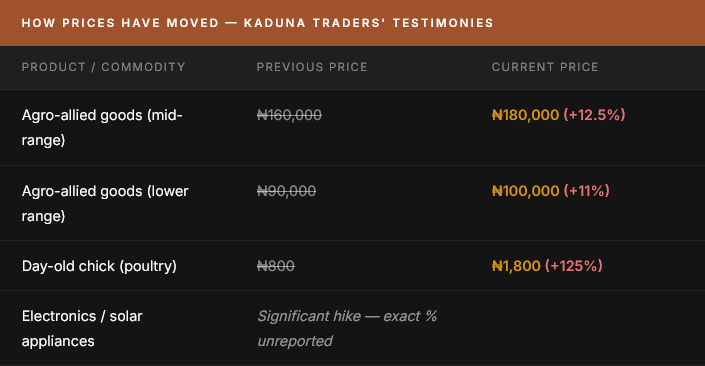
“Products that we sell for ₦160,000 have risen to ₦180,000. Some that were ₦90,000 are now ₦100,000. There is a decrease in customer patronage — customers are not coming as they used to.”
David Philip · Businessman, Heritage Agro Allied, Kaduna
One product. One woman. A 125% price spike.
Perhaps no single number in the Kaduna traders’ testimonies is as stark as this one: a day-old chick that once sold for ₦800 now sells for ₦1,800. That is not a modest inflationary adjustment. That is a 125% price increase on a living commodity that the poultry value chain — from hatcheries to household dinner tables — depends on. Divine Unogwu, who trades in day-old chickens and chicken feed, recounts the figure with the flat, exhausted tone of someone who has had to explain it too many times.
“The price of day-old chickens has risen from ₦800 to ₦1,800.”
Divine Unogwu · Poultry trader, Kaduna
Goods from the port to the shelf — every stop adds a sting
Emmanuella Ejike sells electronic and solar appliances — a sector that might seem insulated from raw commodity pressures but is in fact deeply exposed to the transport cost spiral. Her goods arrive by sea into Lagos, clear customs, move by road to the north, and reach her stall in Kaduna carrying the weight of every toll, every fuel cost, every delay along that journey. Emmanuella has done what any businessperson would do: she has passed the increase on to her customers. But her customers have responded the only way they can — by coming less often.
“I usually get 10 to 15 customers per day, but the number has now dropped to about five.”
Emmanuella Ejike · Electronics & solar appliances trader, Kaduna
Footfall cut by two-thirds. Not because Emmanuella’s products are inferior. Not because she has stopped trying. But because the logistics chain that delivers her goods has become so expensive that the final price is simply out of reach for more and more of her regulars. This is the quiet devastation that transport inflation inflicts on the informal sector — it does not shut businesses down overnight. It starves them slowly.
From restaurant tables to provision stores — no sector is spared
Blessing Adebanjo runs a restaurant. Food — the most fundamental of businesses — is also caught in the same web. Ingredients must be transported. Cooking gas must be delivered. Everything that arrives on a plate in Kaduna has first arrived on a truck, at a price that keeps rising. Blessing is among the traders calling directly on government to intervene — not as a political demand, but as a matter of food security. When restaurant owners cannot afford to stock a kitchen, communities lose access to affordable cooked food. That is not a business problem. That is a social one.
Chima Chidi, who runs a provision store, echoes what every trader in this story has said in their own way: the price of most goods has risen because transport costs have risen. There is no mystery here, no complex economic puzzle. The mechanism is brutally simple — fuel is more expensive, trucks cost more to run, those costs pass through the supply chain, and the informal trader at the end of that chain absorbs what they can and passes on the rest. Until the customer walks away.