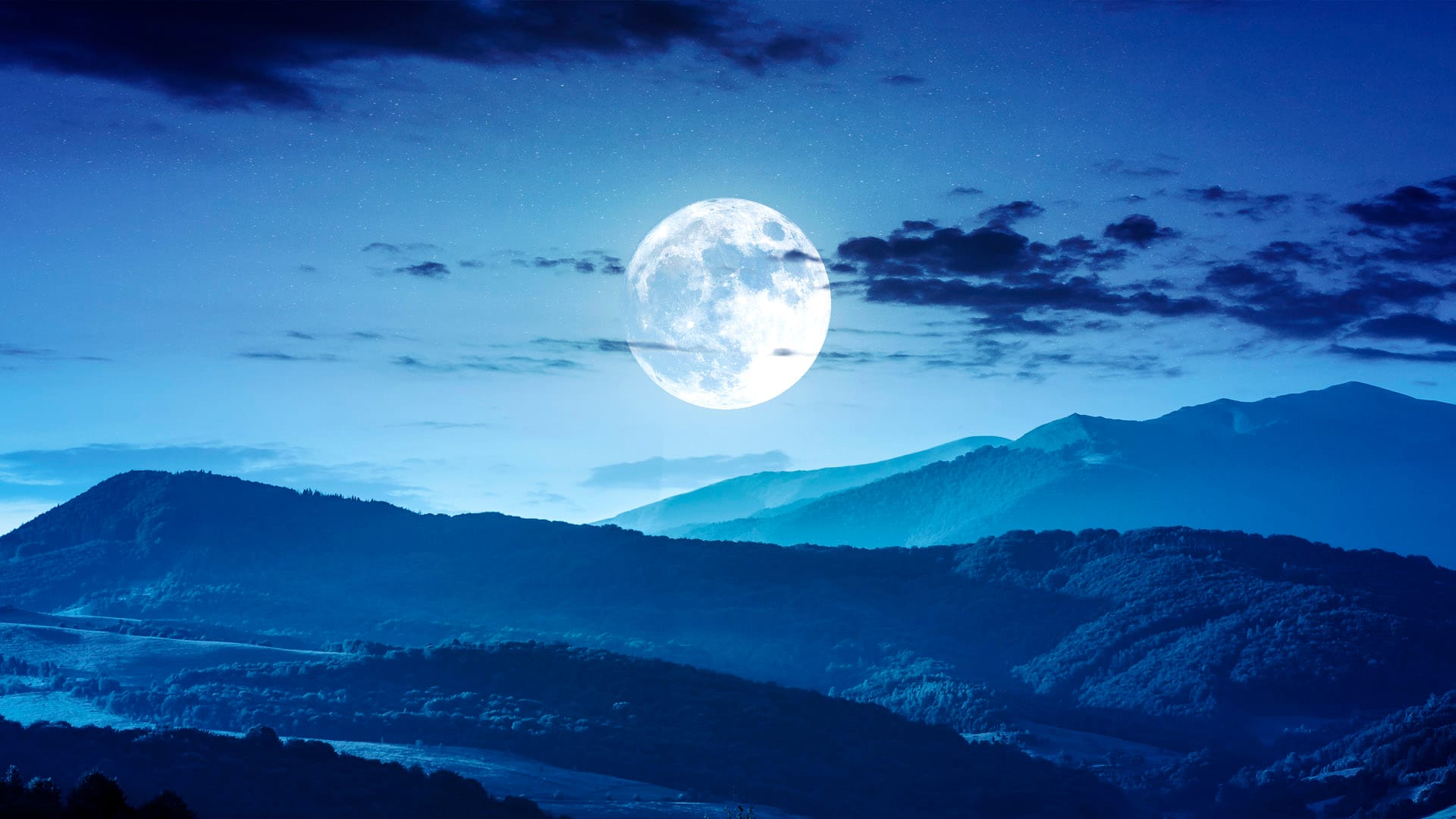
On Sunday, May 31, the Moon turns full for the second time this month — a calendrical Blue Moon, the only one of 2026, and this year’s smallest full Moon too. Here is everything you need to know, and exactly when to look up.
IDEA Television Research Desk

The phrase “once in a blue moon” exists for a reason — it means something so rare it almost never happens. On Sunday, May 31, skywatchers across the world have a chance to watch the real thing. The Moon will reach full phase for the second time in a single calendar month, qualifying it as a monthly Blue Moon, the first since August 2023 and the only one that will occur in 2026.
The lunar month runs approximately 29.5 days, just short enough that when a full Moon falls on the first day of a month, another can squeeze in before the 31st. That is precisely what happened in May 2026: the Flower Moon rose on May 1, and now, thirty days later, the Moon completes another full cycle and glows full once more on the night of May 30 into the early hours of May 31. This timing gives 2026 an unusual total of 13 full Moons instead of the usual 12.
It is also the smallest Moon of the year
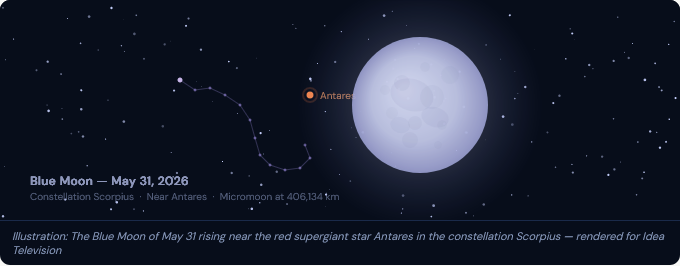
This Blue Moon carries a second distinction: it is also a micromoon. At the moment of full phase, the Moon will be approximately 406,134 km from Earth — around 17,000 km further than average. That extra distance makes it the most remote, and therefore smallest-appearing, full Moon of 2026. To the naked eye the size difference is barely perceptible, but it is real, and it means this Blue Moon will appear subtly less dazzling than its average counterpart.

Exactly when to look — worldwide times
The Moon reaches peak fullness at 8:45 UTC on Sunday, May 31. Here is when that falls in key cities around the world:
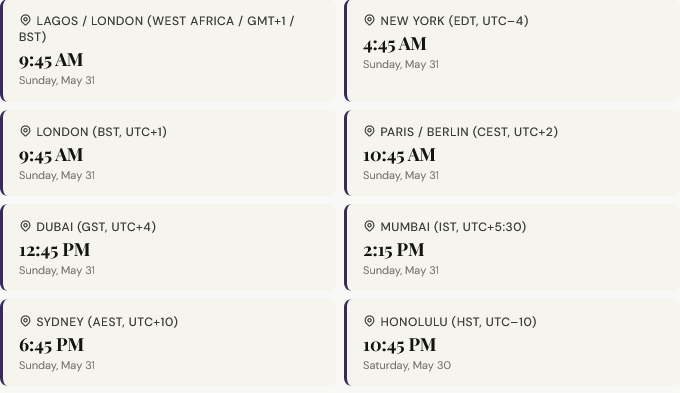
Because peak fullness for Africa and Europe falls during daylight hours on May 31, the best viewing in those regions will actually be on the night of Saturday, May 30 into early Sunday, when the Moon is at near-full brightness, rising in the east after sunset and blazing overhead through the night.
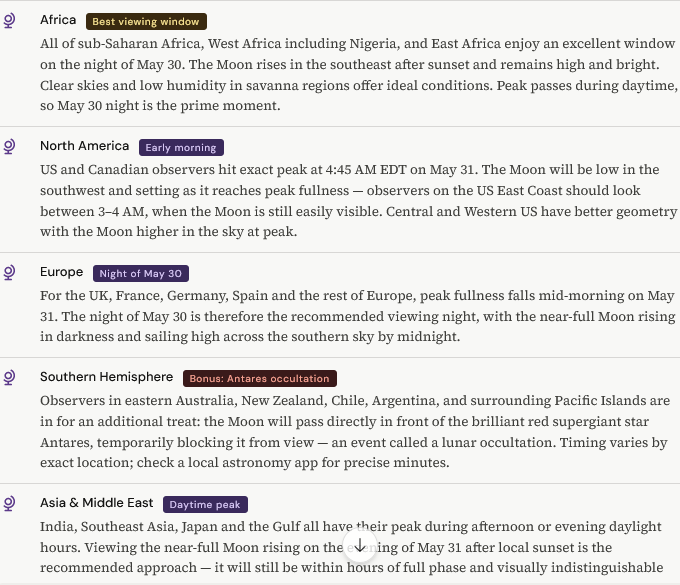
Where in the world it will be most spectacular
A special companion in the sky: Antares
Adding drama to the event, the Blue Moon will rise in close proximity to Antares — the fierce orange-red heart of Scorpius, one of the brightest stars in the night sky. Antares, whose name derives from the ancient Greek for “rival of Mars,” blazes at magnitude 1.1. On the night of May 30–31, it will appear just below or beside the glowing Moon, forming a dramatic pairing visible to the naked eye. For Southern Hemisphere observers it will be even more dramatic, as the Moon will actually pass directly in front of the star in a full occultation.
“The Moon will not appear blue in colour. The term is tied to the calendar, not the colour — but the event remains genuinely rare.”
— EarthSky.org
Why is it called a Blue Moon?
The origin of the phrase is surprisingly murky. Some trace it back over 400 years to an era when “Blue Moon” described something so absurd it was considered impossible — roughly equivalent to saying “when pigs fly.” The modern definition — the second full Moon in a calendar month — only became widespread in the 20th century, partly through a misinterpretation in a 1946 issue of Sky & Telescope magazine that was itself later corrected. A second, older definition — the third full Moon in an astronomical season that contains four — also exists and is used by some astronomers. The next Blue Moon by that older definition falls on May 20, 2027.
Whatever definition you favour, the celestial fact is the same this Sunday: two full Moons in one month. The next time that happens is December 31, 2028. So if the skies are clear, look up.