
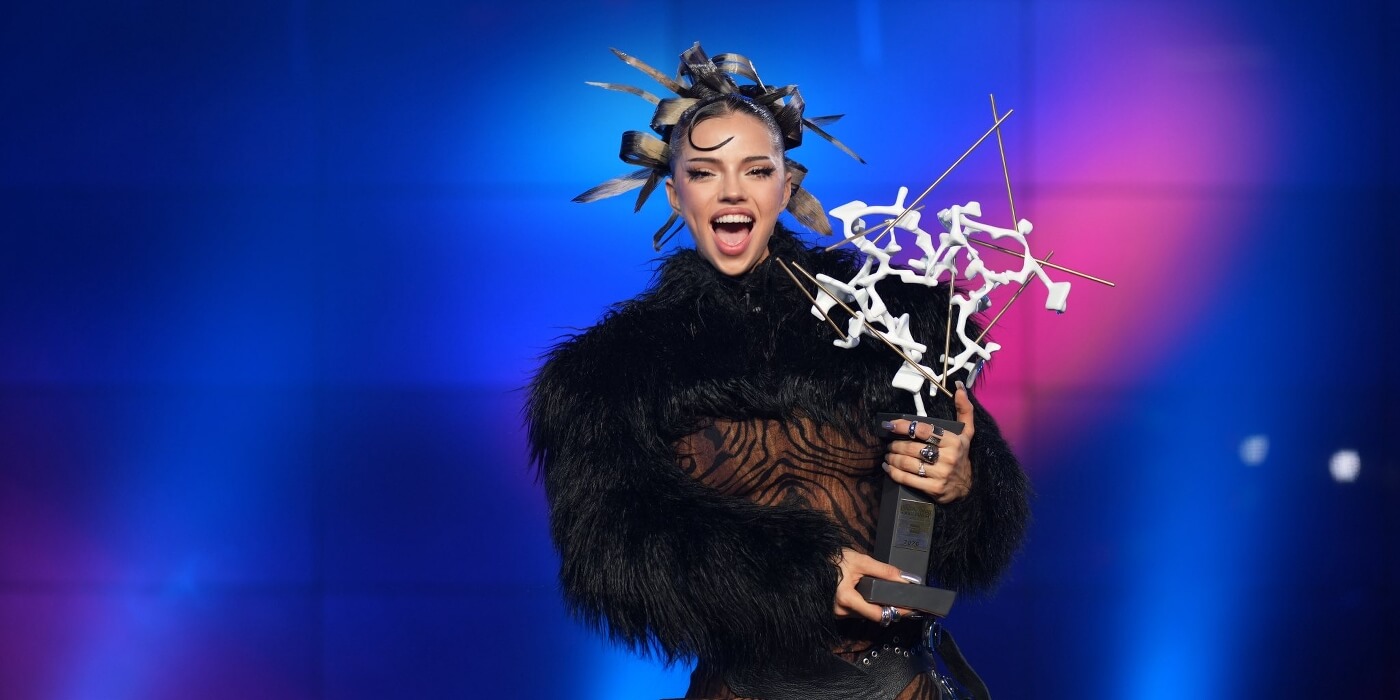
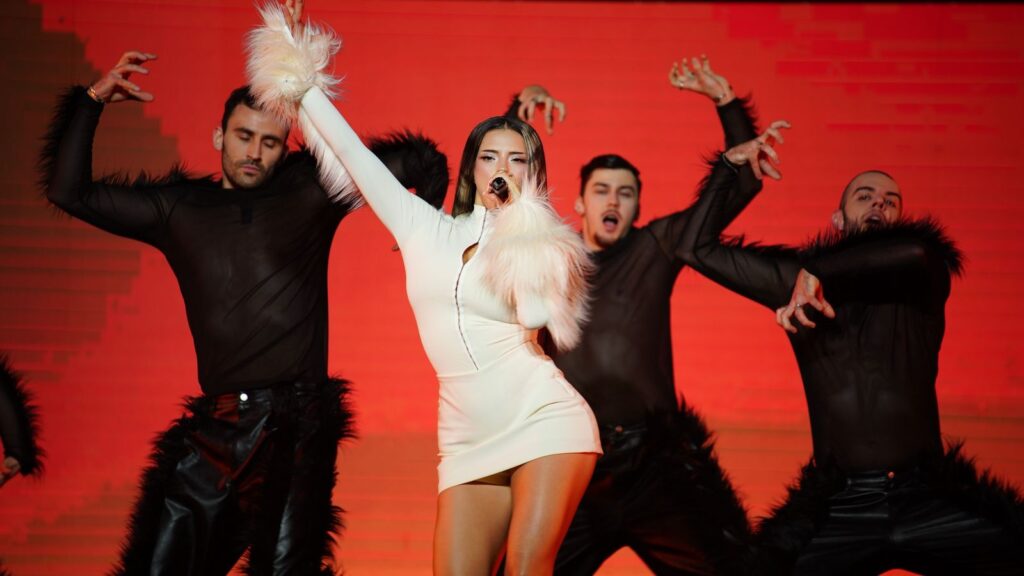
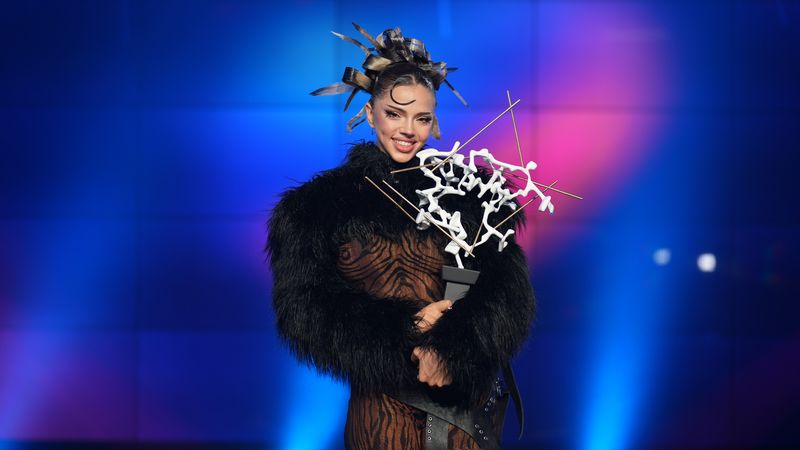
In a stunning, show-stopping performance at Vienna’s Wiener Stadthalle, Bulgarian pop star Dara swept the 70th Eurovision Song Contest with her high-octane anthem “Bangaranga,” claiming the country’s very first Eurovision crown.
Eurovision Song Contest 2026 — Grand Final Report
By Tom Solomon Iboro
Nobody had Bulgaria pencilled in as the favourite when the lights blazed to life inside Vienna’s iconic Wiener Stadthalle on Saturday night, 17 May 2026. But that is precisely what made the moment so breathtaking. When the final scoreboard settled, Dara had not merely won the 70th Eurovision Song Contest — she had dominated it, becoming the first Bulgarian artist to lift the glittering Crystal Microphone trophy in the country’s Eurovision history.
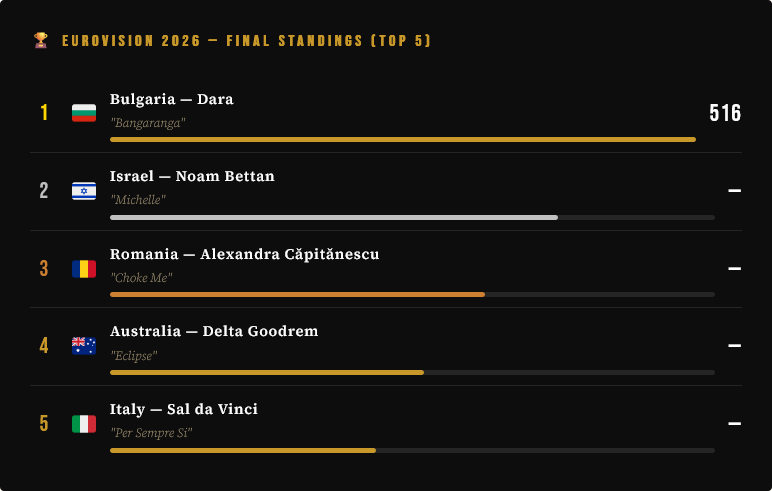
“Bangaranga” — an electrifying dance-pop anthem rooted in ancient Bulgarian folk tradition — finished with a commanding total of 516 points: 204 from the professional juries, placing Bulgaria first, and 312 from the public televote, also placing Bulgaria first. Remarkably, Dara became the first artist since 2017 to simultaneously top both the jury and public vote, a feat that underscores the universality of her performance on the night.

A Song Born From Ancient Ritual
The magic of “Bangaranga” lies in its roots. The song was inspired by the kukeri — an ancient Bulgarian ritual in which men roam through villages dressed in furry costumes adorned with bells and animal masks, believed to chase away evil spirits and usher in a prosperous new season. Dara fused this rich cultural heritage with pounding electronic production, creating a collision of old and new that proved irresistible on the Eurovision stage.

Speaking before the final, Dara described “bangaranga” as “a special energy that everyone has got in themselves — a feeling that everything is possible.” That spirit translated perfectly into her performance: a relentless, joyful riot of colour, movement, and sound that had the Wiener Stadthalle audience on their feet from the first beat. Critics called it an “insanely catchy bop” with “deep, profound, abiding grooviness.”
The Team Behind the Triumph
“Bangaranga” was co-written by Dara alongside celebrated Greek composer and producer Dimitris Kontopoulos, one of the most decorated figures in Eurovision history, having crafted entries for Russia, Georgia, Cyprus, and Azerbaijan over the past two decades. The writing team also includes Romanian hitmaker Monoir and Norwegian songwriter Anne Judith Stokke Wik, whose credits extend into the K-Pop world — a detail that speaks to the borderless ambition baked into the song from its very inception.
Dara herself is no stranger to the spotlight. An alumna of X Factor Bulgaria, she has been building towards a moment like this for years. When the result was announced, she collapsed to the floor in disbelief — a raw, unscripted burst of emotion that instantly became one of the most iconic images of the night. She later returned to the stage to perform the winning song once more, this time with the Crystal Microphone in hand.
A Historic Night for the Balkans
Bulgaria’s victory is all the more remarkable given the country’s complicated recent relationship with Eurovision. Having not participated in the previous three editions of the contest, Bulgaria returned in 2026 as part of a wave of Balkan nations — alongside Romania and Moldova — re-entering the competition after various absences. Their comeback was not just a return; it was a coronation.
The country’s best previous result was at Kyiv 2017, when Kristian Kostov’s “Beautiful Mess” finished second with 615 points — one of the highest scores in Eurovision history. That runner-up finish had haunted Bulgarian fans ever since. Saturday night in Vienna finally closed that chapter. Bulgaria now joins the small and exclusive club of nations to win the contest on a comeback year.
As tradition dictates, the 2027 Eurovision Song Contest will be hosted by Bulgaria — most likely in the capital, Sofia. For a country that was absent from the contest as recently as last year, the transformation from spectator to host is nothing short of extraordinary.
Controversy in the City of Music
The 70th Eurovision Song Contest was not without its shadows. The competition was overshadowed by widespread controversy over Israel’s continued participation, with five countries withdrawing from the contest in protest. Pro-Palestinian demonstrations outside the Wiener Stadthalle echoed similar scenes from the 2024 and 2025 editions in Malmö and Basel. The European Broadcasting Union amended its voting rules in response to concerns, prohibiting contestants and broadcasters from engaging in promotional campaigns orchestrated by third-party governments.
Despite the tensions, Israel finished in second place — for the second consecutive year — with Noam Bettan’s “Michelle,” an emotionally charged ballad sung in Hebrew, French, and English about escaping a toxic relationship. Israel’s strong finish only deepened the debate around the contest’s boundaries between music and geopolitics.
Host Michael Ostrowski addressed the complexities head-on during the closing moments of the broadcast: “In a world often divided, we stand united by music.” It was a sentiment that the evening’s winner, Dara, embodied entirely — bringing together ancient Bulgarian tradition, global pop production, and a shared hunger for joy in one unforgettable performance.

Controversy in the City of Music
The 70th Eurovision Song Contest was not without its shadows. The competition was overshadowed by widespread controversy over Israel’s continued participation, with five countries withdrawing from the contest in protest. Pro-Palestinian demonstrations outside the Wiener Stadthalle echoed similar scenes from the 2024 and 2025 editions in Malmö and Basel. The European Broadcasting Union amended its voting rules in response to concerns, prohibiting contestants and broadcasters from engaging in promotional campaigns orchestrated by third-party governments.
Despite the tensions, Israel finished in second place — for the second consecutive year — with Noam Bettan’s “Michelle,” an emotionally charged ballad sung in Hebrew, French, and English about escaping a toxic relationship. Israel’s strong finish only deepened the debate around the contest’s boundaries between music and geopolitics.
Host Michael Ostrowski addressed the complexities head-on during the closing moments of the broadcast: “In a world often divided, we stand united by music.” It was a sentiment that the evening’s winner, Dara, embodied entirely — bringing together ancient Bulgarian tradition, global pop production, and a shared hunger for joy in one unforgettable performance.