
Introduction
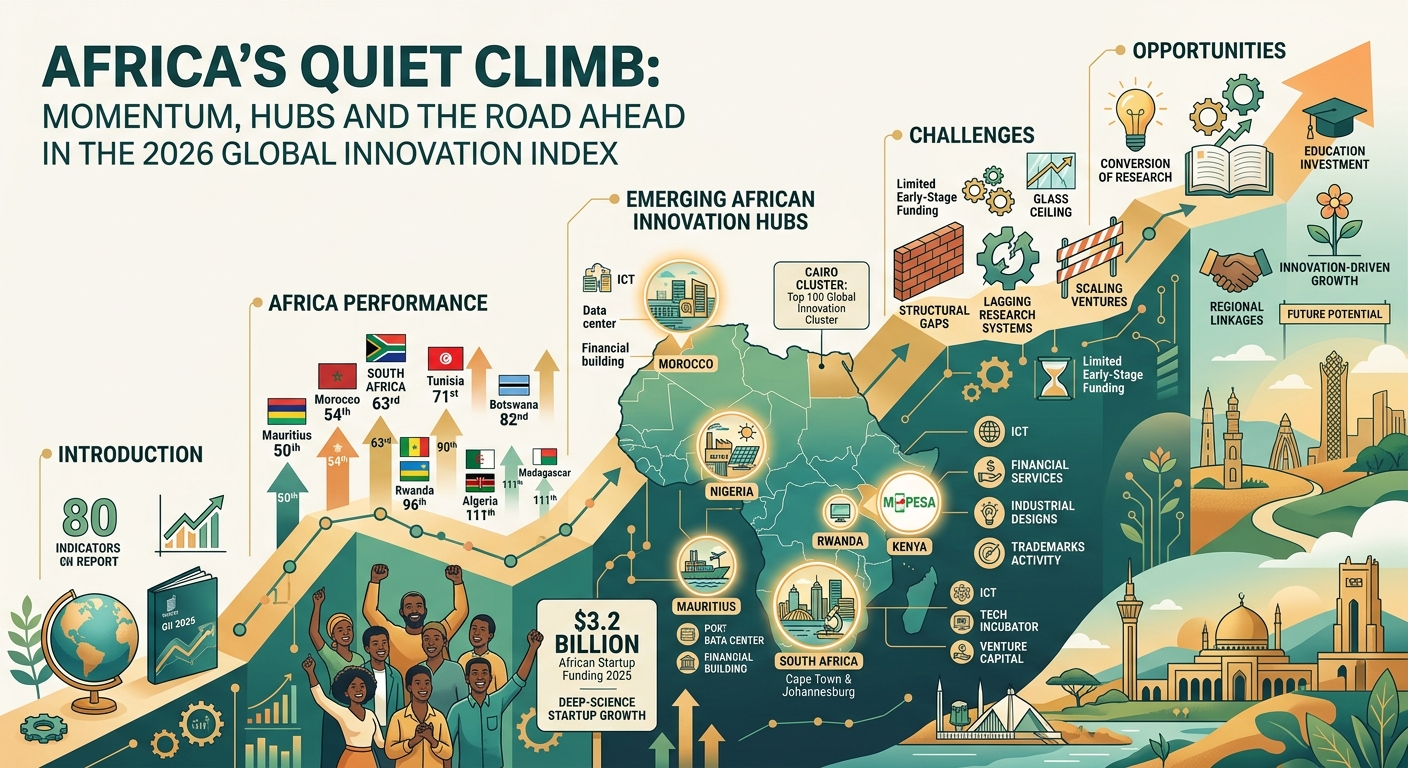
The World Intellectual Property Organization’s Global Innovation Index (GII) 2026 ranks 139 economies on their innovation performance using roughly 80 indicators covering inputs and outputs. While Switzerland, Sweden and the United States continue to lead globally, the report highlights encouraging, if uneven, progress across Africa. Several economies are converting institutional strengths, education investments, industrial upgrading and a nascent venture layer into measurable ranking gains, signalling that the continent is becoming more visible in the global innovation landscape.
Africa Performance
Sub-Saharan Africa is led by Mauritius, which entered the global top 50 for the first time at 50th place. South Africa follows at 63rd and has now overperformed relative to its level of development for a ninth consecutive year. Botswana ranks 82nd and Senegal 90th. Rwanda recorded the strongest advance among low-income economies, rising to 96th, supported by strong institutions. Kenya climbed five places to 97th, while Madagascar also posted significant gains.
In North Africa, Morocco achieved its best-ever ranking at 54th, up three places from the previous year and more than 20 places since 2020. It leads a broader regional improvement that also includes Tunisia (71st), Egypt (83rd) and Algeria (111th). Sub-Saharan Africa hosts the largest number of overperforming economies (seven) relative to their development level. African startups raised approximately $3.2 billion in 2025, a 40% year-on-year increase, and deep-science startup activity in the region has grown rapidly since 2020.
Emerging African Innovation Hubs
Mauritius stands out as a services-driven success story, leveraging ICT, financial and professional services, cultural and creative exports, and venture capital activity. Morocco’s progress is rooted in industrial upgrading combined with stronger commercial use of intangible assets, including industrial designs and trademarks; its innovation outputs now exceed what its inputs would typically predict.
South Africa remains the region’s most consistent overperformer. Rwanda benefits from robust institutions, while Kenya and Botswana show growing use of trademarks, utility models and industrial designs alongside expanding entrepreneurial activity. A thin but real startup and venture-capital layer is taking shape around selected hubs in Kenya, Mauritius, Nigeria and Rwanda. Cairo remains the only African cluster ranked among the world’s top 100 innovation clusters.
Challenges
Despite these gains, structural gaps persist. Only one African cluster features in the global top 100. Most economies still lag in deeper research systems, business R&D intensity, science–industry linkages and the capacity to scale deep-science ventures from pilot projects to commercial deployment. Regional averages remain low, progress is uneven, and early-stage funding is limited outside a handful of hubs. Middle-income climbers often encounter a “glass ceiling” once they reach the upper half of the rankings unless they strengthen these foundational elements.
Opportunities
Africa’s strengths in education investment, institutions, services diversification and intellectual property use provide a solid base for further advances. The rise of deep-science startups and the 40% jump in venture funding demonstrate that private capital and frontier technologies are beginning to take root. Expanding these pockets of success—through better conversion of research into marketable solutions, stronger regional linkages, and continued policy focus on intangible assets—could help more economies move beyond incremental gains toward sustained innovation-driven growth.
Conclusion
The 2026 Global Innovation Index delivers a measured but optimistic message: Africa is no longer invisible in the global innovation conversation. Mauritius’s entry into the top 50, Morocco’s historic high, South Africa’s sustained overperformance and the advances of Rwanda, Kenya and others show that targeted strengths can deliver results. The next phase will depend on turning these pockets of progress into broader, more resilient innovation ecosystems capable of converting scientific and technological potential into scalable industries and inclusive growth.
Analyse and get me a pictorial illustration