

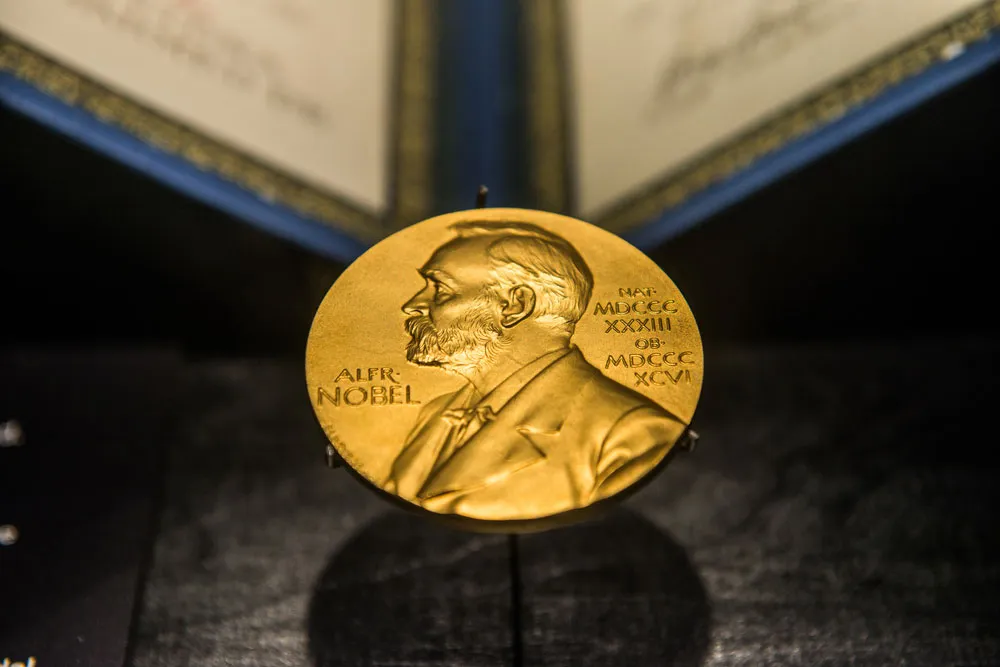
The 2026 Nobel Prize season concluded today (Monday, 12 October 2026) with the announcement of the Economics Prize.
Announcements ran from 5–12 October across six categories, with each prize worth 12 million Swedish kronor (shared among multiple laureates). The formal award ceremonies will take place on Nobel Day, 10 December 2026, in Stockholm (and Oslo for Peace).
5 OCTOBER – PHYSIOLOGY OR MEDICINE
The Nobel Assembly at Karolinska Institute awarded the Physiology or medicine prize jointly to KARL DEISSEROTH (Howard Hughes Medical Institute and Stanford University, USA), PETER HEGEMANN (Humboldt University of Berlin, Germany), and GEORGE NAGEL (University of Würzburg, Germany) “for their discoveries concerning light-gated ion channels and optogenetics.”
Hegemann and Nagel identified channelrhodopsin, a light-sensitive protein from algae that acts as an ion channel. Deisseroth developed this into a practical tool to control individual neurons in living animals with light. Optogenetics has become a foundational technique in neuroscience, enabling precise study of how neural circuits underlie memory, emotion, and behavior.
6 OCTOBER – AWARDED THE PHYSICS PRIZE
The Royal Swedish Academy of Sciences awarded the physics prize to FRANCIS HALZEN (University of Wisconsin–Madison, USA; born in Belgium) “for decisive contributions to the IceCube Neutrino Observatory and the discovery of high-energy neutrinos of astrophysical origin.”
Halzen pioneered the concept of using a cubic kilometre of Antarctic ice, instrumented with optical sensors, as a giant neutrino telescope. IceCube has detected high-energy neutrinos from distant cosmic sources, opening a new observational window on extreme astrophysical processes (such as those associated with black holes, gamma-ray bursts, and other energetic phenomena) that cannot be studied with conventional telescopes.
7 OCTOBER – AWARDED THE CHEMISTRY PRIZE
The Chemistry prize went to HENRI B. KAGAN (Université Paris-Sud / Paris-Saclay, France) and KENSO SOAI (TOKYO University of Science, Japan) “for the discovery of non-linear effects and autocatalysis in asymmetric organic synthesis.”
Many biologically important molecules (including amino acids and many drugs) exist as non-superimposable mirror images (enantiomers), yet nature overwhelmingly uses only one form (homochirality). Kagan demonstrated non-linear effects that can amplify small chiral imbalances, while Soai developed an autocatalytic reaction capable of producing essentially a single enantiomer. These advances are crucial for pharmaceutical manufacturing and illuminate how molecular asymmetry may have emerged in prebiotic chemistry.
8 OCTOBER – AWARDED THE LITERATURE PRIZE
The Swedish Academy awarded the Literature prize to Canadian poet, essayist, and classicist **Anne Carson** “for her bold and inventive oeuvre that, in playful dialogue with the classical tradition, has created new forms for contemporary literature.”
Carson’s work (including *Autobiography of Red*, *Nox*, and various translations and hybrid texts) fuses classical philology, etymology, poetry, and experimental forms. She treats the history of language and ancient texts as living material for contemporary literary innovation.
9 OCTOBER – AWARDED THE PEACE PRIZE
The Norwegian Nobel Committee awarded the Peace prize to South African jurist NAVANETHEM (“NAVI”) PILLAY “for her efforts to promote peace and international law.”
Born in Durban under apartheid, Pillay became a pioneering lawyer (defending anti-apartheid activists, including Nelson Mandela), the first non-white woman appointed to South Africa’s High Court, a judge and later President of the International Criminal Tribunal for Rwanda (where she helped establish precedents that sexual violence can constitute genocide or crimes against humanity), a judge at the International Criminal Court, UN High Commissioner for Human Rights (2008–2014), and chair of a UN commission of inquiry. She has consistently advanced accountability for war crimes, crimes against humanity, and genocide through international legal institutions.
12 OCTOBER – AWARDED THE ECONOMIC SCIENCES PRIZE
The Royal Swedish Academy of Sciences awarded the Sveriges Riksbank Prize in Economic Sciences in Memory of Alfred Nobel to ROBERT E. HALL (Stanford University, USA) and MICHAEL WOODFORD “for microeconomic foundations of macroeconomic stabilisation.”
Hall’s work on consumption and household behavior under uncertainty, combined with Woodford’s development of rigorous New Keynesian models with microfoundations (notably in his 2003 book *Interest and Prices*), shifted macroeconomics from purely statistical or ad-hoc relationships toward models grounded in the optimizing decisions of households and firms, expectations, and price rigidities. These frameworks now underpin the models used by central banks and finance ministries worldwide for analyzing monetary policy, forward guidance, inflation dynamics, and responses to shocks.
The 2026 prizes highlight tools for understanding complex systems at multiple scales: light-controlled neural circuits, cosmic neutrinos, molecular chirality, literary form, international legal accountability, and the micro-to-macro linkages that guide economic stabilisation policy. All announcements were live-streamed, and detailed popular-science backgrounds and press materials are available on nobelprize.org. The laureates will receive their medals, diplomas, and prize money on 10 December.