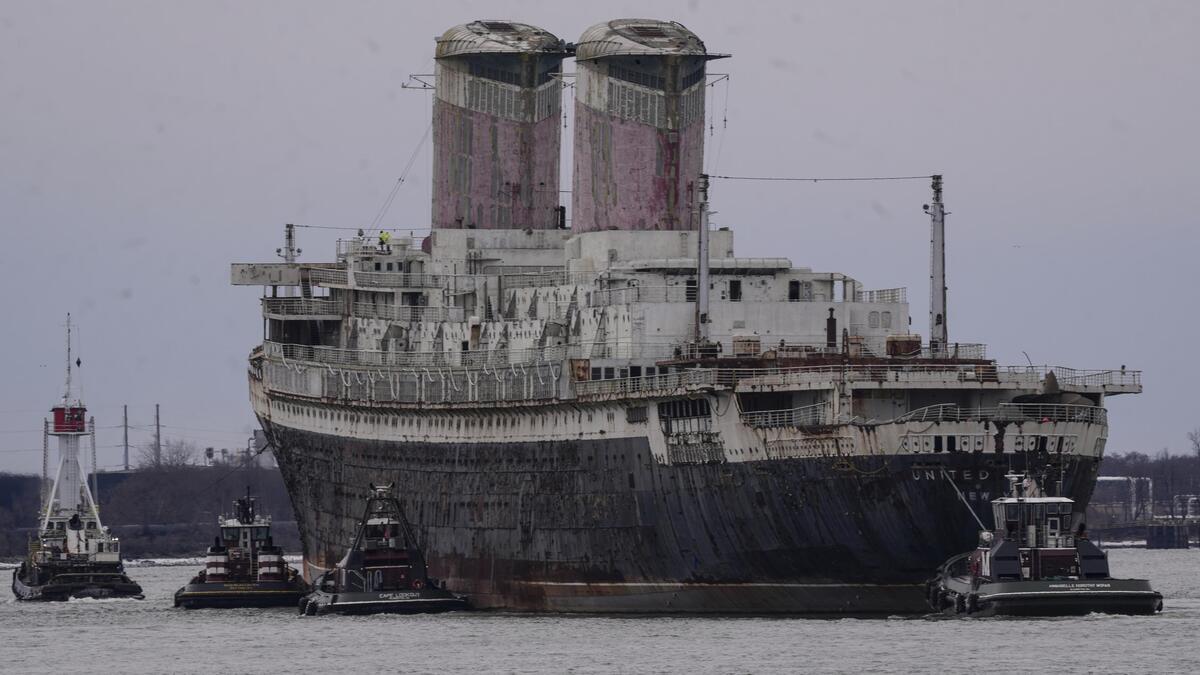
The historic SS United States, once the world’s fastest ocean liner, has been deliberately sunk off the coast of Florida to begin a new chapter as what officials describe as the world’s largest artificial reef.
The nearly 1,000-foot vessel completed its final descent into the Gulf of Mexico on Wednesday night, November 11, after a lengthy controlled sinking operation approximately 22 nautical miles southwest of Destin, Florida.
The sinking marks the end of an extraordinary maritime history for a ship that once symbolised American engineering, luxury and speed.
A Record-Breaking Maritime Legend
Launched in 1952, the SS United States made history during its maiden voyage by setting a transatlantic speed record, earning the prestigious Blue Riband distinction for the fastest Atlantic crossing.
The ship could reach speeds of approximately 38 knots and completed more than 800 Atlantic crossings during its years of service.
It carried thousands of passengers, including prominent political figures, celebrities and wealthy travellers, before being retired in 1969 as commercial air travel increasingly replaced ocean liners.
At approximately 990 feet long, the vessel was also longer than the Titanic.
From Luxury Passenger Ship to Underwater Attraction
After spending decades docked in Philadelphia, the ship faced an uncertain future as preservation efforts became increasingly expensive.
In 2024, Okaloosa County in Florida acquired the vessel for approximately $1 million, with plans to transform it into a major underwater attraction.
The $13.5 million project involved extensive preparation, including removing fuel residues, hazardous materials, wiring, glass and other items that could threaten marine life or divers.
Crews also cut openings through the hull and interior to allow water to enter and marine organisms to move through the structure. No explosives were used during the sinking.
A New Home for Marine Life
The ship is expected to settle approximately 180 feet beneath the Gulf of Mexico, with its upper decks around 55 feet below the surface.
Marine experts expect the enormous underwater structure to attract different species of fish, including red snapper, grouper, amberjack, mackerel and tuna.
The project is also expected to attract scuba divers and fishing enthusiasts, potentially boosting tourism and supporting businesses around Destin-Fort Walton Beach.
Scientists from the Woods Hole Oceanographic Institution are also planning research to monitor how marine organisms colonise the structure and how an ecosystem develops around it.
The End of an Era, the Beginning of Another
The sinking of the SS United States has generated mixed reactions among maritime enthusiasts, with some mourning the loss of an iconic historic vessel while others welcome its transformation into an underwater attraction.
Although the ship will no longer carry passengers across the Atlantic, officials hope its new role will preserve its legacy while supporting marine habitats, scientific research and tourism.
The former ocean liner’s final voyage has therefore become an unusual chapter in maritime history: a record-breaking passenger ship transformed into an enormous underwater reef.