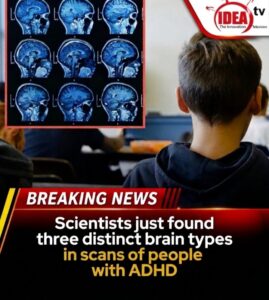
A new study has identified three distinct patterns of brain activity in children with ADHD, anxiety, or both conditions. The research, led by Stanford Medicine and published on 16 October 2026 in Nature Mental Health, shows these “biotypes” cut across traditional diagnostic labels.
Researchers used artificial intelligence to analyse functional MRI brain scans and behavioural data from 3,508 children aged 9 to 11 who took part in the large US Adolescent Brain Cognitive Development (ABCD) study. The findings were confirmed in a separate group of 224 children from the Healthy Brain Network.
The analysis revealed two main brain-behaviour dimensions related to cognitive control and emotion-attention regulation. These combined to form three biotypes:
Externalising-disinhibited**: Linked to impulsivity, defiance, hostility, aggression and rule-breaking. More common in children with ADHD.
Internalising-distressed**: Associated with worry, guilt, tension, perfectionism and anxious-depressed symptoms. More common in children with anxiety.
Mixed dysregulation**: Characterised by attention problems, irritability and self-injury. Also more associated with ADHD.
All three biotypes appeared in children across every diagnostic group (ADHD only, anxiety only, and both). Each child belonged to only one biotype.
The patterns were also visible in baseline brain scans of some children who had no diagnosis at the start of the study but later developed ADHD or anxiety. Researchers say this raises the possibility of using the biotypes as early indicators.
“The high overlap between ADHD and anxiety actually hinders our understanding of the neurobiology underlying traditional, symptom-based diagnoses,” said co-senior author Yu Zhang of Stanford Medicine. “We may be able to use the biotypes as an early indicator.”
Lead author Yong Jiao of the University of Iowa and co-senior author Jing Jiang, also of Iowa, worked with colleagues from several US institutions.
Current diagnoses rely on symptoms alone, and children with the same label often respond differently to the same treatment. The researchers stress that the biotypes are not meant to replace existing diagnoses. Instead, they could eventually help match children to more effective treatments by providing information about underlying brain patterns. Further clinical trials are planned to test this approach.
The brain scans used in the study are research tools and are not currently available as routine clinical tests.