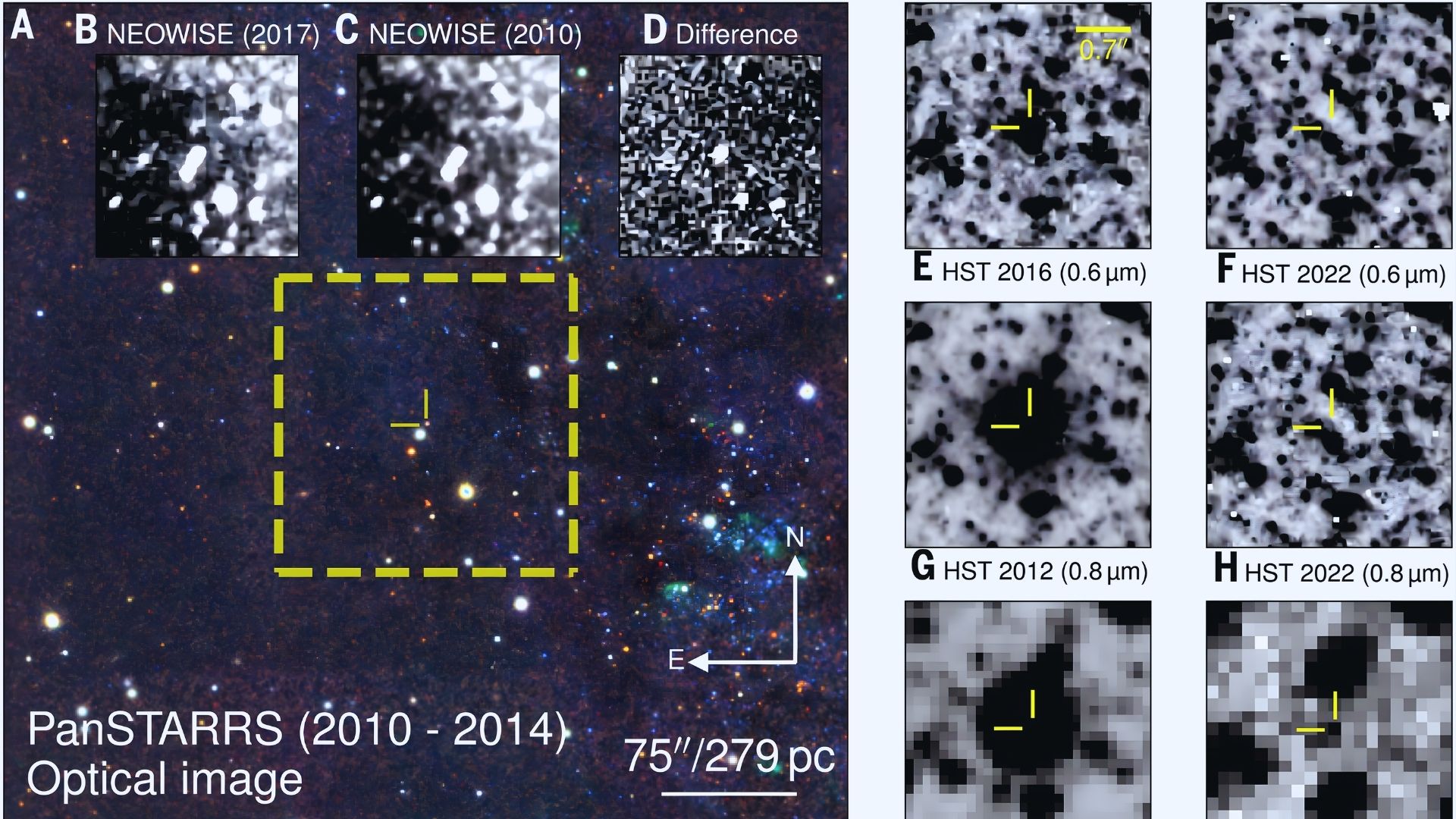
In a breakthrough that upends long-standing theories about the deaths of massive stars, astronomers have confirmed the silent vanishing of a colossal star in the Andromeda Galaxy (M31). Instead of exploding in a brilliant supernova as expected, the star—cataloged as M31-2014-DS1—appears to have collapsed directly into a black hole, leaving behind a mystery that could reshape our understanding of cosmic evolution.
A Star That Refused to Explode
For decades, scientists believed that any star significantly larger than our Sun would end its life with a supernova—a luminous explosion bright enough to briefly outshine entire galaxies. But a decade-long observation campaign using the Hubble Space Telescope and Spitzer Space Telescope has revealed a different fate for M31-2014-DS1: a “failed supernova.”
The evidence began to appear in 2014 when the star, about 20 times the mass of the Sun, started to brighten in the mid-infrared spectrum—a sign it was shedding its outer layers. By 2016, its visible light rapidly faded, and by early 2024, deep imaging confirmed the star had vanished from sight. No massive debris cloud or typical supernova remnant was found. Instead, astronomers detected only a faint infrared glow, likely caused by dust falling into the newborn black hole’s event horizon.
Why Did the Supernova Fail?
Recent findings published in the Astrophysical Journal suggest that stars like M31-2014-DS1 may be “too heavy to explode, but too light to remain stable.” As the star exhausted its nuclear fuel, its iron core collapsed under its own gravity. In a typical supernova, a shockwave bounces off this dense core, blasting the star’s outer layers into space. For M31-2014-DS1, however, the shockwave likely stalled, causing the matter to fall back inward and crush the core directly into a black hole.
Solving the ‘Missing Supernova’ Mystery
This discovery could help explain a puzzle that has baffled astronomers for years: the Missing Supernova Problem. “We observe fewer supernovae than our models predict,” says the study’s lead author. “If 20% to 30% of massive stars simply disappear and become black holes without exploding, it would account for the missing explosions.”
Implications for the Universe
The so-called “Quiet Death” of massive stars has significant implications for the chemical evolution of galaxies. Supernovae are responsible for spreading heavy elements—such as gold, silver, and uranium—throughout the cosmos. If many stars collapse directly into black holes, those elements remain trapped, potentially slowing the enrichment of galaxies and altering the cosmic recipe for future star and planet formation.
Looking ahead, astronomers are now utilizing the James Webb Space Telescope (JWST) to hunt for similar “ghost stars” in nearby galaxies like Triangulum (M33), searching for the faint infrared signatures left behind by stars that have vanished without a trace.
Stay tuned to our website for updates as this remarkable story continues to unfold, offering new insights into the life and death of the universe’s most massive stars.