In the latest escalation of the Iran-US maritime war, a large cargo vessel has reported being attacked by multiple small craft just 11 miles off Iran’s coast — marking at least the 24th attack on shipping in and around the strait since February 2026.
Idea Television World News Desk
A large cargo ship operating near the Strait of Hormuz has reported being attacked by multiple small watercraft, according to the British military’s United Kingdom Maritime Trade Operations (UKMTO) centre — the global monitor for maritime security incidents. The vessel was positioned just 11 miles from the Iranian coastline when the attack occurred, in one of the world’s most strategically critical and currently most dangerous shipping lanes.
The attack, reported on Sunday May 3, 2026, carries enormous significance. It is the first reported incident in the area since April 22 — and comes at a particularly delicate moment, as Iran simultaneously put forward a new peace proposal to the United States seeking to end the war within 30 days.
“The threat level in the area remains critical.” — UK Maritime Trade Operations Centre
No immediate claim of responsibility has been made. However, the tactical profile of the attack — multiple small, fast-moving boats operating in close proximity to Iranian territorial waters — matches the documented pattern of Iran’s Islamic Revolutionary Guard Corps (IRGC), whose patrol boats are described by military analysts as small, nimble and exceptionally difficult to detect on radar.
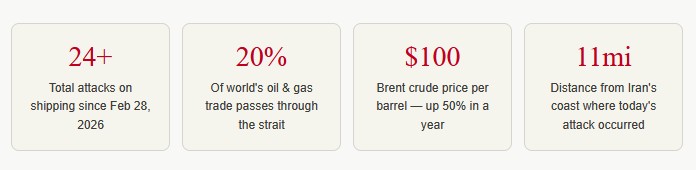
The broader context of Sunday’s attack is staggering in its geopolitical weight. The Strait of Hormuz — a narrow waterway at the mouth of the Persian Gulf — has been effectively closed to Western shipping since February 28, 2026, when the United States and Israel launched a military air campaign against Iran and assassinated Supreme Leader Ali Khamenei. In retaliation, Iran’s Revolutionary Guard began boarding, seizing and attacking commercial vessels, while also laying naval mines across the waterway.
The International Energy Agency has described the effective shutdown of the Strait of Hormuz as “the biggest energy security threat in history.” Analysts estimate the closure is equivalent to one billion barrels of oil missing from the global economy.
Since the crisis began, the IRGC has attacked or seized dozens of vessels from multiple nations. Among the most significant incidents, the Thailand-flagged Mayuree Naree caught fire following an attack, with 20 crew members rescued by the Royal Navy of Oman and three others confirmed dead. The Greek-owned Epaminondas was attacked with gunfire and rocket-propelled grenades. The Italian-owned MSC Francesca was seized and moved to the Iranian coast. Two Indian-flagged vessels were forced back by Iranian gunboats. And a cruise ship, the Mein Schiff 4, was directly threatened by IRGC forces via radio.
The economic shockwaves of the crisis are being felt globally. Brent crude oil — the international benchmark — is trading at around 100 dollars per barrel, a 50 percent increase compared to a year ago. Energy markets have been rattled repeatedly by reports of renewed attacks in the strait, which in normal times handles roughly one fifth of the world’s oil supply and a significant share of its liquefied natural gas.
“Tehran will not back down from our position on the Strait of Hormuz, and it will not return to its prewar conditions.” — Iran’s Deputy Parliament Speaker Ali Nikzad
Despite the hardline rhetoric, diplomatic channels remain open — just barely. Iran has submitted a new proposal to the United States, routed through Pakistan which hosted face-to-face negotiations last month, calling for all outstanding issues to be resolved within 30 days and for a formal end to the war rather than another ceasefire extension. The fragile three-week ceasefire between Washington and Tehran appears to be holding, though US President Donald Trump told journalists on Saturday that further military strikes remained a possibility.
For Africa and the developing world, the crisis in the Strait of Hormuz carries consequences that go far beyond energy prices. The waterway also carries fertiliser shipments critical to agricultural production across Sub-Saharan Africa and South Asia. Any prolonged disruption to these supply chains threatens food security across the continent at a time when millions are already food insecure.
Idea Television will continue to monitor and report on developments in the Strait of Hormuz crisis as they unfold. This is one of the most consequential geopolitical standoffs of the decade — and its resolution or escalation will shape the global economy, energy markets, and international security for years to come.