
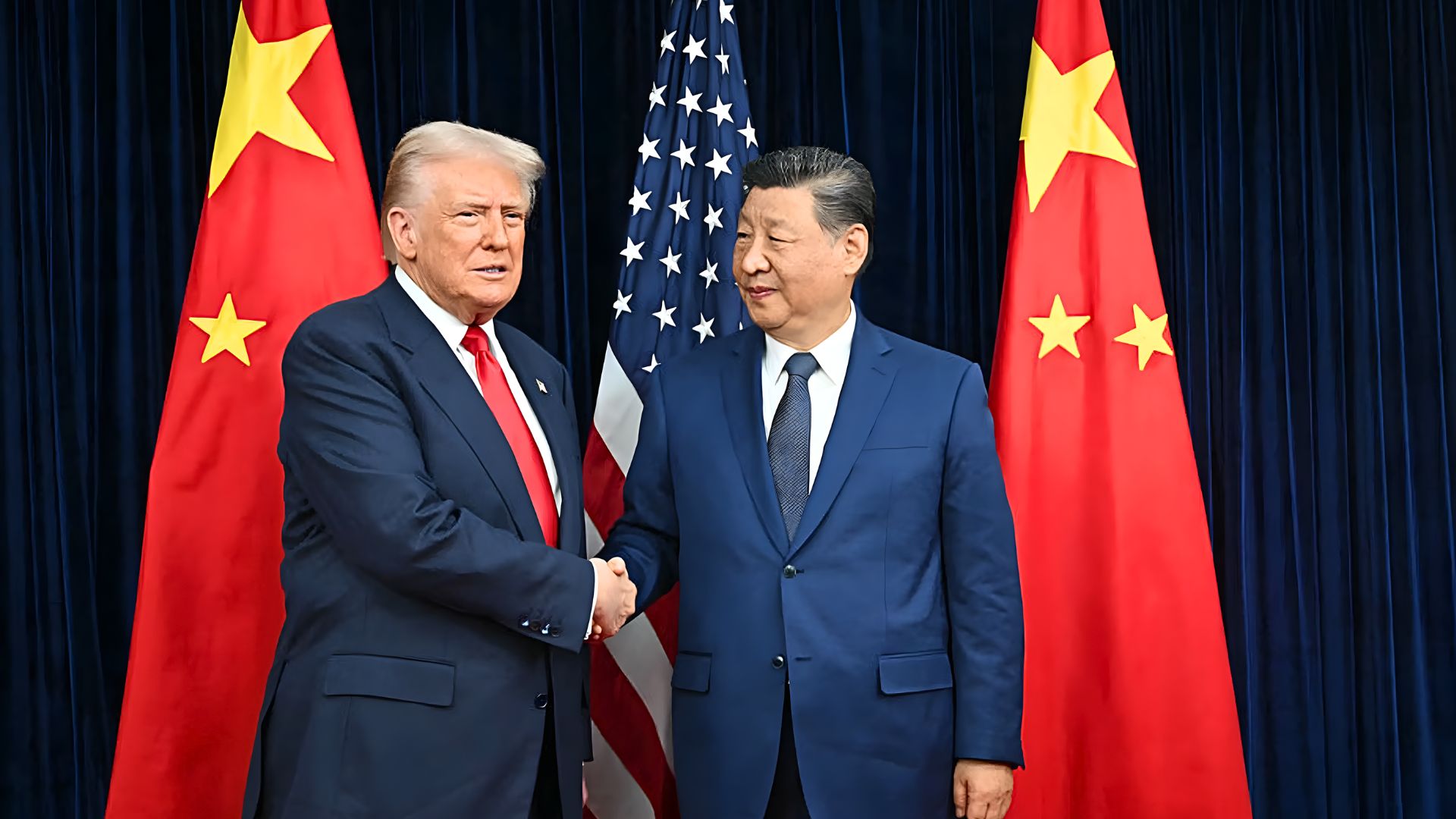
Partnership was the stated goal. Taiwan remains the fault line. A summit full of warmth — and unresolved tension.
World Affairs Desk
United States President Donald Trump and Chinese President Xi Jinping sat down in Beijing on Thursday for a two-day summit that both leaders publicly framed as an opportunity for partnership — even as deep disagreements over Taiwan, trade, and the ongoing conflict in Iran cast long shadows over the proceedings.
The talks, held at the imposing Great Hall of the People, opened with military honours, national anthems, and the kind of diplomatic pageantry Beijing reserves for its most consequential guests. Trump was accompanied by a delegation that included Secretary of State Marco Rubio, Defence Secretary Pete Hegseth, Treasury Secretary Scott Bessent — and, unusually for a presidential foreign visit, a roster of America’s most powerful business executives, among them Tesla’s Elon Musk, Apple’s Tim Cook, and Nvidia’s Jensen Huang.
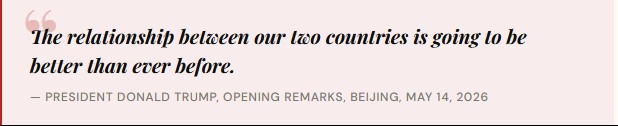
In his opening remarks, Trump described the relationship between the two nations as headed toward being “better than ever before,” praising Xi’s leadership and calling the summit potentially “the biggest ever” between the two powers. Xi, for his part, called on both countries to build a “constructive, strategic, and stable relationship” — language Beijing has been deliberately cultivating to reset a bilateral dynamic that has frayed badly over tariffs, technology, and geopolitical rivalry.
Background
This summit is the first visit by a sitting US president to China in nearly a decade, and Trump’s first return to Beijing since his 2017 state visit. The two leaders previously met on the sidelines of the APEC summit in Busan, South Korea in October 2025, where they agreed a preliminary trade framework. Since then, an escalating conflict involving Iran has added new urgency — and new complexity — to the bilateral relationship.
A Constructive Start — On Some Fronts
By most diplomatic measures, the opening day of talks produced cautious optimism. Both sides agreed that the Strait of Hormuz must remain open to support the free flow of energy, and Xi expressed interest in purchasing more American oil to reduce China’s dependence on the strait. Trade talks were described as making progress, with the Chinese foreign ministry stating that economic and trade teams produced “generally balanced and positive outcomes” — good news, it said, for the people of both countries and the world.
Trump described his conversations with Xi as “extremely positive and productive” — remarks he delivered at a lavish state banquet hosted by the Chinese president on Thursday evening. He extended a formal invitation for Xi to visit the United States later this year, a gesture widely read as a signal that both sides intend to sustain diplomatic momentum beyond this week’s summit.
| Trade & Tariffs Both sides report “generally positive” outcomes. China signalled interest in buying more US oil and farm products. | Iran / Hormuz Agreement that the Strait of Hormuz must stay open. China opposed to militarisation of the waterway. | Taiwan Xi issued a stark warning: mishandling Taiwan could lead to “clashes and even conflicts.” Not mentioned in US readout. |
| Technology US restrictions on Chinese tech firms remain a source of friction. No breakthrough announced on semiconductors. | AI Governance Plans to establish bilateral boards for economic and AI oversight were discussed, per White House officials. | Russia / Ukraine China’s trade with Russia during the war, including dual-use goods, remains a persistent irritant for Washington. |
The Taiwan Shadow
Whatever goodwill the day generated, it could not paper over the issue both sides knew was waiting: Taiwan. Xi said that Taiwan was the most important issue in US-China relations, and warned that if not handled well, it would push the bilateral relationship to a “dangerous” place. Beijing’s foreign ministry was more specific still, stating that Xi warned mishandling of the Taiwan issue would cause “clashes and even conflicts, putting the entire relationship in great jeopardy.”
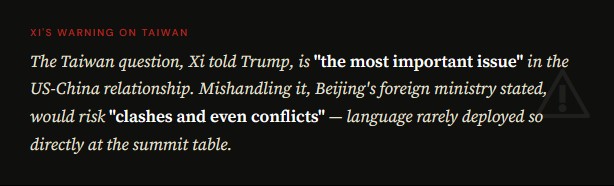
Notably, the American readout of the meeting made no mention of Taiwan at all, instead focusing on trade and Iran — a contrast in framing that analysts say underscores just how differently the two sides approach the issue. Taiwan’s own government monitored the meeting closely. A spokesperson for Taipei’s Mainland Affairs Council said the island was “in close contact with Washington” and that Thursday’s talks had not produced any surprises.
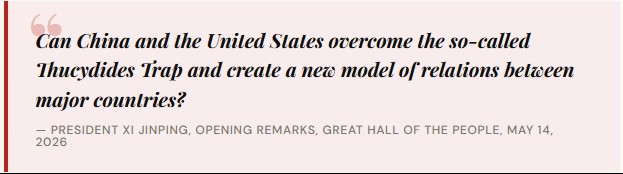
Xi raised the broader philosophical question of whether the United States and China could avoid the so-called “Thucydides Trap” — the historical tendency for a rising power and an established power to drift toward war. It was a rhetorical frame that set the existential stakes of the summit in sharp relief: two superpowers at a crossroads, seeking stability while knowing exactly how fragile it is.
The Verdict: Warm Words, Hard Realities
Elon Musk, asked to describe his experience meeting Xi ahead of the evening banquet, offered a single word: “Awesome.” Trump told reporters at the Temple of Heaven — where the two leaders strolled together through one of Beijing’s most ancient and symbolic sites — that things were “great.” The atmosphere throughout the day was, by all accounts, genuinely cordial.
| Signs of Progress Trump called talks “extremely positive and productive” Both sides agree Strait of Hormuz must stay open Xi interested in buying more American oil Trade talks described as making progress Plans for bilateral economic and AI oversight boards Xi invited to visit the US later in 2026 | Unresolved Tensions Xi warns Taiwan mishandling risks “clashes and conflicts” No US concessions on tech export restrictions China’s economic ties to Iran remain a US concern China’s trade with Russia still a source of friction Taiwan absent from US readout — diverging narratives No formal trade deal announced |
The power dynamics have shifted since Trump’s 2017 visit to Beijing, when China went out of its way to lavish Trump and buy billions in US goods. This time, analysts note, it is the United States that is acknowledging China’s standing — a signal of how much has changed in the intervening years.
Talks resume on Friday with a bilateral tea and working lunch, after which Air Force One is expected to depart for Washington. Both governments have hinted that trade-related announcements — including a possible Chinese commitment to purchase US soybeans, beef, and commercial aircraft — could come before the visit concludes. Whether the warmth of the banquet can translate into durable agreements on the harder questions remains the defining question of this summit.
For now, the world’s two largest economies have chosen dialogue over decoupling — at least for this week. Beijing set the stage. The script for what comes next is still being written.