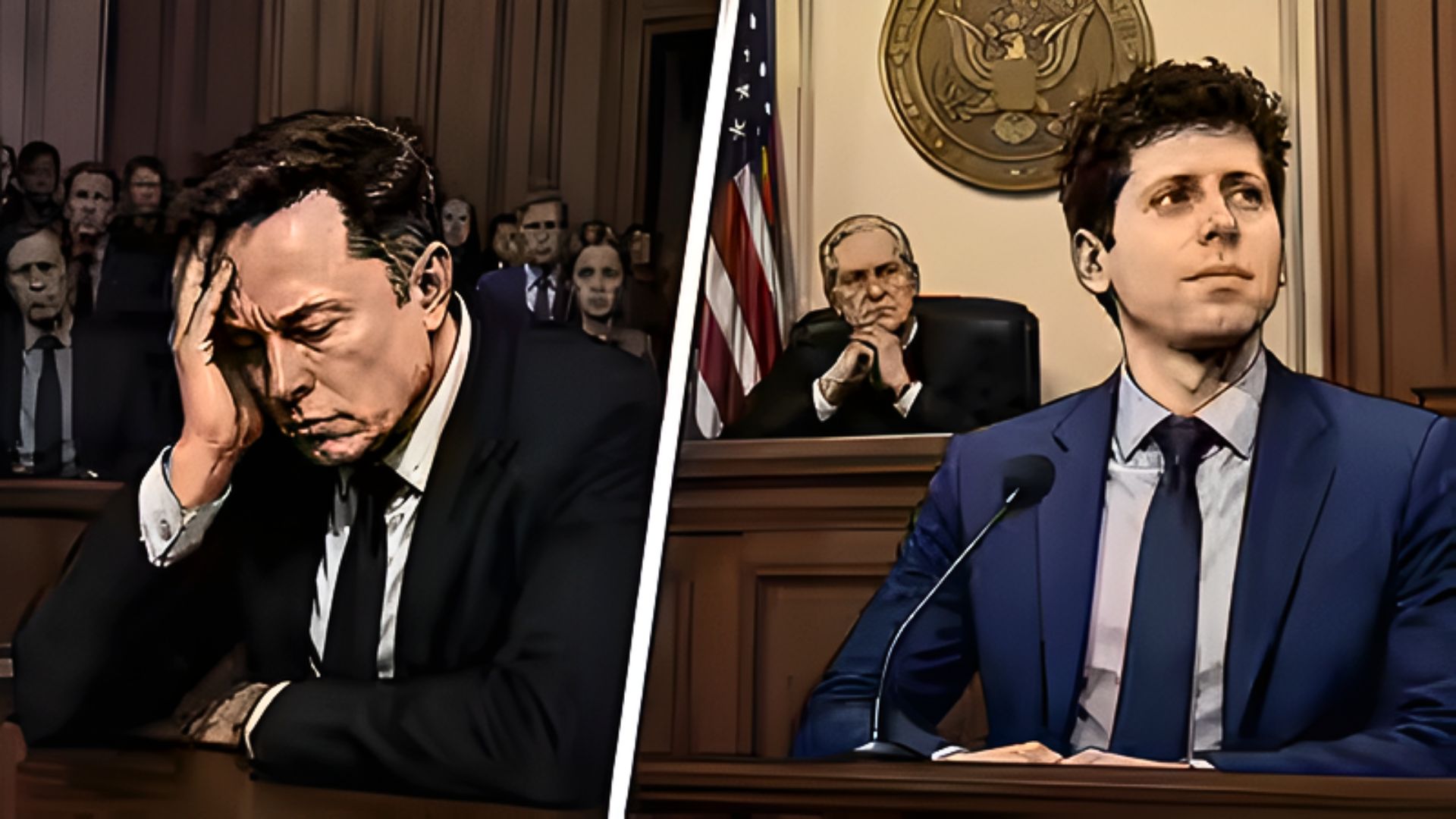
In one of Silicon Valley’s most closely watched trials, a federal jury in Oakland has handed Elon Musk a decisive defeat in his lawsuit against OpenAI, CEO Sam Altman and co-founder Greg Brockman — ruling the case was filed too late.
Tech & Business Desk — IDEA TELEVISION
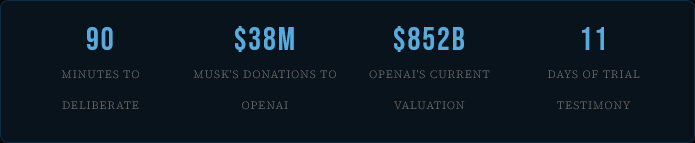
After eleven days of explosive testimony, private text messages, personal diaries and bitter accusations between two of the most powerful men in technology, a nine-person jury in Oakland, California delivered its verdict in under 90 minutes on Monday — Elon Musk waited too long to sue OpenAI, and his case is barred by the statute of limitations.
U.S. District Judge Yvonne Gonzalez Rogers, who presided over the trial, accepted the advisory jury’s findings as her own, stating in court: “I think there is a substantial amount of evidence to support the jury’s finding, which is why I was prepared to dismiss on the spot.”
What the Case Was About
Musk co-founded OpenAI in 2015 alongside Sam Altman, Greg Brockman and others with a vision to build artificial intelligence for the benefit of humanity — structured as a nonprofit. He donated $38 million to the organisation in its early years before departing from the board in 2018.
In February 2024 — after founding his own competing AI company, xAI, in 2023 — Musk filed suit, accusing Altman and Brockman of effectively “stealing a charity” by pivoting OpenAI into a for-profit structure. He sought to force the company to repay more than $130 billion to its nonprofit arm, remove both men from leadership, and unwind the corporate restructuring that had transformed OpenAI into one of the world’s most valuable technology companies.
“The finding of the jury confirms that what this lawsuit was, was a hypocritical attempt to sabotage a competitor.”
— William Savitt, OpenAI’s Lead Attorney, May 18, 2026
Why Musk Lost: The Statute of Limitations
The jury’s verdict did not rule on the merits of whether OpenAI had breached its founding mission. Instead, it found that Musk knew about the behaviour described in his lawsuit as early as 2021 — yet waited until 2024 to file, well beyond the legal deadline. OpenAI’s attorneys argued powerfully that Musk only chose to sue once he had founded xAI and had competitive reasons to weaken the company.
OpenAI also argued that Musk’s donations came with no enforceable conditions to maintain a nonprofit structure and that Musk himself, as early as 2017, pushed for OpenAI to create a for-profit subsidiary — on the condition that he control it. When that demand was refused, he left the board.
A Trial Full of Bombshells
The three-week trial pulled back the curtain on some of the most intimate workings of Silicon Valley’s AI revolution. Among the highlights:
Key Revelation 01
Shivon Zilis — Neuralink executive, former OpenAI board member and mother of four of Musk’s children — testified that she served as a communication conduit between Musk and OpenAI leadership after his departure. Her testimony did not corroborate Musk’s version of the founding commitments. Even OpenAI’s attorney noted in closing that “even the mother of his children” could not back Musk’s account.
Key Revelation 02
Musk attempted to poach OpenAI talent before and after leaving the company, including reportedly asking co-founder Andrej Karpathy for a list of top staff to recruit for Tesla — a claim partially confirmed by Zilis in her testimony.
Key Revelation 03
Texts between Musk and Meta CEO Mark Zuckerberg were submitted as evidence, showing the two discussed possibly attempting to buy OpenAI together — a remarkable detail given their fierce public rivalry.
Key Revelation 04
Microsoft, which has invested more than $100 billion in OpenAI, was named as a co-defendant for allegedly “aiding and abetting” the restructuring. Microsoft’s spokesperson welcomed the jury’s decision, calling the timeline of the case “long clear.”
Key Revelation 05
Greg Brockman’s personal diaries were submitted as evidence — referred to by Musk’s own attorneys as a “journal.” Brockman also testified that Musk belittled a researcher to the point of nearly driving them out of the field — that researcher later became a key figure behind ChatGPT.
Reactions to the Verdict
Elon Musk
xAI Founder / Tesla CEO
“Altman & Brockman did in fact enrich themselves by stealing a charity. She just handed out a free license to loot charities if you can keep the looting quiet for a few years!”
xAI Founder / Tesla CEO
“Altman & Brockman did in fact enrich themselves by stealing a charity. She just handed out a free license to loot charities if you can keep the looting quiet for a few years!”
William Savitt
OpenAI’s Lead Attorney
“OpenAI is a not-for-profit, mission-driven organization that has been and will continue to be faithful to that mission. Musk can bring his claims, but what nine jurors found is his stories were just that — stories.”
Marc Toberoff
Musk’s Lead Attorney
“This at its core is a travesty. But for Musk, they get away with it and they shouldn’t.” He confirmed plans to appeal.
Microsoft Spokesperson
Statement after verdict
“The facts and the timeline in this case have long been clear, and we welcome the jury’s decision to dismiss these claims as untimely.”
What Happens Next
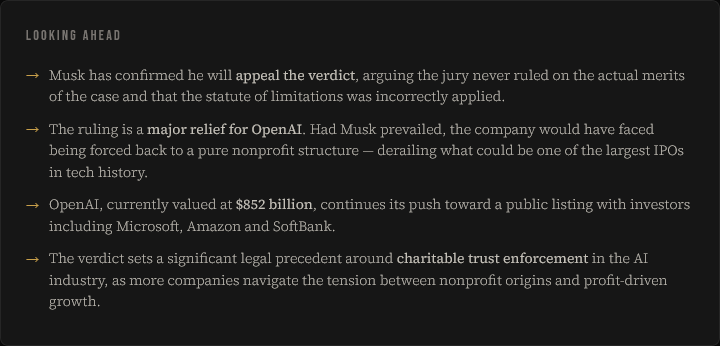
For now, the battle between two of the most consequential figures in artificial intelligence moves from the courtroom to the appeals court — and to the competitive battlefield of the AI race itself, where Musk’s xAI (now merged with SpaceX as SpacexAI) continues to square off against the very company he once helped build.