Ahead of World No Tobacco Day, the World Health Organisation sounded a global alarm: a new generation of young people is being deliberately targeted by the tobacco and nicotine industry — and governments must act now.
By IDEA Television News Desk

The World Health Organisation (WHO) has issued an urgent call to governments around the world to strengthen measures protecting young people from tobacco and nicotine addiction, warning that a new generation risks becoming hooked on products cynically marketed as safer alternatives — including e-cigarettes, heated tobacco products, and nicotine pouches.
The call was made on Friday, 29 May 2026, ahead of World No Tobacco Day, which falls annually on 31 May. This year’s theme — “Unmasking the Appeal: Countering Nicotine and Tobacco Addiction” — reflects growing alarm at how the tobacco industry has reinvented itself with sleek new products designed to hook young, first-time users while sidestepping decades of hard-won regulatory controls.

A Generation in the Crosshairs
The WHO’s warning is backed by stark data. At least 40 million children between the ages of 13 and 15 currently use at least one tobacco product globally — with 20 million smoking cigarettes and 10 million using smokeless tobacco. Beyond traditional products, at least 15 million adolescents in the same age bracket are already using e-cigarettes. In countries where data is available, young people are on average nine times more likely to vape than adults.
The WHO emphasised that adolescence is a critical window of brain development — and that nicotine exposure during this period can permanently impair attention, learning, and mood regulation, while significantly raising the risk of future addiction to other substances. Protecting young people from nicotine is not merely a public health issue, the organisation stressed: it is a long-term social and economic priority for every government on earth.
The Industry Playbook: Flavours, Influencers and Social Media
At the heart of the WHO’s concerns is the tobacco industry’s deliberate pivot beyond the traditional cigarette. Companies have aggressively rolled out flavoured e-liquids, disposable vape devices, and nicotine pouches — all promoted through social media platforms, influencer partnerships, branded merchandise, and retail channels easily accessible to minors.

The WHO warned that such marketing tactics are systematically undermining decades of progress in tobacco control. These are not accidental trends — they are the result of calculated strategies, including the use of synthetic nicotine, nicotine salts, and chemical analogues designed to enhance addiction potential while being marketed as “innovative” or even less harmful alternatives.
The 2026 World No Tobacco Day campaign aims to expose these industry strategies directly — stripping back the glossy appeal to reveal the deliberate architecture of addiction underneath.
What WHO Is Demanding of Governments
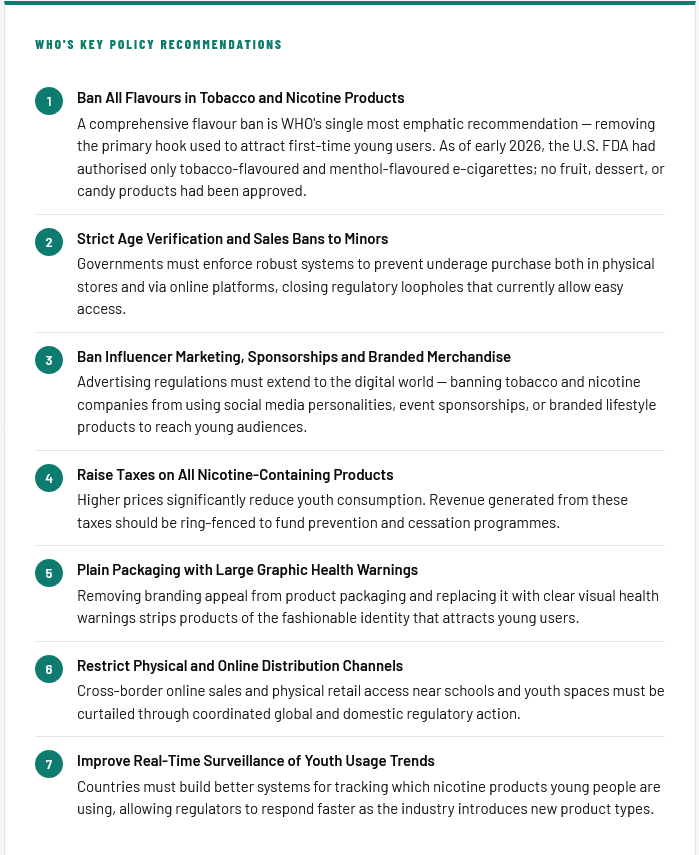
The WHO did not merely raise the alarm — it issued concrete, specific policy demands for governments globally. The organisation framed these not as aspirational suggestions but as minimum actions required to protect young people from a predatory industry.
The Brain Science Behind the Urgency
The WHO’s alarm is grounded firmly in neuroscience. The adolescent brain continues developing until the mid-twenties — and nicotine directly targets the brain’s reward and learning systems during this vulnerable window. Regular nicotine exposure in young people has been shown to impair working memory and attention, destabilise mood regulation, increase impulsivity, and dramatically raise the likelihood of developing dependence on other addictive substances later in life.
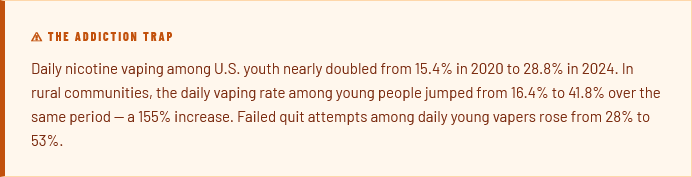
Crucially, data shows the addiction burden among young vapers is already severe. More than one in four young people who currently vape report daily use. Among daily youth vapers in the United States, unsuccessful quit attempts rose from 28% to 53% between 2020 and 2024 — a near-doubling in the number of young people trapped in an addiction they cannot escape.
Europe’s Particular Challenge
The WHO’s European Region faces a distinctive and severe challenge. Approximately 11.6% of 13 to 15-year-olds across Europe — around 4 million children — currently use tobacco products. Europe holds the dubious distinction of the highest global rate of adolescent cigarette smoking at 8.4%, and the highest rate of smoking among adolescent girls worldwide at 8.7%. Use of e-cigarettes and nicotine pouches is rising rapidly across the region, and the European Region holds the highest global average prevalence of e-cigarette use among young people.
A Global Market Fuelling the Crisis
The commercial forces driving youth nicotine addiction are enormous. The global vape market was valued at between $35.7 and $45.7 billion in 2025, with North America accounting for 43.5% of all revenue. China exported $4.1 billion worth of vape products to the United States in 2025 alone — an 11% increase from the prior year. Research firms project compound annual growth rates above 33% for the vape sector through 2033, suggesting the industry has no intention of slowing down its expansion.
The WHO stressed that no single country can effectively tackle this crisis alone, and called for stronger global cooperation to address cross-border sales, regulatory arbitrage, and the loopholes that allow restricted products to circulate freely across borders.