
With nearly 1,000 suspected cases across the DRC and Uganda and no licensed vaccine or treatment in existence, the world’s leading epidemic preparedness body is urgently accelerating three experimental candidates — including an mRNA shot from Moderna.
June 1, 2026 · · 4 min read

Global health authorities have launched an urgent financial push to accelerate three experimental vaccines against the Bundibugyo strain of Ebola, as a fast-moving outbreak in the Democratic Republic of Congo and Uganda continues to outpace containment efforts — and with no licensed vaccine or treatment yet available for this particular strain.
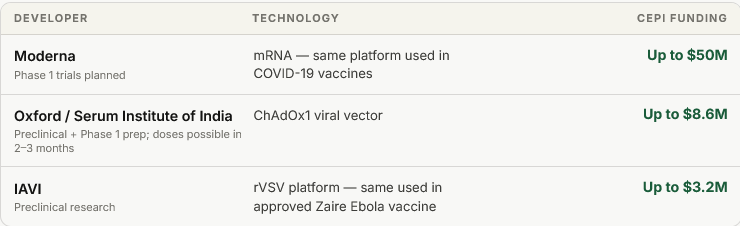
The Coalition for Epidemic Preparedness Innovations (CEPI) announced on Monday it would commit up to $62 million across three candidate vaccines identified by the World Health Organization as the most promising currently under development. The three developers — Moderna, the University of Oxford working with India’s Serum Institute, and the International AIDS Vaccine Initiative (IAVI) — use distinct technology platforms, including the same mRNA approach validated by Moderna during the COVID-19 pandemic.
“With Bundibugyo virus spreading rapidly and no licensed vaccines, every day counts in the race against this deadly disease.”
— Dr Richard Hatchett, CEPI Chief Executive Officer
Bundibugyo is one of the less commonly seen Ebola strains, and this is precisely what makes the current outbreak so difficult to manage. While approved vaccines exist for the more common Zaire strain — the basis of past major outbreaks — none are licensed for Bundibugyo. The European Commission noted that the strain is harder to control than Zaire Ebola, describing it as transmissible through direct contact with bodily fluids of infected individuals or contaminated surfaces.
Cases have been detected in the major Congolese cities of Goma and Bunia, raising fears of wider urban spread. The WHO has already declared the situation a public health emergency of international concern, with the first emergency committee on this outbreak held on May 22.
How soon could vaccines be available?
The Oxford/Serum Institute candidate is the furthest along, with WHO experts noting that doses could potentially be ready within two to three months for clinical efficacy trials — though additional animal study data are still required first. The WHO has said a single dose of this candidate could be appropriate for contacts of confirmed cases, while a two-dose regimen might be used for high-risk but as-yet uninfected groups such as healthcare workers.
All three technology platforms have existing safety data from work on related viruses including the Zaire and Sudan strains of Ebola and the Marburg virus, providing a head-start in development.
International response
WHO Director General Dr Tedros Adhanom Ghebreyesus described the CEPI investment as a pivotal step in building a vaccine that could not only control this epidemic but also strengthen preparedness for future outbreaks. Africa CDC Director General Dr Jean Kaseya welcomed the announcement as both timely and critical to health and economic security on the continent, adding that it advances Africa’s ambitions to build its own research and vaccine manufacturing capacity.