While claiming welfare tax credits and reporting near-zero income to the IRS, Jamshid Ghomi allegedly funnelled over $15 million from Iran into the US — and sent hundreds of tons of American tech equipment straight to Tehran’s nuclear and military establishments.
IDEA Television News Desk
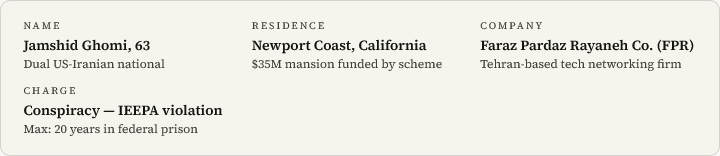
Jamshid Ghomi, a 63-year-old dual US-Iranian national and CEO of a Tehran-based computer networking company, was arrested on Wednesday on a federal criminal complaint charging him with running a decade-long sanctions-busting operation that funnelled American networking, security, and encryption technology directly to Iran’s nuclear establishment and military complex. He made his initial court appearance at US District Court in Santa Ana, California. If convicted, he faces up to 20 years in federal prison.
Ghomi is the founder, owner and CEO of Faraz Pardaz Rayaneh Co. Ltd. — known as FPR — a Tehran-based company whose annual sales exceeded $10 million and reached hundreds of Iranian companies and government entities, many of them already under US sanctions. Among FPR’s most sensitive customers were the Atomic Energy Organisation of Iran, the government body overseeing Iran’s centrifuge and uranium-enrichment programmes, and Iran’s Ministry of Defence and Armed Forces Logistics. Neither FPR nor Ghomi ever obtained the required US Treasury licence to legally export a single item to Iran.
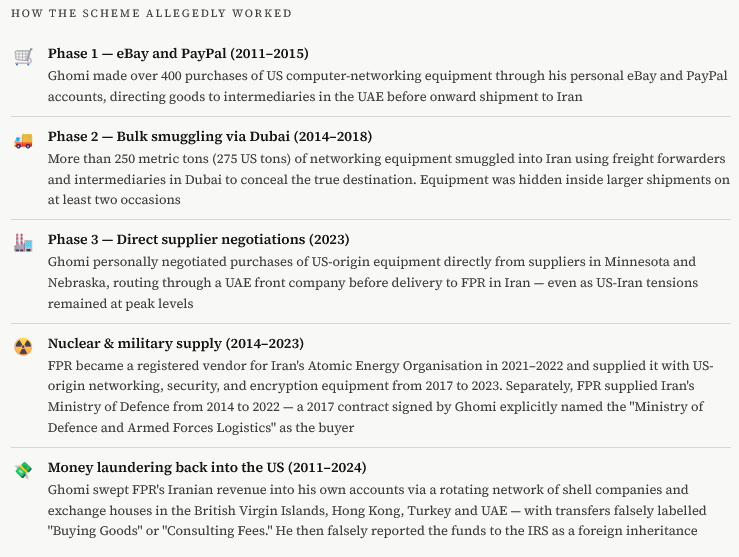

“Motherland.” — the codeword Ghomi and his co-conspirators used to refer to Iran in internal communications about equipment procurement.
— US DOJ criminal complaint affidavit, June 4, 2026
Internal communications recovered by investigators show that Ghomi and his UAE co-conspirators used the word “Motherland” as a codeword for Iran when discussing equipment logistics. Despite receiving explicit warnings on invoices and software licences that exporting these goods to Iran was prohibited, Ghomi allegedly directed associates to keep his name off shipping documents, omit invoices from Iran-bound shipments, and hide equipment within unrelated cargo. He used a rotating network of front companies in the UAE to further obscure his role throughout the operation.