
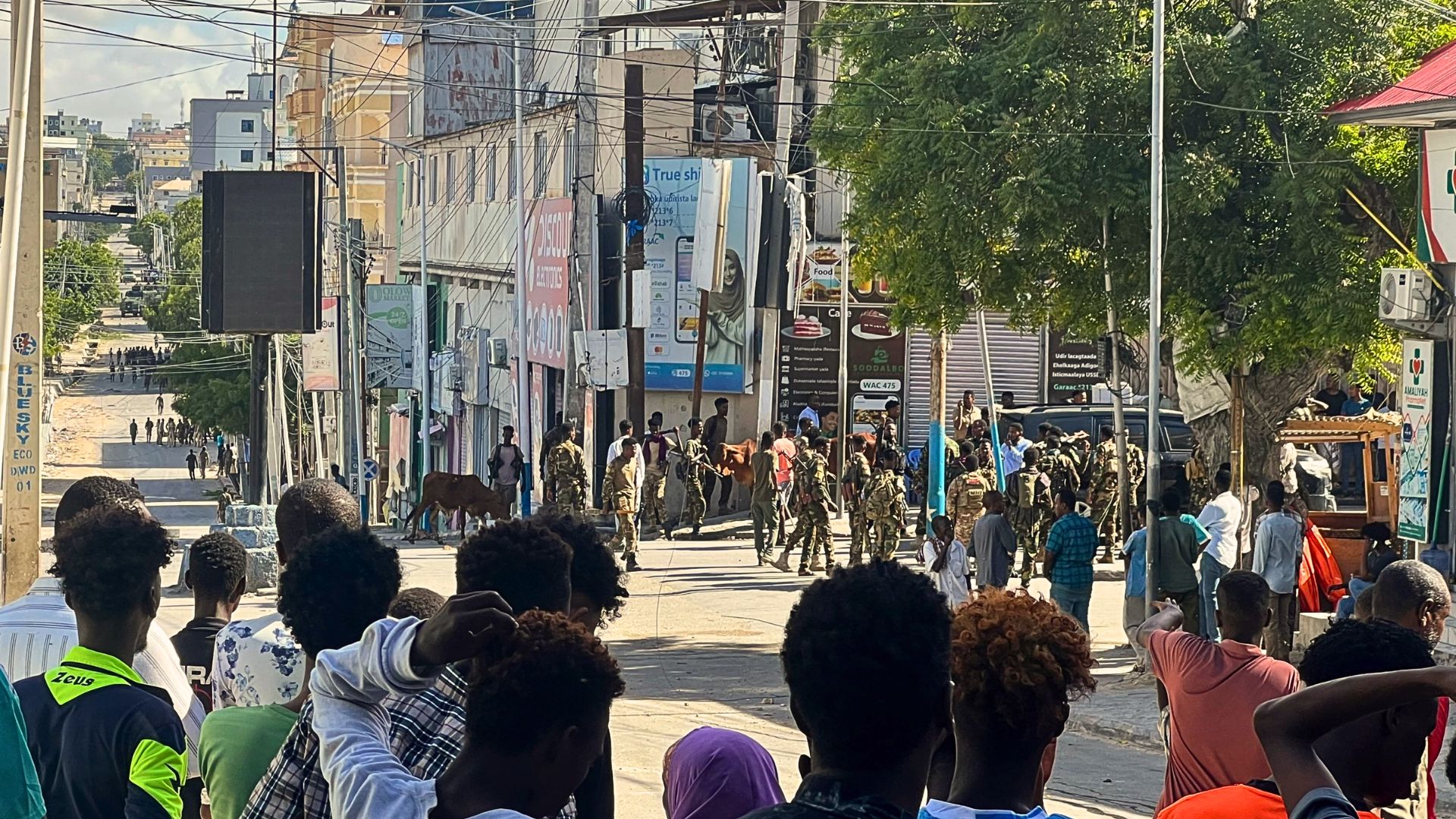
Heavy gunfire, rocket-propelled grenades and mortar fire rocked Somalia’s capital for a second consecutive day as government forces and opposition supporters clashed ahead of anti-government protests, drawing urgent condemnation from the United Nations and the United States.
IDEA TELEVISION AFRICA DESK

MOGADISHU — The United Nations Secretary-General António Guterres has strongly condemned violence in Somalia’s capital Mogadishu after two days of heavy clashes between opposition supporters and government security forces left civilians dead, injured and fleeing their homes. The fighting — sparked by a deepening political dispute over President Hassan Sheikh Mohamud’s continued hold on power — drew unprecedented alarm from international partners, with the UN warning that the crisis echoes a dangerous episode from 2021 that nearly tore the country apart.
How the violence erupted
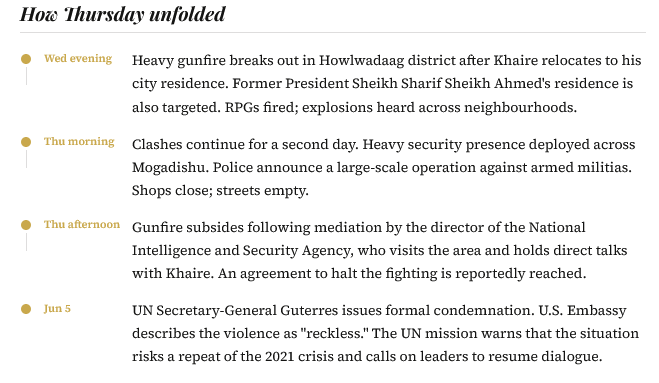
The trouble began on Wednesday evening when former Prime Minister Hassan Ali Khaire relocated from the heavily fortified green zone near Mogadishu’s airport to his city residence in the Howlwadaag district — a move intended to allow him to participate in the next day’s planned protest. Within hours, fighting had broken out.
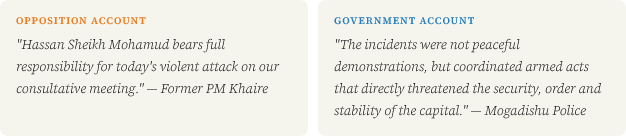
Khaire accused President Mohamud’s forces of launching a direct attack. “An attack was launched against us by forces commanded by the president whose term has expired,” he wrote on social media, adding that they had been preparing for a peaceful demonstration. “For the second time in less than 24 hours, Hassan Sheikh Mohamud has directed armed forces against our peaceful gatherings.”
The government rejected that account entirely. Mogadishu police said the violence stemmed from coordinated attacks by armed militias pursuing political interests, describing it as organised armed action — not peaceful protest. Defence Minister Ahmed Moalim Fiqi accused opposition figures of distributing mortars and artillery across the capital, comparing their conduct to Sudan’s Rapid Support Forces.
Witnesses on the ground described scenes of panic. “We heard heavy weapons fire and people were fleeing their homes,” said Abdullahi Mohamed, a resident of the Howlwadaag district. Another resident, Xalimo Salad, said the neighbourhood did not sleep through the night due to sporadic gunfire, with more intense fighting breaking out on Thursday morning. “We have seen federal government forces deploying reinforcements,” she said. Witnesses also reported rocket-propelled grenades being fired, with the sound of explosions carrying across surrounding neighbourhoods.
“Actions taken in the coming hours and days may have lasting consequences for Somalia’s security, unity, and future.”
— UN Transitional Assistance Mission in Somalia
The UN’s alarm — and a warning from history
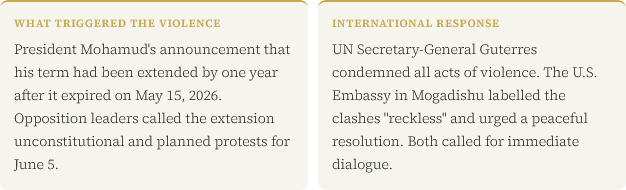
UN Secretary-General Guterres said the violence resulted in civilian deaths, injuries, and damage to critical infrastructure. He strongly condemned all acts of violence and incitement to violence undertaken for political advantage, and called on all parties to exercise maximum restraint, protect civilians, and return to dialogue.
The UN Transitional Assistance Mission in Somalia went further, drawing a direct parallel with the 2021 political crisis — a period that saw Mogadishu convulsed by similar fighting when then-President Mohamed Abdullahi Farmajo’s term expired and opposition groups took to the streets. The mission said it and international partners had repeatedly warned Somali leaders of the risk of a repeat of that crisis, and that those warnings had not been heeded. It urged Somali leaders to prioritise the national interest and resume talks that collapsed on May 15.
The opposition alleged that Somali troops trained and equipped by international partners specifically to fight the al-Shabaab extremist group — one of Africa’s most deadly militant organisations — had been redeployed against political opponents, a claim that, if verified, would represent a serious misuse of international security assistance.
What comes next
Somalia’s international partners have made clear they remain ready to support and facilitate renewed dialogue between the government and the opposition. However, the window for a peaceful resolution is narrowing. Both sides have hardened their public positions, and the grievances at the heart of the dispute — a contested term extension, a collapsed electoral roadmap, and an opposition that has lost confidence in the current administration — are structural, not easily resolved by a single round of talks.
Somalia has made hard-won progress in recent years, including the first popular election in half a century, increased pressure on al-Shabaab, and growing international recognition. The current crisis risks squandering those gains. The UN, the African Union, and Somalia’s key bilateral partners are watching closely — and urging, in the sharpest language yet, that Somali leaders choose dialogue over confrontation before the situation becomes irreversible.