By IDEA TV News Desk: 15th August 2026
Nigeria’s universities are facing a major challenge in global digital visibility, with none of the country’s universities making the top 20 in Africa in the July 2026 Webometrics Ranking of World Universities.

The finding is contained in a memorandum by the Nigerian Universities Ranking Advisory Committee (NURAC) to the Minister of Education, Dr. Tunji Alausa, and submitted through the Executive Secretary of the National Universities Commission (NUC), Professor Abdullai Y. Ribadu dated 8th August 2026, and was exclusively obtained by Idea TV.

The July 2026 ranking, published by the Cybermetrics Lab of the Spanish National Research Council, assesses universities largely through indicators linked to digital presence, research visibility, open scholarly repositories and web-based academic communication.
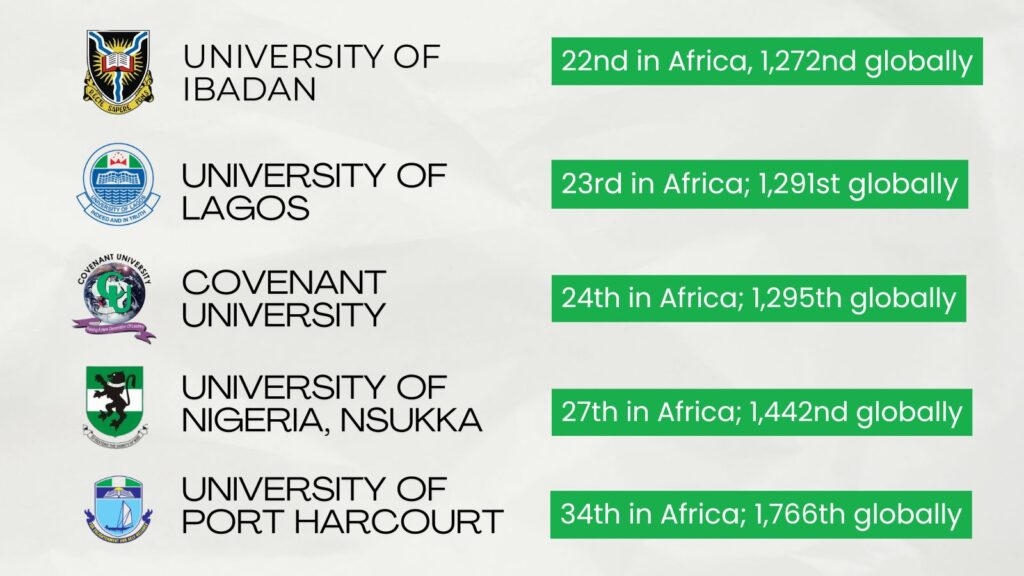
However, the University of Ibadan retained its position as Nigeria’s highest-ranked university, placing 22nd in Africa and 1,272nd globally. It was followed by: University of Lagos, 23rd in Africa; 1,291st globally; Covenant University, 24th in Africa; 1,295th globally; University of Nigeria, Nsukka, 27th in Africa; 1,442nd globally, and the University of Port Harcourt, 34th in Africa; 1,766th globally
For the Nigerian university community, the figures are likely to raise an important question regarding the visibility of the knowledge being produced in Nigeria’s universities to the rest of the world?
NURAC, however, cautions that a lower Webometrics position should not automatically be interpreted as a decline in teaching or research quality. The ranking is relative, meaning an institution may maintain or improve its own indicators but still fall in global position if other universities improve at a faster rate.
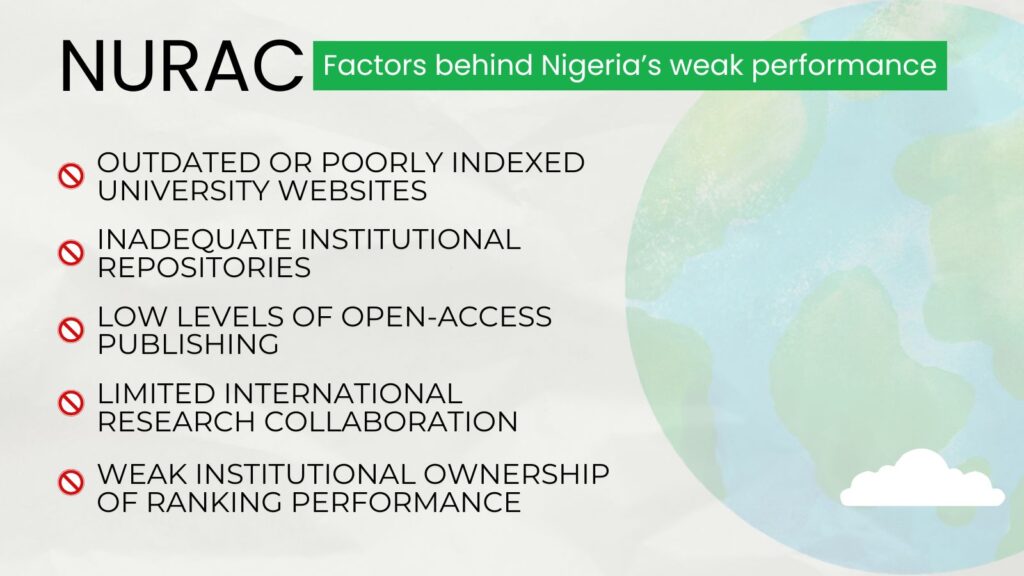
In the memo, NURAC identifies several factors behind Nigeria’s weak performance, including outdated or poorly indexed university websites, inadequate institutional repositories, low levels of open-access publishing, limited international research collaboration and weak institutional ownership of ranking performance.
The committee also points to fragmented university web domains and inconsistent researcher identities, including variations in names, affiliations, ORCID records and other academic profiles, which can make it difficult for research outputs to be correctly attributed to institutions.
The committee recommends that Nigerian universities focus on research that addresses consequential problems, is published through credible outlets, encourages international collaboration and reaches audiences capable of using and citing the research.
On what Nigerian universities should do, NURAC recommends stronger investment in institutional repositories, open-access publishing, library digitisation and digital infrastructure.
It also wants universities to designate senior officers responsible for ranking performance and research visibility, while encouraging stronger international research partnerships with universities in countries currently outperforming Nigeria.
The committee says the performance of institutions such as Covenant University and Osun State University demonstrates that Nigeria’s position can change through deliberate and sustained institutional action.
WATCH: