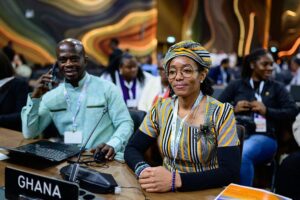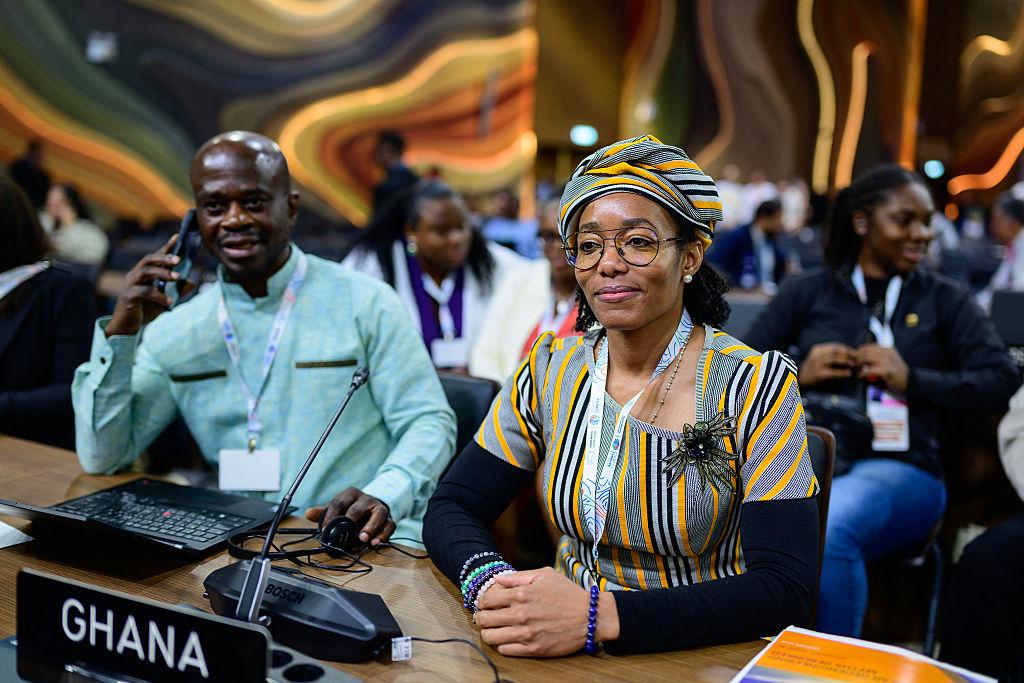
The confrontation occurred on Sunday, November 22, when Ghana’s Minister for Environment, Science and Technology, Dr Zanetor Agyeman-Rawlings, was presenting a statement on behalf of the African Group of Negotiators (AGN), which represents African countries in international climate negotiations.
During the address, COP31 President and Türkiye’s Minister of Environment, Urbanisation and Climate Change, Murat Kurum, interrupted the Ghanaian minister.
The interruption prompted the Chair of the African Group of Negotiators, Nana Dr Antwi-Boasiako Amoah, who is also Ghanaian, to challenge the conference president over the treatment of the African delegation.
Expressing his displeasure, Amoah said the president had failed to show respect to a group representing 54 African countries.
He questioned why the African representative had been interrupted while other delegates had been allowed to deliver their statements without similar interference.
The Ghanaian delegation argued that the incident violated the principles of respect, fairness and meaningful participation expected during international climate negotiations.
COP31 PRESIDENT ISSUES APOLOGY
Following the protest, Murat Kurum apologised to Dr Agyeman-Rawlings and the African Group of Negotiators, saying he had no intention of disrespecting Ghana or the African delegation.
The minister subsequently accepted the apology and returned to complete her statement.
She emphasised that international climate negotiations must be guided by mutual respect, inclusivity and the equal dignity of participating countries.
AFRICA’S DISAPPOINTMENT WITH COP31 OUTCOME
Beyond the confrontation, the African delegation expressed disappointment with the overall outcome of the climate negotiations.
Africa had pushed for stronger commitments on climate financing, adaptation support and the implementation of existing climate agreements.
One major concern was the failure to secure sufficiently clear and predictable financial commitments to help vulnerable African countries respond to climate change.
The African Group also raised concerns about the postponement of decisions on the just transition mechanism, which is intended to support countries and communities as they move towards more sustainable economies.
The conference ended without consensus on its main political decision after negotiations extended almost 48 hours beyond the scheduled closing date.
AFRICA CONNECTION — SCIENCE, TECHNOLOGY AND INNOVATION
The dispute highlights a wider challenge facing Africa: ensuring that its scientific evidence, development priorities and climate solutions receive meaningful consideration in global decision-making.
African countries contribute relatively little to global greenhouse gas emissions but face serious consequences from droughts, flooding, desertification, coastal erosion and changing agricultural conditions.
The continent needs greater access to climate finance to invest in renewable energy, climate-resilient agriculture, early-warning systems, flood monitoring, water-management technology and scientific research.
African universities, research institutions and technology companies also have an important role in developing locally relevant climate solutions.
The central message from the Ghanaian delegation was that Africa must not simply be present at international climate conferences; it must be heard, respected and involved in decisions that directly affect its people and future.