

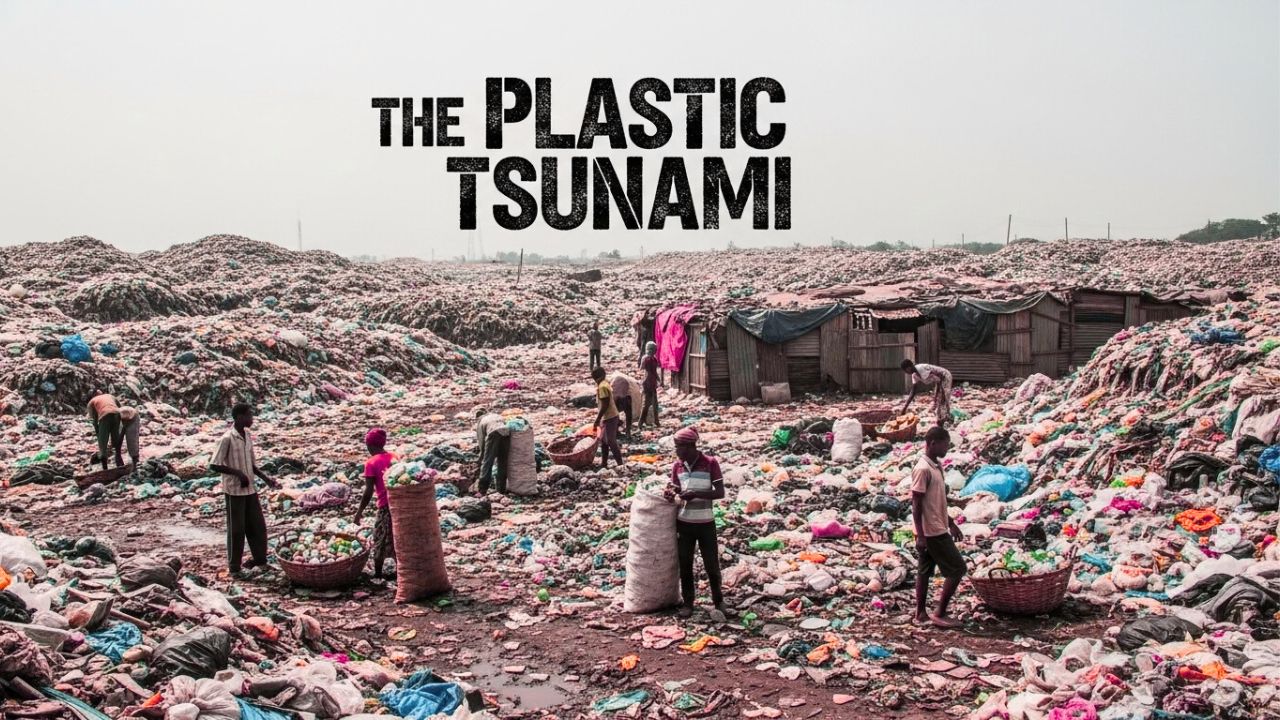
By Cynthia (Reporter, IDEA TV, Abuja Nigeria)
Globally, plastic production continues to rise, reinforcing the urgency of addressing downstream management failures. Without intervention, the volume of unmanaged waste entering terrestrial and marine ecosystems will likely intensify. Global plastic production has expanded at an unprecedented rate over the past seven decades. According to Our World in Data, annual production has increased from approximately 1.5 million tonnes in 1950 to more than 450 million tonnes today. This exponential rise reflects the integration of plastics into nearly every sector of modern life, from packaging and consumer goods to healthcare and construction.
However, the central challenge is not production alone. The more pressing issue lies in effective waste management capacity. While high-income countries generate larger volumes of plastic waste per capital, they often operate structured waste collection and treatment systems. In contrast, many low- and middle-income regions face infrastructure deficits that result in high levels of mismanaged waste, with plastics openly dumped, burned, or washed into waterways. It is within this “leakage gap” that Africa’s vulnerability becomes evident.
Africa’s Structural Challenge
Africa accounts for roughly 5% of global plastic production and approximately 4% of global consumption. Despite this comparatively modest share, the continent faces disproportionate environmental consequences due to limited waste management capacity and infrastructure intertwined with rapid urban growth. Projections from the World Bank and UNIDO indicate that, if current trends persist, Africa could become the leading source of mismanaged plastic waste by 2060. This projection is driven by population growth, accelerated urbanization, and the insufficient expansion of waste management systems.
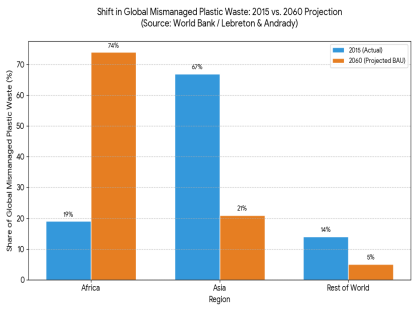
Major cities such as Nairobi, Cairo, and Lagos are experiencing rapid demographic expansion with increases in consumption levels. Yet waste collection, recycling facilities, and sanitary landfills have not developed at a comparable pace. The resulting strain exacerbates widespread littering, blocked drainage systems, and increased marine pollution. Plastic waste pollution in this context is not merely an environmental concern; it is a governance and infrastructural issue.
The Nigeria Case Study: A Crisis of Scale
Nigeria represents a critical case study within the African context. As the continent’s most populous country, it ranks among the top ten globally in plastic waste generation. Current estimates place Nigeria’s annual plastic waste output at approximately 2.5 million tonnes. A significant proportion of this waste originates from single-use packaging, particularly water sachets. A 2026 brand audit identified “pure water” sachets as the leading plastic pollutant in the country, with an estimated 60 million sachets discarded daily, amounting to more than 20 billion annually.
In Lagos and other major cities in Nigeria, plastic waste frequently obstructs drainage channels, drastically intensifying urban flooding during heavy rainfall. In July 2023, severe flooding across parts of Lagos submerged residential neighbourhoods after drainage channels clogged with plastic debris obstructed stormwater flow. Similar patterns were documented in 2022 flooding in Lekki and Ajah districts, where blocked canals intensified water retention and damaged road infrastructure.
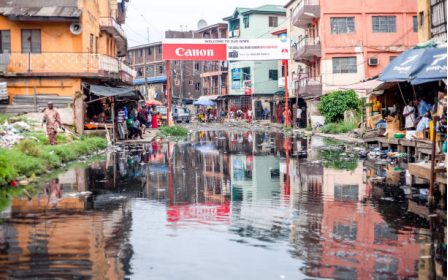
Flood-related damages result in significant financial losses each year; they lead to significant financial losses including destroyed infrastructure, property damage, and severe productivity disruptions. In some cases many lives are lost.
Waste Composition and Management Gaps
Our analysis indicates that sachets constitute roughly 45% of Nigeria’s plastic waste stream. Polyethylene Terephthalate (PET) bottles account for approximately 25%, plastic bags and wrappers 20%, and other plastics 10%. These figures illustrate the structural dominance of lightweight, single-use packaging materials designed for convenience but rarely engineered for recovery. Because these plastics are thin, low-value, and widely dispersed after use, they are among the hardest materials to capture within formal recycling systems.
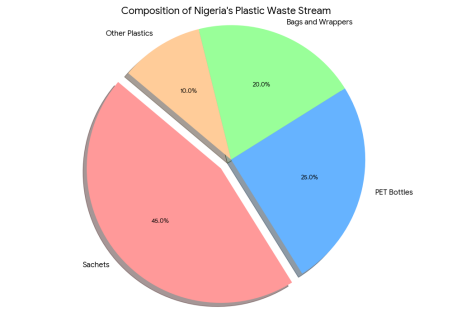
Across much of sub-Saharan Africa, similar patterns are emerging. Informal retail systems rely heavily on sachet-sized packaging to make products affordable to low-income consumers. While economically accessible, these materials are technically difficult to recover at scale. Flexible plastics and multilayer sachets have low recycling value and require specialized sorting and processing infrastructure that is largely absent in many African cities. As a result, they are more likely to be openly dumped, burned, or washed into waterways.
Regionally, Africa produces less plastic overall than Asia or Europe. However, the mismanagement rate is significantly higher, reflecting systemic gaps in waste collection coverage, engineered landfill capacity, material recovery facilities, and data tracking systems. In several fast-growing urban centers, waste collection does not cover the entire metropolitan footprint, leaving peri-urban and informal settlements particularly exposed to plastic accumulation.
The issue is therefore not simply volume, but system design. Without investment in collection networks, decentralized aggregation hubs, recycling technology, and producer responsibility enforcement, lightweight packaging will continue to dominate the waste stream and disproportionately contribute to terrestrial and marine leakage.
Policy and Systemic Responses
In 2024, Nigeria introduced a ban on single-use plastics within government offices. While symbolically important, policy measures of this nature require complementary infrastructure to achieve meaningful impact. Enforcement mechanisms, viable alternatives, and investment in waste systems are essential for effectiveness.
Extended Producer Responsibility (EPR) frameworks present one viable pathway. Under such systems, manufacturers, particularly multinational beverage and consumer goods companies are required to finance the collection and recycling of their products at end-of-life. Transitioning from voluntary corporate social responsibility initiatives to binding circular economy commitments is critical.
Innovation and the Logistics Hurdle
Local innovation demonstrates significant potential through private-sector initiatives. Companies like Wecyclers and Recycle-points operate incentive-based collection systems that reward households for sorting materials with the integration of technology. Wecyclers is using low-cost cargo bicycles and mobile technology to collect recyclables from households in densely populated Lagos communities. Residents earn redeemable points through a digital tracking system. While RecyclePoints deploys smart collection hubs and digital reward systems to encourage household sorting.
Furthermore, startups are turning waste into value, like Ecobarter, a private enterprise focusing on a digital platform that allows households to spend their plastic waste as currency for basic health insurance or groceries.
Several startups are now melting down non-recyclable “pure water” sachets and mixing them with sand to create durable, low-cost paving stones for rural roads. Projects like the Kundu Waste Management Project by Manasseh Aluga in Nigeria and others in Borno are turning plastic waste into construction materials, similar to initiatives by Gjenge Makers in Kenya, which makes bricks five to seven times stronger than concrete.
However, a primary constraint remains unorganized logistics. Moving waste across large urban centers to centralized facilities requires massive logistics planning. Most Nigerian operations are currently ad hoc, leading to high operational costs. Establishing decentralized recycling hubs within local government areas could lower transportation barriers, generate employment, and improve material recovery rates.
As a major oil-producing nation, Nigeria has the raw materials for conventional plastics. However, strategic investment in bio-based alternatives derived from agricultural by-products, such as cassava peels, could stimulate a domestic circular economy.
The trajectory is clear. Plastic pollution in Africa is a multifaceted challenge encompassing health, infrastructure, and economics. Our data demands a shift from voluntary corporate charity to transparent, enforceable policies powered by innovation. The decision that remains is whether policy, industry, and communities will act with the urgency that this “Plastic Tsunami” requires before the leakage gap becomes an unbridgeable canyon.
Cynthia Bassey is a Science and Innovation Reporter at IDEA TV.
IDEA TV is Africa’s first innovation-focused television network. Our platform is dedicated to amplifying advancements in science, technology, health, entrepreneurship, education, and policy that drive sustainable development across the continent. Through rigorous reporting and expert analysis, IDEA TV serves as the premier destination for those shaping Africa’s future.