Scientists have begun construction of one of the world’s most ambitious particle physics experiments, a massive underground facility designed to investigate some of the universe’s greatest mysteries, including how it evolved after the Big Bang and why matter dominates over antimatter.
The project, known as the Deep Underground Neutrino Experiment (DUNE), is being constructed approximately 1.5 kilometres beneath the surface at the Sanford Underground Research Facility (SURF) in Lead, South Dakota, United States.
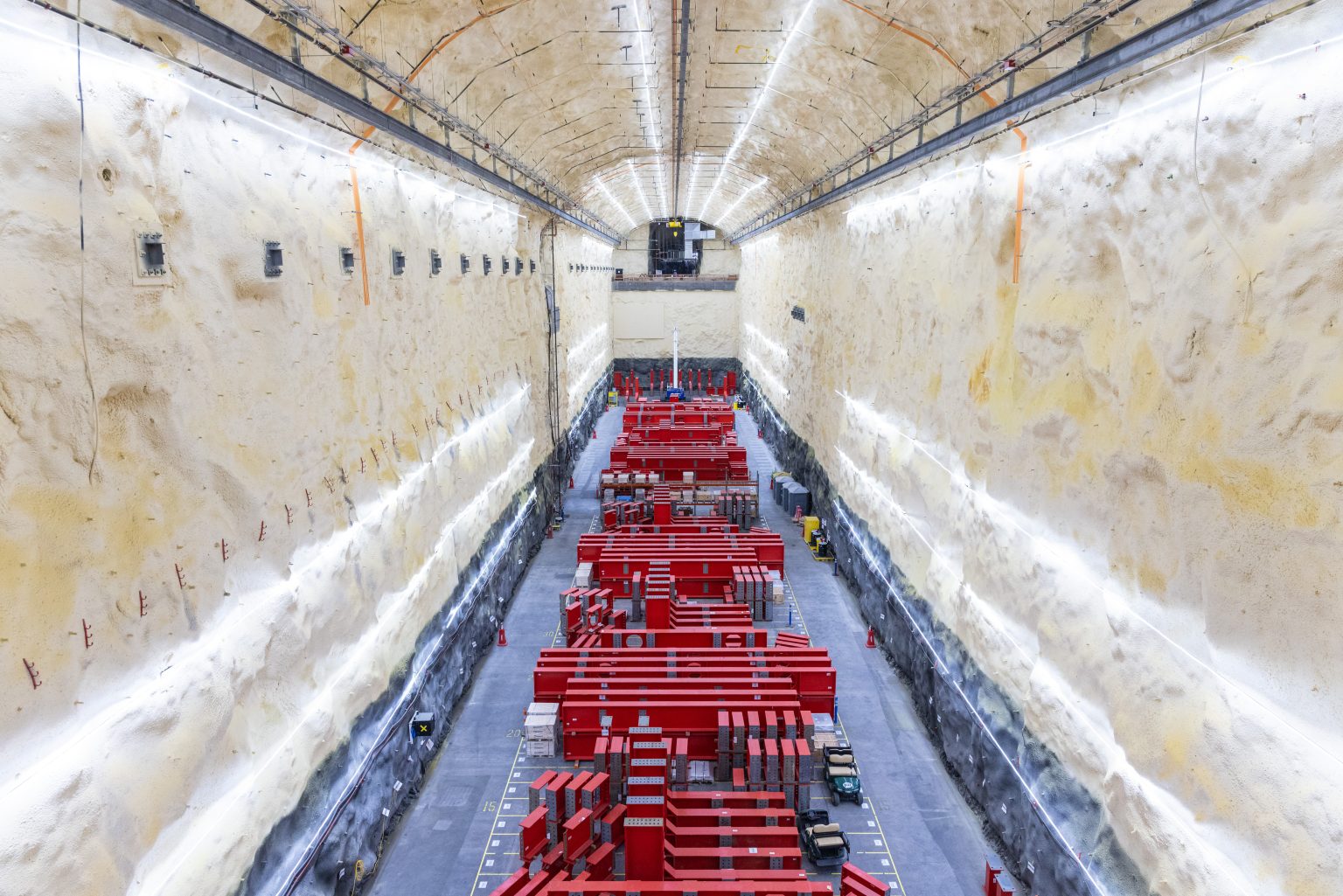
Installation teams from the United States Department of Energy’s Fermi National Accelerator Laboratory (Fermilab), the European Organisation for Nuclear Research (CERN), and SURF have commenced assembling thousands of steel beams that will form the outer structures of two enormous detector modules.
The structures will serve as cryostats, specially insulated containers designed to hold approximately 17,000 tonnes of liquid argon each at an extremely low temperature of about minus 185 degrees Celsius.
The steel components, weighing more than 6,200 tonnes in total, are being transported underground individually and assembled within the facility’s massive underground caverns.
Fermilab Director Norbert Holtkamp described DUNE as the laboratory’s top priority, expressing optimism that the experiment could significantly expand humanity’s understanding of the universe while creating opportunities for technological advancement.
When fully operational, DUNE will use a powerful neutrino beam generated at Fermilab in Illinois and send it approximately 1,300 kilometres through the Earth to detectors buried deep beneath South Dakota.
A second detector near the beam’s source will measure the neutrinos before their journey, allowing scientists to compare the particles at both locations and study how they change as they travel.
Neutrinos are extremely small, electrically neutral subatomic particles that interact very weakly with matter, making them difficult to detect. Scientists believe studying their properties could provide important clues about the fundamental laws governing the universe.
The international collaboration involves more than 1,500 researchers and institutions worldwide, with CERN providing significant technical expertise, engineering support and more than 6,200 tonnes of steel for the detector structures.
CERN Director-General Mark Thomson described the partnership as an important example of international scientific cooperation, noting that the project represents a major contribution by the European organisation to an experiment taking place outside Europe.
Each of the two cryostats will measure approximately 66 metres long, 19 metres wide and 18 metres high, making them among the largest structures of their kind ever built for a particle physics experiment.
The project will require approximately 2,600 steel beams. While installation is already under way in the South Cavern, preparations have also begun in the North Cavern, where assembly of the second detector structure is expected to commence next year.
According to SURF Laboratory Director Mike Headley, the experiment is expected to operate into the late 2040s, potentially creating opportunities for generations of scientists and supporting highly skilled employment in the region.
Construction of the underground facility is expected to be completed by 2029, with the detector apparatus scheduled for completion in 2030. Scientists anticipate that the neutrino beam will begin reaching the underground detectors by 2031, following upgrades to Fermilab’s particle accelerator.
Once operational, DUNE will also investigate neutrinos originating from the Sun and outer space, opening new possibilities for understanding the universe and the fundamental forces of nature.
For scientists, the experiment represents more than an extraordinary engineering achievement. It is a major step towards answering some of the most profound questions about the origins, composition and evolution of the universe.