

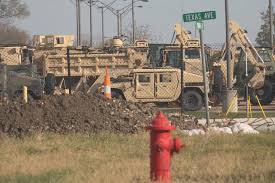
The United States Army has carried out a controlled detonation of approximately five tons of unstable lead azide at an ammunition plant in Iowa, despite concerns from residents, environmental groups and public officials about possible lead contamination.
The detonation took place on Wednesday, November 25, at approximately 9:00 a.m. local time at the Iowa Army Ammunition Plant in Middletown, south-eastern Iowa.
The operation involved 68 barrels containing nearly 9,500 pounds of lead azide, a highly sensitive explosive chemical used in the manufacture of detonators and other explosive devices.
US military officials said the material had deteriorated and developed dangerous crystalline formations, making it increasingly unstable and potentially capable of exploding spontaneously, particularly as temperatures dropped.
Major General Eric Shirley, who is leading the Army’s operation, said delaying the disposal was no longer considered a safe option.
The Army maintained that a controlled explosion offered a safer alternative to allowing the deteriorating chemicals to detonate unexpectedly. Officials also said they had considered alternative disposal methods but concluded that moving or chemically treating the material could trigger an accidental explosion.
WHY THE OPERATION RAISED CONCERNS
The decision generated considerable public opposition because lead is a toxic heavy metal that can cause serious health problems, particularly in children and pregnant women.
Before the operation, the Army warned that the explosion could release lead-containing particles into the atmosphere, potentially spreading beyond the ammunition plant and affecting surrounding communities, farms, water sources and properties.
Residents were advised to evacuate designated areas or remain indoors, close windows and doors, and take precautions to prevent exposure to airborne dust.
The United States Environmental Protection Agency deployed more than 100 personnel and contractors to support the operation. It also conducted more than 1,001 environmental samples involving air, land and water before the explosion.
The Army said it had implemented mitigation measures, including barriers, specialised materials and large quantities of water, to limit the spread of potentially contaminated particles.
ENVIRONMENTAL AND PUBLIC HEALTH IMPLICATIONS
The operation attracted criticism from environmental groups and residents who questioned whether sufficient consideration had been given to alternative disposal methods and the potential consequences for nearby communities.
Iowa Governor Kim Reynolds had also called for delays, while environmental organisations pursued legal action to challenge the operation.
The Army proceeded after the legal challenges failed to prevent the detonation.
Following the explosion, authorities began monitoring environmental conditions and collecting additional samples to establish whether lead-containing particles had spread beyond the installation.
Importantly, the projected movement of a toxic dust plume does not automatically establish that harmful contamination occurred. The actual environmental impact will depend on monitoring results and laboratory analysis.
The Iowa incident offers an important lesson for African countries managing hazardous industrial chemicals, mining waste and ageing military stockpiles.
Across Africa, the expansion of mining, manufacturing, petroleum processing and chemical industries makes effective hazardous-material management increasingly important.
Governments need stronger environmental monitoring systems, modern chemical-waste treatment facilities, emergency-response technology and independent laboratory testing.
Artificial intelligence, remote sensors, satellite monitoring and real-time air-quality measurement can help authorities identify environmental threats and communicate risks to affected communities.
For Nigeria, where oil and gas operations, mining activities and industrial facilities generate potentially hazardous waste, investment in environmental engineering and local scientific research is essential.
The Iowa incident demonstrates that decisions involving dangerous industrial materials must balance immediate safety risks with long-term public health and environmental protection.