

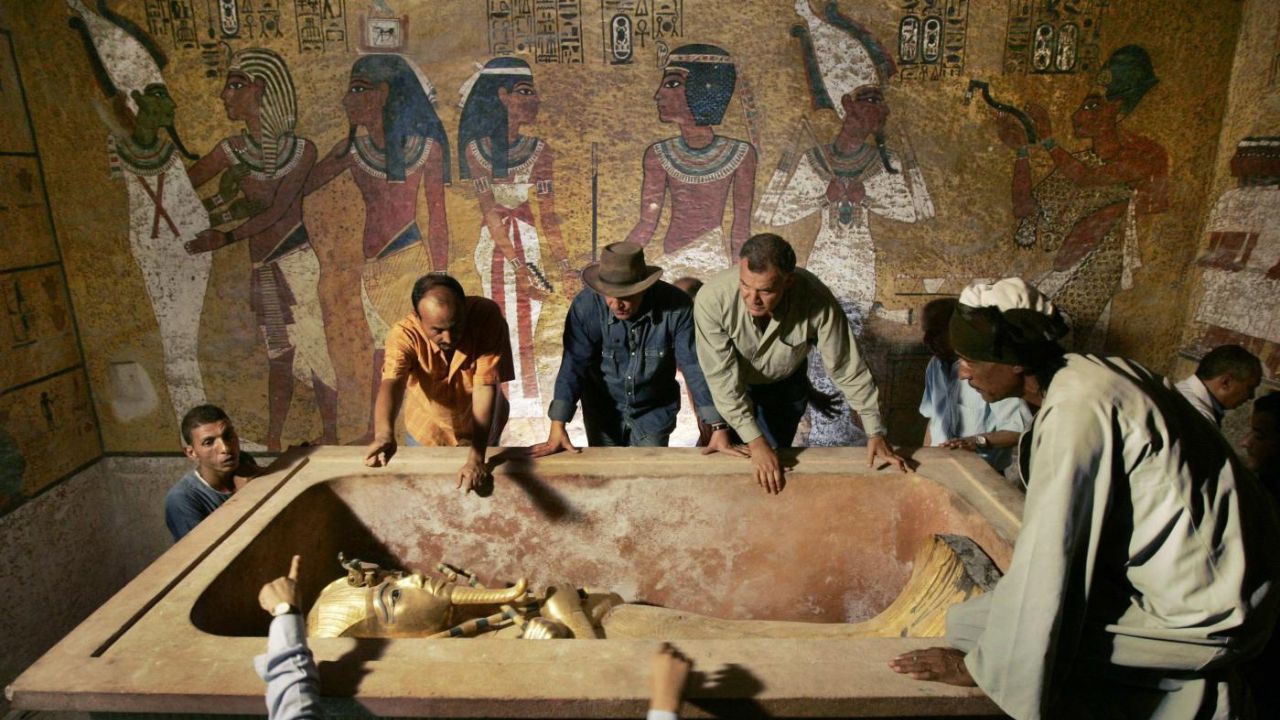
Thirty-three centuries had passed since human feet last trod the floor on which we stood, and yet the signs of recent life were around us.
Ninety years on, Howard Carter’s clipped English voice sounds itself almost like an ancient relic. When he spoke on BBC radio in 1936, 14 years had gone by since he first uncovered the treasure-rich tomb of Tutankhamun. The almost miraculous discovery by Carter and his expert team of the boy king’s intact tomb had made him world-famous and sparked a craze for all things ancient Egyptian.
Speaking on a programme reviewing the events of 1924, he conjured the uncanny sensation he felt on 12 February that year when they finally reached Tutankhamun’s sarcophagus, the stone coffin where the pharaoh had lain undisturbed for millennia. When he notes details such as “a half‑filled bowl of mortar, a blackened lamp, the chips of wood left on the floor by a careless carpenter”, his sense of wonder comes through as alive as ever.
“We had penetrated two chambers, but when we came to a golden shrine with doors closed and sealed,” he said, “we realised that we were to witness a spectacle such as no other man in our time had been privileged to see.” He removed the precious seal and opened the door to reveal a second shrine “even more brilliant in workmanship than the last”.
When the door swung open slowly, he was confronted by an “immense yellow quartzite sarcophagus”. There was no way forward without raising its stone lid that weighed about 2,500lb, or 1,130kg. An audience of VIPs and dignitaries watched as an intricate pulley system raised it. When Carter removed the stone, light shone into the coffin. “A gasp of wonderment escaped our lips, so gorgeous was the sight that met our eyes,” he said. “A golden effigy of the young king of magnificent workmanship filled the whole of the interior; this was but the lid of a series of three coffins, nested one within the other, enclosing the mortal remains of the young King Tutankhamun.”
Strange animals, statues and gold. Everywhere the glint of gold – Howard Carter
Despite going on to make one of the world’s greatest archaeological discoveries, Carter had left school at 15 and had no formal training. With his talent for drawing, a local aristocratic family who lived near his rural Norfolk home took the solitary teenager under their wing. The Amhersts’ Didlington Hall had the greatest private collection of Egyptian objects in Britain, and he became fascinated by their stories. At 17, his artistic skill secured him work in Egypt as a draughtsman and tracer. He arrived during a boom for archaeology, much of it funded by wealthy amateurs and British aristocrats. For more than two decades he trained on the job.
The staggering discovery of Tutankhamun’s tomb owed much to good fortune. Carter had been toiling away with little success for years in the Valley of the Kings, an area just west of the Nile used by the ancient Egyptians as the main burial ground for the pharaohs. The tomb entrance had long been concealed by layers of ancient debris, keeping it beyond the reach of both grave robbers and archaeologists.
The cult of King Tut was born
The breakthrough came in November 1922 when Carter held up a candle and peered into the darkness through a small hole chiselled in a door. Waiting nervously nearby, his wealthy patron Lord Carnarvon asked if he could see anything. The legend goes that Carter replied, “Yes, wonderful things.” He wrote in his excavation diary: “As my eyes grew accustomed to the light, details of the room emerged slowly from the mist. Strange animals, statues and gold. Everywhere the glint of gold.”
All this treasure was intended to accompany Tutankhamun into the next life. The 11th pharaoh of Egypt’s 18th dynasty, Tutankhamun was aged about 17 when he died. It is thought that he inherited the throne at the age of eight or nine. The cause of death remains uncertain, with theories ranging from assassination to a hunting accident.
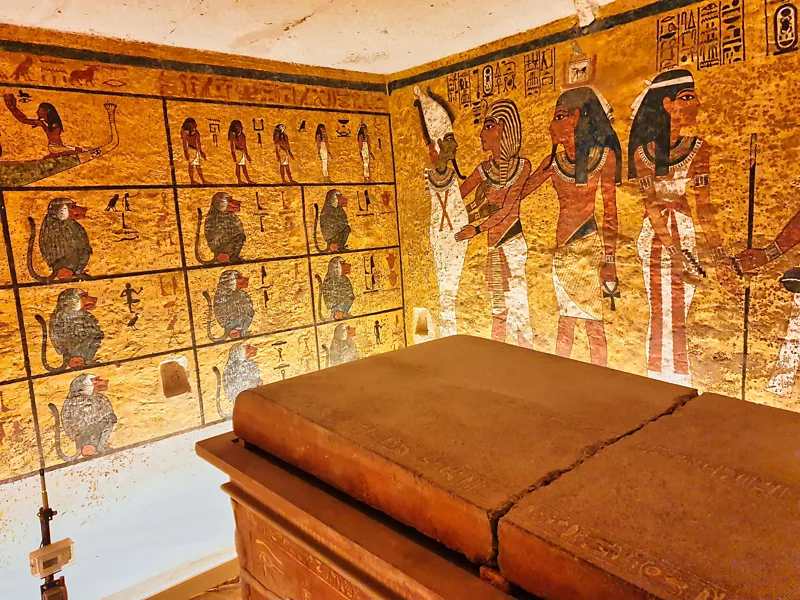
The November 1922 find was only the start of it, revealing what Carter described as the antechamber, a small outer room. It took another 15 months for the team to reach the sarcophagus. When the Times newspaper published its world exclusive about “what promises to be the most sensational Egyptological discovery of the century”, the cult of King Tut was born. Egyptomania swept through the 1920s, inspiring everything from fashion and Art Deco design adorned with pyramid and lotus-flower motifs, to silent films and jazz songs. Carter and Carnarvon became international celebrities.
However, just a few months after the big reveal, Carnarvon’s luck ran out when he died of blood poisoning from an insect bite. His death gave the Tutankhamun story a new lease of life, with tales of the mummy’s curse and Tut’s revenge adding to the growing myths around the discovery.