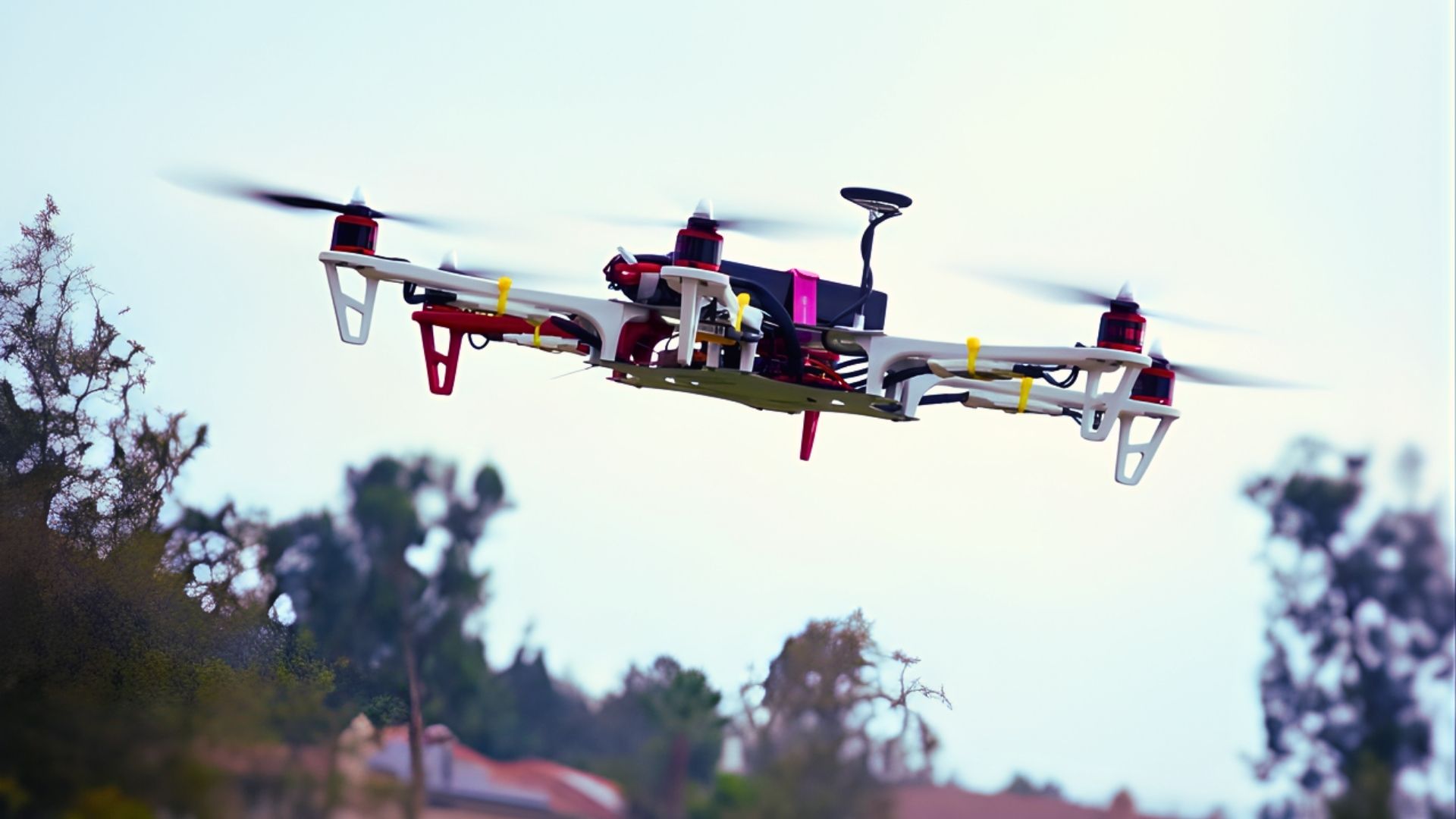
The science of drones—or Unmanned Aerial Vehicles (UAVs)—is a mashup of physics, aerodynamics, and high-speed computing. Most consumer and military “swarms” (like the ones currently in the news) are multirotors, which stay airborne using four or more propellers.
Here is the breakdown of the “how” and “why”:
1. The Physics: Lift and Torque
Drones move by manipulating Newton’s Third Law (every action has an equal/opposite reaction).
- Vertical Movement: To climb, all four motors spin faster than the force of gravity. To hover, they spin at a speed where lift exactly equals the drone’s weight.
- Rotation (Yaw): Drones have two props spinning clockwise and two counter-clockwise. To turn right, the drone slows down the clockwise motors and speeds up the counter-clockwise ones. This creates an imbalance in torque, causing the body to spin.
- Direction (Pitch/Roll): To move forward, the rear motors spin faster than the front ones, tilting the drone forward and pushing air backward.
2. The “Brain”: Flight Controller
Because a human can’t manually balance four motors thousands of times per second, the Flight Controller (FC) does the heavy lifting:
- IMU (Inertial Measurement Unit): This contains a gyroscope and accelerometer to detect tilt and vibration.
- The PID Loop: The FC runs a “Proportional-Integral-Derivative” loop—a math formula that constantly calculates the difference between the pilot’s command and the drone’s actual position, adjusting motor speeds instantly to keep it stable.
3. Navigation and Swarming
Modern drones, like those mentioned in the Ukraine-Russia conflict, rely on:
- GPS/GNSS: For coordinate-based strikes and “Return to Home” features.
- Optical Flow: Downward-facing cameras that “see” the ground to maintain position when GPS is jammed.
- Swarm Intelligence: This uses Bio-inspired Algorithms (think of how birds fly in a flock). Each drone communicates its position to its neighbors to avoid collisions while moving as a single, overwhelming unit.
4. Energy and Propulsion
Motors: They use Brushless DC Motors. Unlike your old RC car, these have no physical brushes, making them more efficient, quieter, and capable of much higher RPMs.
Power: Most use LiPo (Lithium Polymer) batteries because they offer a high discharge rate (bursts of power) and are lightweight.