
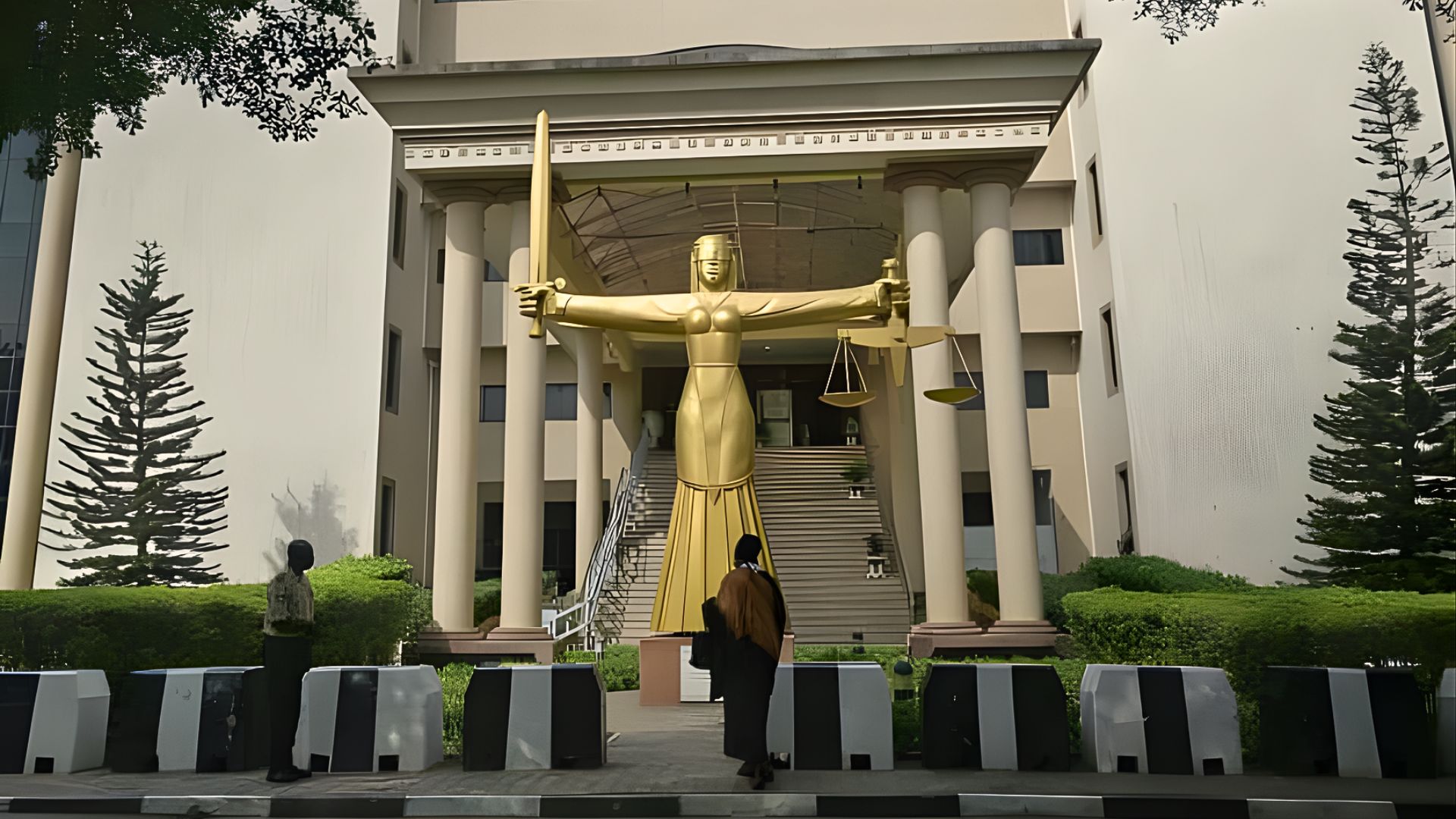
A Federal High Court in Abuja has set aside INEC’s revised pre-election timetable for 2027, ruling that the commission overstepped its statutory authority — opening a window for defectors and primary losers to re-enter the race.
By IDEA Television News Desk
In a ruling with sweeping implications for Nigeria’s 2027 general elections, the Abuja Division of the Federal High Court has nullified key portions of the Independent National Electoral Commission’s (INEC) revised election timetable, handing political parties a significant legal victory and potentially reshuffling the electoral landscape ahead of what promises to be a fiercely contested cycle.
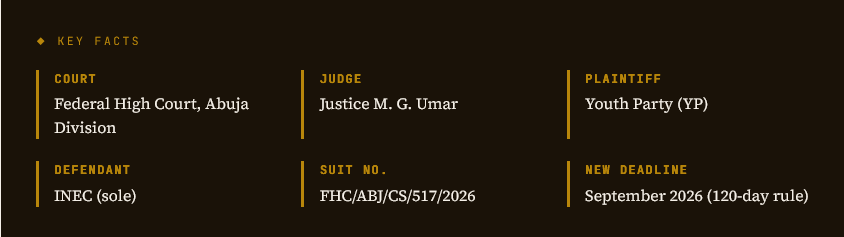
Justice Mohammed Garba Umar, delivering judgment in a suit filed by the Youth Party, held on Thursday that INEC had acted beyond its statutory authority by imposing timelines on political parties for the conduct of primary elections and the submission of candidates’ particulars — timelines that were shorter than what is prescribed under the Electoral Act, 2026.
What the Court Decided
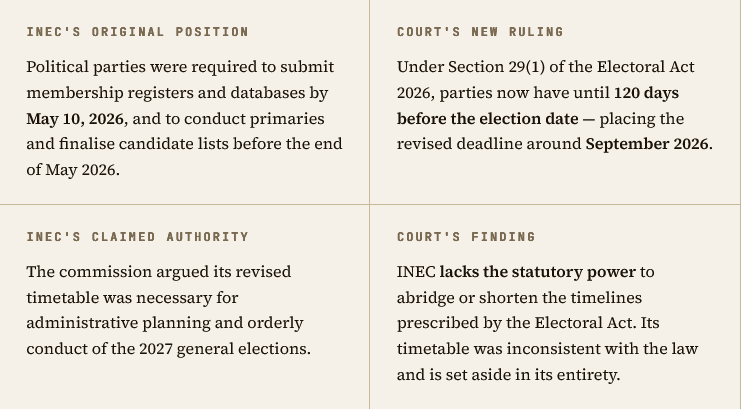
At the heart of the ruling was INEC’s directive requiring all political parties to submit their membership registers and databases by May 10, 2026 as a mandatory precondition for participating in the 2027 elections. The court squarely set aside that deadline.
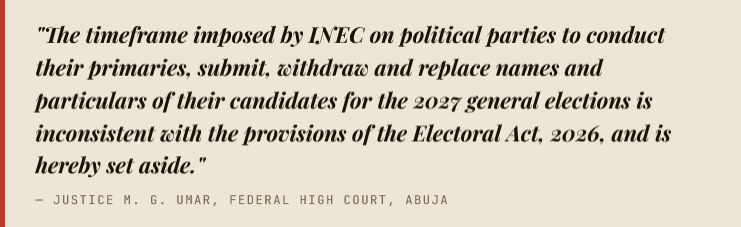
Justice Umar grounded his decision in Section 29(1) of the Electoral Act, 2026, which gives political parties up to 120 days before an election to submit the personal particulars of their candidates. Since the 2027 general elections are expected to hold in February 2027, that statutory window pushes the effective deadline to approximately September 2026 — nearly five months beyond what INEC had mandated.
The Suit: Youth Party vs. INEC
The legal action was filed on March 11, 2026, by the Youth Party (YP), with INEC named as the sole defendant. Through its counsel, J. O. Olotu, the party had sought several reliefs, central among them a declaration that INEC’s powers under Sections 29, 82, and 84(1) of the Electoral Act do not extend to fixing or prescribing the timetable within which political parties may conduct their primaries. The court agreed on all fronts.
A Certified True Copy (CTC) of the judgment was made available in Abuja on Thursday, confirming the full scope of the ruling. The court ordered that the timeframes in INEC’s Revised Timetable and Schedule of Activities for the 2027 General Election — including deadlines for the conduct of primaries, submission of candidates’ particulars, and the withdrawal or replacement of names — be nullified.
Political Fallout: Who Benefits?
The political implications of this ruling are enormous. INEC’s compressed timetable had been widely seen as a structural barrier designed — whether intentionally or not — to lock out politicians who either lost in recent party primaries or who had recently defected from one political party to another. With the court’s ruling, that door is now reopened.
Politicians who lost their seats or switched parties after INEC’s original deadlines had effectively been boxed out of the 2027 race. Under the new legal reality, they now have until September 2026 to register under new parties, conduct fresh primaries, and submit their candidacies — provided the ruling survives any appeal by INEC.
The judgment was welcomed by former presidential candidate Dr. Gbenga Hashim, who described it as “a victory for the rule of law and constitutional order,” commending Justice Umar for what he called a courageous decision that checked administrative overreach.
What Happens Next?
While the ruling is binding as it stands, INEC is widely expected to challenge it at the Court of Appeal. The commission has not issued an official response at the time of publication, but legal observers note that any stay of execution, if granted by an appellate court, could restore the original deadlines in the interim.
Until then, political parties and their aspirants would be entitled to rely on the statutory 120-day window. The ruling also raises broader questions about the scope of INEC’s administrative powers and whether the commission can issue directives that in effect modify legislative timelines — a question that may ultimately require resolution by Nigeria’s highest courts.
For now, the judgment reshapes the political calendar ahead of 2027 and injects fresh uncertainty — and fresh opportunity — into an election cycle that was already shaping up to be one of Nigeria’s most consequential.
By Tom Solomon Iboro for IDEA Television