
Academics at the University of Jos say scrapping local-language instruction in early childhood education is a step backwards, urging Abuja to look to global best practice — and warning against the creeping “recolonisation” of Nigerian education.
IDEA Television News Desk
The Academic Staff Union of Universities at the University of Jos has come out strongly against the federal government’s decision to reverse its mother-tongue instruction policy for early childhood education, describing the reversal as a backward step that squanders years of evidence-based progress in Nigerian schooling. The union’s chairperson, Jurbe Mwolwus, made the position clear at a press conference in Jos on Monday, setting out a wide-ranging critique that stretched well beyond the language question.
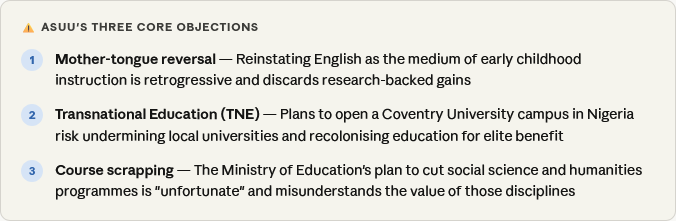
The Academic Staff Union of Universities at the University of Jos has come out strongly against the federal government’s decision to reverse its mother-tongue instruction policy for early childhood education, describing the reversal as a backward step that squanders years of evidence-based progress in Nigerian schooling. The union’s chairperson, Jurbe Mwolwus, made the position clear at a press conference in Jos on Monday, setting out a wide-ranging critique that stretched well beyond the language question.
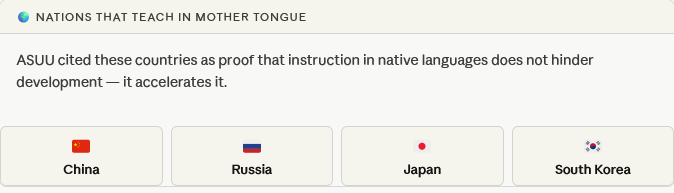
“Using local languages for instruction is standard and best practice in technologically advanced nations.”
— Jurbe Mwolwus, ASUU University of Jos Chairperson
The union turned its attention next to the federal government’s plan to establish a campus of Coventry University in Nigeria under what is known as the Transnational Education framework. ASUU’s position is unambiguous: the scheme is not an upgrade for Nigerian education, but a vehicle for a small group of well-connected Nigerians and their foreign partners to profit at the expense of public universities. Rather than inviting foreign institutions to plant branches on Nigerian soil, Mwolwus said the government should be channelling resources into making Nigerian universities internationally competitive — institutions capable of attracting foreign students and scholars, and of retaining the homegrown talent that currently leaves the country in search of better academic environments.
The third strand of ASUU’s critique concerns a proposal from the Federal Ministry of Education to eliminate certain university courses, with the ministry reportedly singling out disciplines in the social sciences and humanities as “irrelevant” contributors to graduate unemployment. Mwolwus pushed back on this characterisation firmly, insisting that every academic programme carries genuine value — both for the individual who studies it and for society at large.
“Skills, critical thinking, creativity, collaboration, communication and digital literacy are laid by the so-called irrelevant courses — philosophy, religious studies, linguistics and fine arts.”
— Jurbe Mwolwus, ASUU University of Jos
He questioned whether the unemployment problem among Nigerian graduates is truly concentrated among arts and social science graduates alone, and called on the government to address the structural economic conditions that cause unemployment rather than eliminating entire fields of knowledge. What Nigeria needs, he argued, is an enabling environment for industry to grow and generate employment — not an academic purge dressed up as reform.
Rounding off the union’s statement, Mwolwus also raised concerns about governance within the university system, calling on the government to put an end to irregular appointments, the misuse of funds, and the routine bypassing of due process in university administration. The remarks signal that ASUU’s frustration extends well beyond any single policy — pointing instead to a pattern of decision-making that the union believes is steadily weakening Nigeria’s educational foundations.