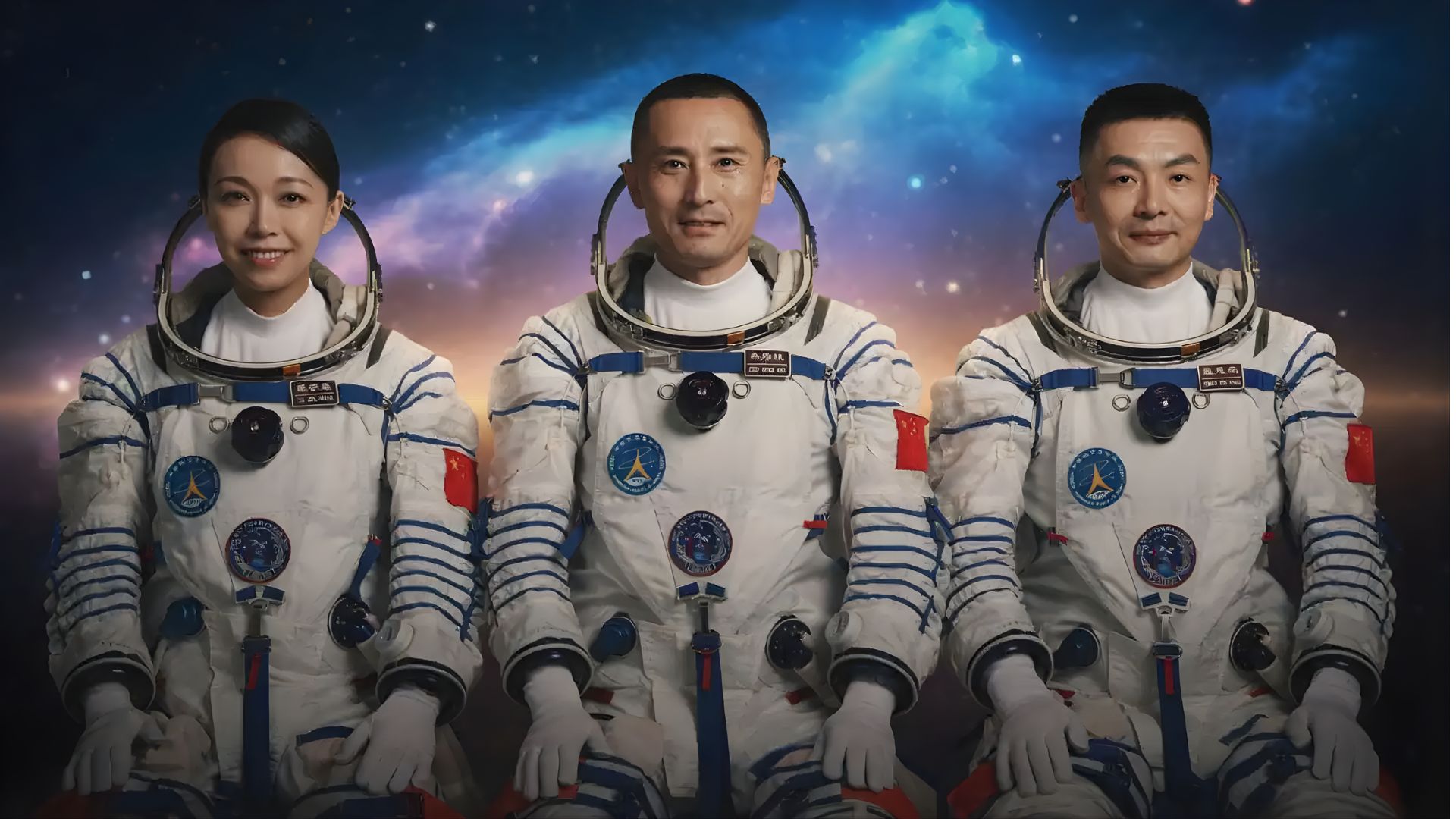
Police superintendent and computer forensics expert Lai Ka-ying has made history as Hong Kong’s first person to travel to space, launching to the Tiangong station aboard a Long March 2F rocket.
IDEA Television Desk
A new chapter in space history was written on Sunday night as China launched the Shenzhou-23 crewed spacecraft from the Jiuquan Satellite Launch Center in northwestern China, carrying three astronauts to the Tiangong space station — including Lai Ka-ying, who has become the first person from Hong Kong ever to travel to space.

A new chapter in space history was written on Sunday night as China launched the Shenzhou-23 crewed spacecraft from the Jiuquan Satellite Launch Center in northwestern China, carrying three astronauts to the Tiangong space station — including Lai Ka-ying, who has become the first person from Hong Kong ever to travel to space.
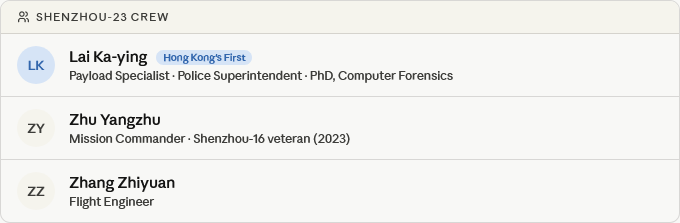
A new chapter in space history was written on Sunday night as China launched the Shenzhou-23 crewed spacecraft from the Jiuquan Satellite Launch Center in northwestern China, carrying three astronauts to the Tiangong space station — including Lai Ka-ying, who has become the first person from Hong Kong ever to travel to space.
“A historic moment” — Hong Kong Chief Executive John Lee, on Lai Ka-ying’s launch
Hong Kong’s Chief Executive John Lee publicly celebrated the achievement, describing it as a landmark moment for the city and commending Lai for completing the demanding selection and training process required for the mission. The launch has sparked widespread pride across Hong Kong, where the achievement is being seen as a powerful symbol of the city’s role within China’s growing space ambitions.
The Shenzhou-23 crew heads to a space station that has become the centrepiece of China’s manned spaceflight programme — supported by massive state investment as Beijing works to close the gap with the United States and Russia in human spaceflight capability. The station typically houses rotating three-person crews for six-month tours of duty, and the incoming Shenzhou-23 crew is expected to carry out a handover with the Shenzhou-21 crew, who have been aboard for more than 200 days.
One notable feature of this mission is that one of the three astronauts will undertake an extended one-year in-orbit residency experiment — a significant step as China builds operational experience for prolonged human presence in space. Chinese authorities have not specified which crew member will take on the year-long stay. The crew’s agenda also includes conducting extravehicular activities, cargo transfers, and dozens of science and application projects during their time aboard.
The mission fits squarely into China’s broader lunar ambitions. Beijing has set a firm target of landing astronauts on the Moon by 2030, with an eventual goal of building a permanent base on the lunar surface. China’s Manned Space Agency has pledged to work steadily and tirelessly toward that goal, and year-long missions like the one being conducted on Shenzhou-23 are considered a vital building block toward future deep-space exploration.
For Hong Kong, the moment marks far more than a space milestone — it signals the city’s active participation in one of humanity’s most ambitious technological frontiers, and opens the door for a new generation of Hongkongers to imagine their place among the stars.