The US Department of Defence has expanded its list of firms it alleges support China’s military to 188 companies — now targeting some of Beijing’s most prominent commercial brands.
IDEA TV News Desk
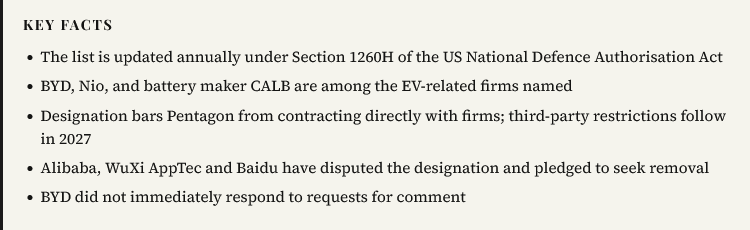
The United States Pentagon has added electric vehicle giant BYD, e-commerce titan Alibaba, and technology conglomerate Baidu to its official list of alleged Chinese military companies, in a sweeping update that also sweeps in dozens of other firms across artificial intelligence, battery manufacturing, biotech, and solar energy sectors.
The designations were published in a Federal Register notice scheduled for Wednesday, with the US Department of Defence designating the firms as “Chinese military companies” under Section 1260H of the National Defence Authorisation Act. The Pentagon’s list now includes 188 firms — up from 134 in 2025.

Notable companies named in the update include:

The designations do not impose sanctions directly, but mean the Defence Department will be prohibited from contracting with listed companies starting later this month, and from procuring their products or services through third parties from June 2027.
“There is no basis to conclude that Alibaba should be placed on the Section 1260H List. Alibaba is not a Chinese military company nor part of any military-civil fusion strategy.”
— Alibaba Group statement
China’s embassy in Washington condemned the listing as “discriminatory,” accusing the US government of “overstretching” the concept of national security and calling on Washington to create a fair environment for Chinese companies operating abroad.
The move reflects Washington’s broader view that key commercial sectors — including AI, electric vehicles, batteries, and cloud infrastructure — cannot be cleanly separated from China’s national security apparatus. Analysts, however, say the Pentagon is unlikely to prompt the US Treasury or Commerce Department to impose more formal restrictions on the named firms in the near term, as Washington seeks to maintain a degree of stability in bilateral relations.