
IDEA TV News Desk, ABUJA, Nigeria, (1 October 2026)
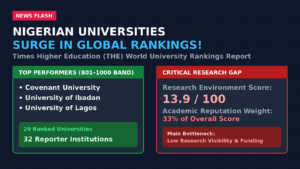
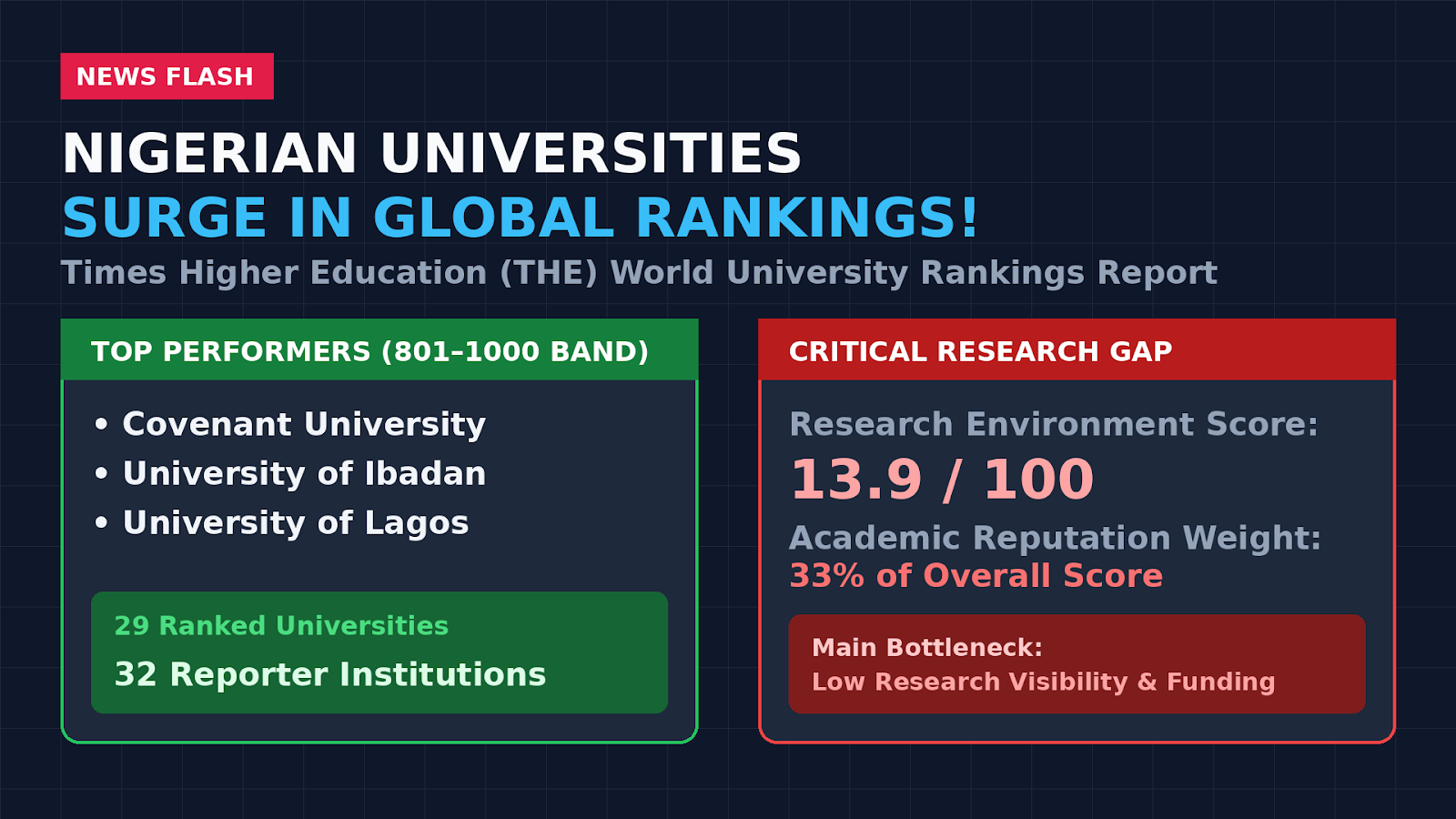
Nigeria has expanded its presence in the Times Higher Education (THE) World University Rankings, with 29 universities ranked in the 2027 edition, up from 24 in 2026. A further 32 Nigerian universities are listed as Reporters, creating a potential pipeline of institutions that could enter the global table.
The recent findings are contained in a new report by the Nigerian Tertiary Education Ranking Advisory Committee (NiTERAC), chaired by Prof. Peter A. Okebukola. The report describes Nigeria as the most represented country in sub-Saharan Africa in the 2027 rankings, accounting for 29 of the region’s 69 ranked universities.
Three universities, namely Covenant University, the University of Ibadan and the University of Lagos, share Nigeria’s leading position in the 801–1000 global band. Four others, including Ahmadu Bello University, Bayero University, Landmark University and the University of Ilorin, are in the 1001–1200 band, giving Nigeria seven universities within the global top 1,200.
Notable movements include Covenant University’s return to the 801–1000 band; Ahmadu Bello University and the University of Ilorin’s move into the top 1,200; Babcock University’s rise from 1501+ to 1201–1400; and upward movement by Nnamdi Azikiwe University and the University of Benin. Osun State University also made a notable debut in the 1201–1400 band.
Despite the broader representation, the report identifies significant structural weaknesses. Nigerian universities recorded their strongest average performance in Research Quality, with a mean score of 43.3, but Research Environment was the weakest pillar at 13.9, followed by Teaching at 20.6. The two weaker pillars together carry 58.5% of THE’s overall weighting.
Academic reputation is identified as the single largest area requiring attention: reputation measures account for 33% of the overall score. The report links the challenge to limited global visibility, modest research income and productivity, and relatively low doctoral output. It also notes that strong citation performance does not automatically translate into reputation, income or doctoral performance.
For universities in the Reporter category, eligibility remains a major hurdle. Times Higher Education generally requires at least 1,000 Scopus-indexed research outputs over five years, with at least 100 in each year, among other requirements. The report says targeted support could help more of the 32 Nigerian Reporters cross the threshold.
The report recommends building a global academic reputation through international conferences, joint research, visiting professorships, and stronger engagement with diaspora academics and alumni; increasing competitive research funding, research productivity, and support for early-career researchers; improving the accuracy and completeness of institutional data submitted to THE and NiTERAC; and expanding doctoral training, supervision, funding, and timely completion. Others are the deepening of international collaboration, especially international co-authorship, and improving conditions for international students and staff; strengthening of university–industry partnerships, patenting and licensing of research outputs; providing targeted support to the 32 Reporter universities so they can meet ranking eligibility requirements and the use of NiTERAC and the Virtual Institute for Capacity Building in Higher Education (VICBHE) to build capacity in ranking methodology, data management and research visibility.
The report argues that the rankings should be treated not simply as a league table, but as a diagnostic tool for identifying institutional performance gaps. For students, academics and university leaders, the message is clear: publishing high-quality research is important, but converting research into global visibility, collaboration, funding, doctoral success and real-world impact is equally critical.
As Nigeria prepares its 2026 national tertiary education ranking, NiTERAC says the exercise is intended to stimulate healthy competition and help position Nigerian institutions for stronger global performance.
This report is coming barely three months after the Cybermetrics Lab of the Spanish National Research Council report, which indicates that none of Nigeria’s universities made the top 20 in Africa in the July 2026 Webometrics Ranking of World Universities.
Join the conversation with IDEA TV: @ideatelevision on our social media handles, or connect directly at [email protected], or call 2348116619732