
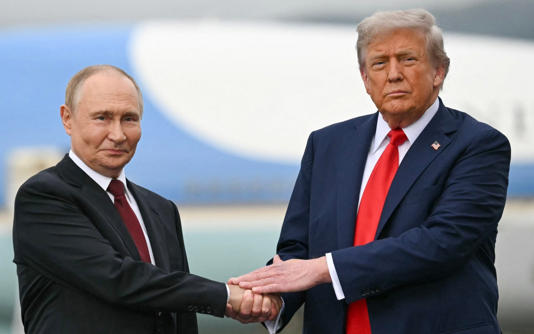
US President Donald Trump is reportedly considering a broader agreement with Russian President Vladimir Putin aimed at ending the war in Ukraine and securing the reopening of the Strait of Hormuz, raising concerns among European leaders that Washington could sideline Kyiv in negotiations with Moscow.
According to sources cited by The Telegraph, the proposed arrangement could involve offering Russia concessions on European security in exchange for Putin using his influence over Iran to help end the conflict in the Middle East and restore access to the strategic shipping route.
The proposed deal is viewed by some people close to the discussions as an opportunity for Trump to secure breakthroughs in the Ukraine and Iran conflicts within a short period.
Gulf mediators are reportedly optimistic that Washington and Tehran are approaching a nuclear agreement that could end the fighting and reopen the Strait of Hormuz. However, they believe Iran may still require encouragement from Moscow, given its close relationship with Russia, before accepting a final settlement.
The reported diplomatic efforts come amid separate discussions between Iran and Russia over the possible supply of advanced air defence systems to Tehran, contradicting Trump’s assertion that Moscow is not providing assistance to the Islamic Republic.
A confidential Iranian planning document reviewed by The Telegraph reportedly indicated that Tehran would rely on Moscow for support in the event of another confrontation with the United States.
Trump Raises Fresh Concerns Over European Security
Speaking in the Oval Office on Thursday, Trump confirmed that he was discussing an agreement with Putin to end the Ukraine war and reshape Europe’s security arrangements.
His remarks have heightened concerns among European governments that the US president could pursue a settlement favourable to Moscow at the expense of Ukraine’s sovereignty and security interests.
Two senior officials told The Telegraph that European leaders would resist any arrangement imposed without their involvement, while another source said they were preparing for the possibility that Washington could pressure Europe to sacrifice Ukraine’s interests to secure an agreement with Russia.
Trump’s comments followed a meeting with Russian presidential envoy Kirill Dmitriev at the White House. The meeting came after First Lady Melania Trump hosted representatives from Ukraine and Russia.
During his visit, Dmitriev reportedly presented Melania Trump with a picture of an 11-year-old girl evacuated from the front line, bearing the message, “I love Melania.”
Trump later told reporters that he had met with the “head person of Russia”, apparently referring to Dmitriev, but declined to disclose details of their discussion.
“I can’t tell you what I discussed. But I’m just telling you, there’s going to be an agreement, it’s going to be a big agreement, and it’s going to involve more than Ukraine,” Trump said.
“It might involve all of Europe … It’s going to be a big, beautiful agreement, and everyone is going to be thrilled.”
Kushner Outlines Proposed European Security Framework
Trump’s son-in-law and senior envoy, Jared Kushner, subsequently indicated that discussions were under way to establish a broader European security arrangement designed to reduce tensions between Russia and Western countries.
Kushner said Trump had advanced discussions with several European leaders on creating conditions for lasting peace.
He noted that Europe and Russia had struggled for more than three decades to establish a sustainable security framework, citing mistrust, competing security interests and the consequences of the Ukraine war as major obstacles.
According to Kushner, the proposed framework would focus on five key areas: permanent security consultations, reliable crisis communication channels, increased military transparency, reciprocal measures to reduce the risk of escalation, and long-term arrangements for European security and stability.
He also stressed that any agreement must respect the sovereignty, territorial integrity and independent decision-making of every country, while maintaining NATO’s central role in European defence.
Russian President Vladimir Putin has repeatedly criticised NATO’s eastward expansion, arguing that the alliance’s growing presence near Russia’s borders threatens Moscow’s security.
Previous reports suggested that addressing Russia’s concerns over NATO expansion could form part of efforts to bring Putin back to the negotiating table.
Europe Seeks Stronger Voice in Upcoming Peace Talks
The diplomatic discussions are expected to continue in Abu Dhabi, United Arab Emirates, next week, where Ukrainian and Russian representatives are scheduled to meet with US negotiators.
Officials from the European Union, NATO, Britain, France and Germany are also expected to attend, although they may not participate directly in the negotiations.
The prospect of Europe’s security arrangements being discussed without its leaders having a central role has prompted European governments to seek a unified representative for the talks.
Italian Prime Minister Giorgia Meloni has criticised what she described as the European Union’s “disjointed” approach, warning European Council President António Costa in a letter that the bloc risks losing influence in the peace process.
European concerns could deepen further as Trump is expected to hold joint discussions with Putin and Chinese President Xi Jinping later this month.
Beijing has confirmed that preparations are under way for the meeting, expected to take place on the sidelines of the Asia-Pacific Economic Cooperation summit in Shenzhen.
The proposed three-way meeting has drawn comparisons with the 1945 Yalta Conference, where the leaders of the United States, Britain and the Soviet Union discussed the post-war order in Europe.
However, some European diplomats have warned Washington against relying too heavily on transactional negotiations with Moscow.
One diplomat cautioned that Russia could outmanoeuvre the United States if its negotiating strategy was based primarily on exchanging concessions.
Another European source argued that any proposed settlement would only succeed if European governments supported it, potentially placing pressure on Ukraine to accept an agreement.
Under that scenario, Kyiv could face increased pressure if it lost the backing of key European allies, particularly Britain, Germany and France.
However, a source familiar with Ukraine’s position expressed doubts that the country would accept such an arrangement, saying: “They will not buy it like that.”