
The Chinese and Russian leaders met at the Great Hall of the People on Wednesday for a summit marking 25 years of their nations’ treaty of friendship — a carefully timed signal to Washington and the world.
By Idea Television World Desk
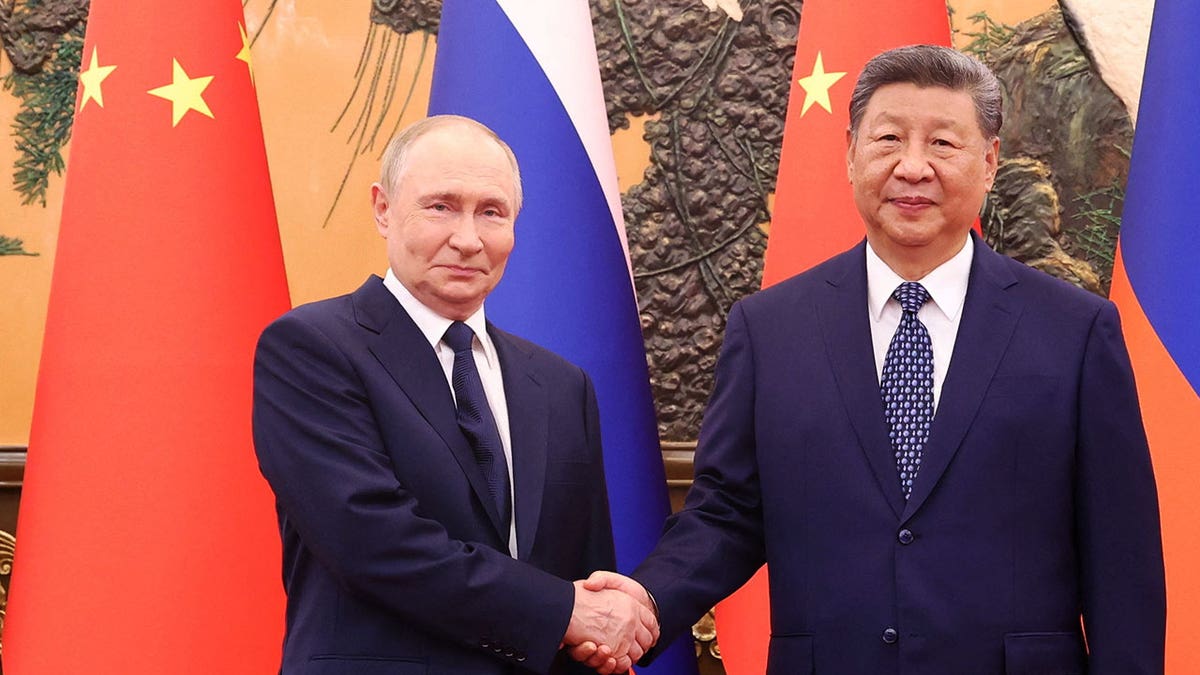
Beijing has rarely been a city that deals in coincidences. So when Vladimir Putin arrived at the Great Hall of the People on Wednesday to be greeted by Xi Jinping with a red carpet, a military band and a full honour guard ceremony, the symbolism was unmistakable. The Russian president is the second world leader to receive such treatment in Beijing within a matter of days — Donald Trump, the US president, had stood in the same ceremonial space only last week.
The back-to-back summits were not accidental. China’s leadership has staged this diplomatic double-billing with a clear intent: to project Beijing as the indispensable hub of 21st-century global power — a capital equally comfortable hosting America and Russia, owing allegiance to neither, beholden to its own interests alone.
“The message is clearly one that China maintains friendship and strategic partnership with whichever power it likes — and the USA is just one of them.”
— Steve Tsang, Director, SOAS China Institute, University of London
Old Friends, New Stakes
Putin, who has now visited China 25 times as president, began the formal talks by describing the “strong, positive” momentum between the two nations — a phrase well-worn in bilateral communiqués but carrying fresh significance given the pressures each country faces. The Kremlin entered the summit with what spokesman Dmitry Peskov described as “very serious expectations,” noting that the agenda would advance the countries’ “privileged and strategic partnership.”
The visit coincides with the 25th anniversary of the Sino-Russian Treaty of Good-Neighbourliness and Friendly Cooperation — a milestone that both sides have used to frame the summit as a moment of historical continuity rather than reactive politics. Putin and Xi have now met on more than 40 occasions, a frequency that speaks to the depth of personal rapport that underpins the formal partnership.

The Great Hall of the People, Tiananmen Square — the venue for Wednesday’s welcoming ceremony and bilateral talks. Photo: Wikimedia Commons
The Energy Agenda
Beneath the geopolitical theatre lies a transaction of enormous material consequence. China has become Russia’s single most important economic partner since Moscow’s full-scale invasion of Ukraine in 2022. Western sanctions effectively severed Russia from European markets, and Beijing stepped into the vacuum — purchasing vast quantities of Russian oil, gas and commodities while supplying Moscow with the high-technology components that the West refuses to export.
Russia’s oil exports to China surged by 35% in the first quarter of 2026 alone, according to Putin’s presidential aide Yuri Ushakov. Since the Ukraine war began, China has taken delivery of more than $367 billion worth of Russian fossil fuels. Energy cooperation is expected to dominate the summit’s substantive agenda — foremost among the issues being the proposed Power of Siberia 2 pipeline, a roughly 2,600-kilometre route that would carry natural gas from western Russia through Mongolia into northern China. The project would compensate for the markets Moscow lost in Europe and would significantly reduce Beijing’s dependence on seaborne energy imports.
“We will continue to work hand in hand and spare no effort to deepen the Russia-China partnership and good-neighbourly friendship.”
— Vladimir Putin, ahead of Wednesday’s summit
Ukraine, the Middle East and Trump’s Shadow
The two leaders are also expected to exchange assessments of the ongoing war in Ukraine, now in its fifth year with no resolution in sight. The Kremlin said on Monday that it hoped the peace process “will eventually resume” and urged the United States to continue its mediation efforts — a notable shift in tone suggesting Moscow is not entirely opposed to a negotiated exit, provided conditions are favourable. Analysts believe Xi will brief Putin on the substance of last week’s Trump conversations, in what amounts to Xi positioning himself as a crucial intermediary in any future diplomatic settlement.
The Middle East, too, will be high on the agenda. Russia has characterised itself as a “reliable energy supplier” amid the ongoing conflict in Iran, and expects the regional turmoil to increase Chinese demand for Russian crude in the months ahead. Ushakov described China as a “responsible consumer” — language that carries implicit criticism of Western pressure on Beijing to limit its energy dealings with Moscow.

A Lopsided Partnership?
For all the language of equals, questions persist about whether the Sino-Russian relationship has retained genuine parity. Russia’s isolation under Western sanctions and the enormous economic cost of the Ukraine war have left Moscow increasingly dependent on Beijing in ways that are structurally difficult to reverse. The Financial Times reported ahead of the summit that Beijing’s patience with some aspects of Kremlin policy may be showing signs of strain — though both sides are invested in projecting unity, particularly in the current geopolitical climate.
Putin arrived in Beijing accompanied by a large delegation of Russian business figures and government ministers, underscoring the extent to which the partnership has moved beyond rhetoric into deep commercial integration. Up to 40 bilateral cooperation agreements are expected to be signed during the visit, spanning sectors from energy and trade to tourism and education. A 47-page joint statement on the strengthening of the partnership is also anticipated, along with a joint declaration on the establishment of what both sides term a “multipolar world” — a concept that serves as shorthand for an international order less dominated by American power.
“Bilateral ties are at a truly unprecedented level.”
— Vladimir Putin, statement ahead of the Beijing summit
The Bigger Picture
When the formal sessions concluded, Putin and Xi retreated for a more intimate dinner and tea — the format their aides call “tea diplomacy” — where the two leaders customarily speak frankly away from the formal machinery of bilateral summitry. It is in these settings, officials say, that the real texture of the relationship is maintained.
Whatever emerges from the communiqués and signing ceremonies, the most consequential message of this week may simply be the image itself: Trump’s motorcade departing Beijing, Putin’s arriving. The world’s most watched capital hosting, in rapid succession, the leaders of its two greatest strategic rivals — and doing so with equal ceremony, equal warmth, and complete self-possession. For Xi Jinping, that is the point.