
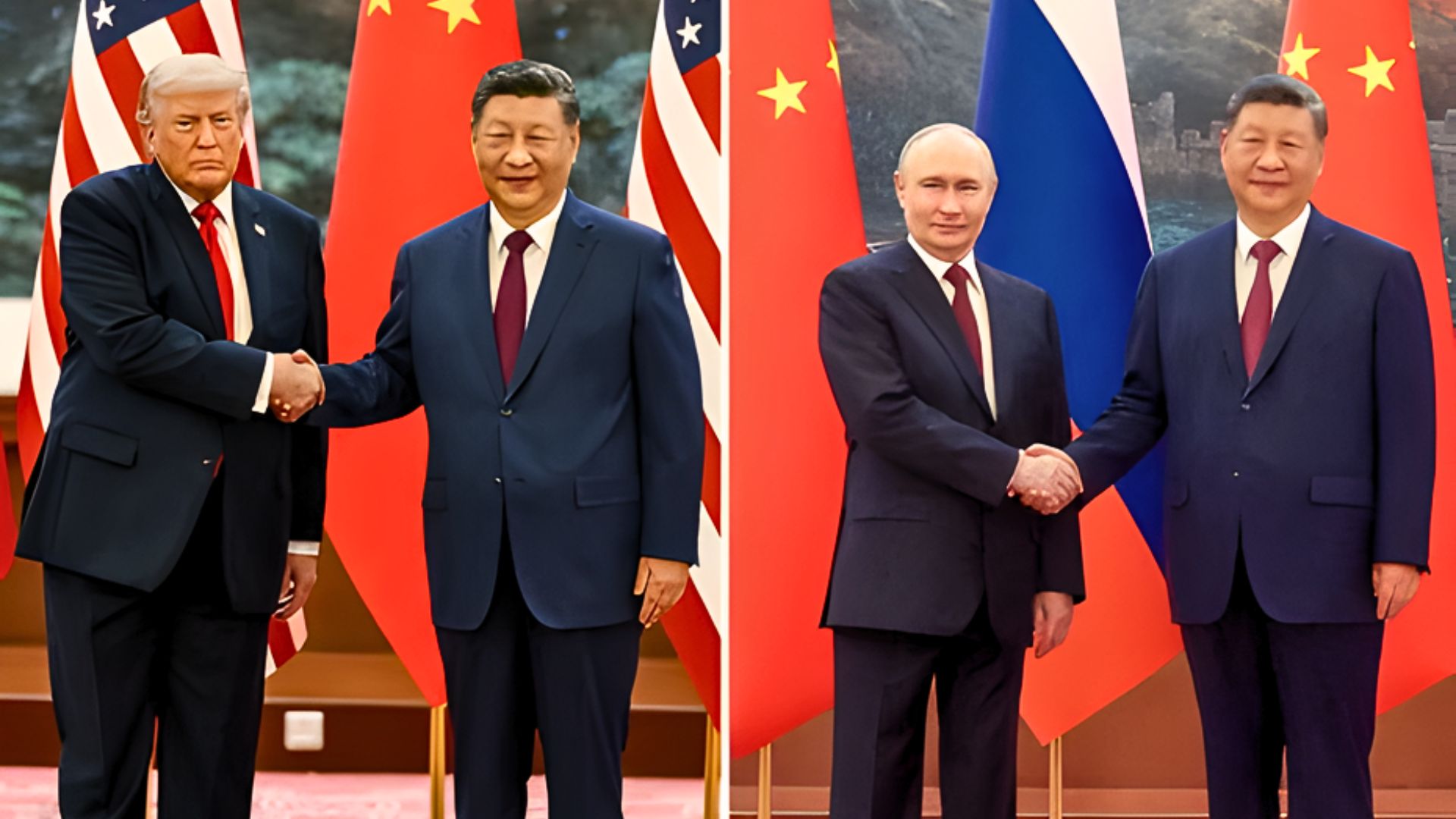
Within the span of a week, Xi Jinping hosted both Donald Trump and Vladimir Putin under the same rooftop in Beijing — a diplomatic double act that revealed everything about where global power now sits.
BY IDEA TELEVISION NEWS DESK


In the space of a single week, the world’s most consequential city for global diplomacy was not Washington, not Brussels, not Kyiv — it was Beijing. Within days of each other, Chinese President Xi Jinping hosted both US President Donald Trump and Russian President Vladimir Putin at the Great Hall of the People, delivering back-to-back summits that together told a striking story about where the centre of geopolitical gravity now lies.
On the surface, the two summits looked remarkably similar — formal handshakes in Beijing’s Tiananmen Square, enthusiastic greetings from flower-waving children, and marching columns of soldiers brandishing gleaming bayonets. But beneath the ceremonial pageantry, the two visits unfolded under entirely different dynamics, with different atmospheres, different agendas, and profoundly different implications for the world order.
Trump Comes to Beijing
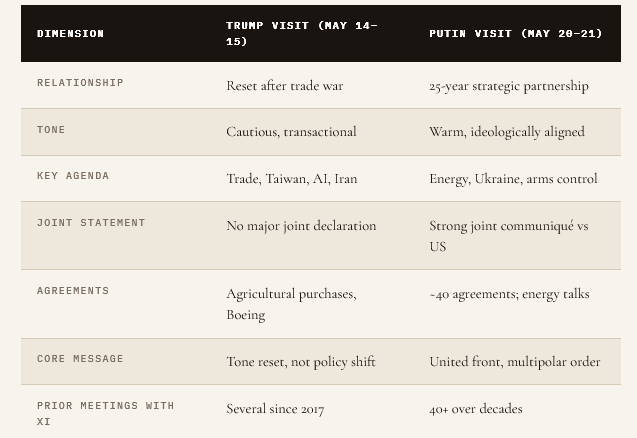
Trump’s visit to China on May 14 and 15 was the first by a sitting US president in nearly a decade. The two leaders met against a fraught backdrop — just over a year earlier, Trump’s hefty tariffs on China and dozens of other trading partners had sparked a tit-for-tat trade war with Beijing, leading the two countries to briefly jack up tariffs on each other’s goods to over 100%. China and the US also squared off over rare earth elements, semiconductors, student visas, fentanyl precursor chemicals and other issues.
China came into this meeting far more confident than in 2017, when it feared even a small rise in US tariffs. In the past year, Xi had been able to push back and neutralise much of Trump’s actions. The visit was about tone as much as substance. The two sides’ statements began to demystify a meeting that was largely about resetting the tone between the world’s top economies after a fractious year that drove both to the edge of decoupling.
Taiwan, Iran and artificial intelligence were on the agenda, along with tariffs and rare earths. Xi asked whether the US and China could avoid the “Thucydides Trap” — the historical tendency for tensions between a rising and a ruling power to result in war.
“China comes into this meeting far more confident than in 2017… Xi has been able to push back and neutralise much of Trump’s actions.”
— Scott Kennedy, Center for Strategic and International Studies
Notably, mention of “tariff reductions” was conspicuously absent from the White House summary of the talks, with Trump telling reporters that he and Xi did not discuss the tariff issue. Critics and analysts noted the visit was heavier on atmosphere than on binding commitments — a reset of tone rather than a revolution in policy.
Putin Follows Days Later
With the ceremonial trappings of Trump’s welcome barely cleared, Beijing prepared for its second state visit of the fortnight. Russian President Vladimir Putin arrived for a two-day summit with Xi Jinping, visiting an ally that had barely had time to clear the ceremonial decorations it laid out for Trump just days earlier.
Although they received the same red-carpet welcome ceremony, Putin’s visit contrasted sharply with Trump’s trip the week before. The Russian president is marking 25 years of Sino-Russian friendship and has visited China dozens of times, meeting with Xi on more than 40 previous occasions. This was not a tentative reset — it was a well-worn partnership deepening in real time.
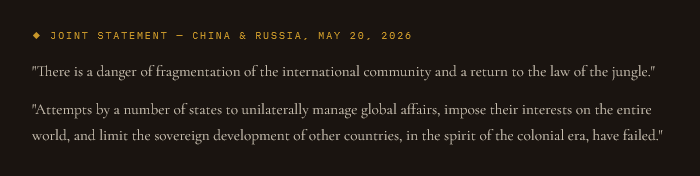
Xi and Putin signalled a united front against Washington during the summit in Beijing, warning against a global return to the “law of the jungle”. In a joint statement, China and Russia took aim at US President Donald Trump’s plans for a $175bn “Golden Dome” defence system, which would create a new missile field in the Midwest.
The two leaders also criticised the expiry of the last US-Russia arms control treaty, which fell to the wayside in February when Trump failed to respond to Moscow’s proposal to extend it by a year.
Putin Follows Days Later
With the ceremonial trappings of Trump’s welcome barely cleared, Beijing prepared for its second state visit of the fortnight. Russian President Vladimir Putin arrived for a two-day summit with Xi Jinping, visiting an ally that had barely had time to clear the ceremonial decorations it laid out for Trump just days earlier.
Although they received the same red-carpet welcome ceremony, Putin’s visit contrasted sharply with Trump’s trip the week before. The Russian president is marking 25 years of Sino-Russian friendship and has visited China dozens of times, meeting with Xi on more than 40 previous occasions. This was not a tentative reset — it was a well-worn partnership deepening in real time.
Xi and Putin signalled a united front against Washington during the summit in Beijing, warning against a global return to the “law of the jungle”. In a joint statement, China and Russia took aim at US President Donald Trump’s plans for a $175bn “Golden Dome” defence system, which would create a new missile field in the Midwest.
The two leaders also criticised the expiry of the last US-Russia arms control treaty, which fell to the wayside in February when Trump failed to respond to Moscow’s proposal to extend it by a year.
“Xi is calling for a more multipolar world, where the US has less power and influence.”
— Al Jazeera’s Katrina Yu, reporting from Beijing
The Bigger Picture
The week in Beijing illuminated a world in transition. China holds strong leverage for its dealings with both Washington and Moscow — its support has become increasingly important to Putin amid mounting economic pressures in Russia and military setbacks in Ukraine, while its trade relationship with the US remains the world’s largest bilateral economic partnership.
Xi has positioned China not as an ally of Russia against America, nor as a partner of America against Russia — but as the indispensable pivot of a new world order, one in which Beijing increasingly sets the terms of engagement rather than responds to them.
For the nations watching from the sidelines — from Africa to Southeast Asia to the Middle East — the message from this week’s Beijing double-bill was unmistakable: the centre of twenty-first century diplomacy may have shifted East.
Trump vs. Putin: The Two Summits Compared