A Nepali guide, left for dead at 25,000 feet on the world’s highest mountain, crawled his way back to base camp nearly a week later — with no food, no water and no oxygen. The world is still struggling to believe it.
IDEA TELEVISION WORLD NEWS DESK
KATHMANDU — When Hillary Dawa Sherpa sat down to rest on a rock just below Camp IV on Mount Everest, at roughly 25,000 feet above sea level, his fellow climber Chris Thrall checked on him, heard his reassurance, and pressed on down the mountain. Nobody imagined that Dawa would not be seen again for six days — or that, against every expectation, he would be seen again at all.
On Thursday, June 4, workers from the Sagarmatha Pollution Control Committee (SPCC) spotted the 52-year-old Sherpa crawling out of the Khumbu Icefall toward base camp — still wearing the same blue and yellow summit suit he had on when he disappeared on May 29. He had no food, no water, and no supplemental oxygen. He had descended alone more than 7,500 feet from the death zone — and he had done it over nearly a week, in some of the most inhospitable terrain on Earth.
“It’s kind of crazy one minute to be fighting back tears with his daughter, and then the next minute to see him crawling into town. It’s absolutely amazing, beyond words.”
— Chris Thrall, British climber, speaking to BBC Newshour
The moment of separation
Chris Thrall, a former British Royal Marine who had summited Everest with Dawa as his guide, recounted the moment the two became separated during the descent. Dawa, carrying a heavy pack as Sherpas routinely do, told Thrall he needed a brief rest.
Thrall told BBC’s Newshour: he turned to Dawa and asked if he was alright. The guide replied, “Yes, yes, I’m fine, Chris. Please go.” Thrall continued his descent, moving approximately 50 to 100 metres below, where he came across a Polish climber who was in urgent need of help — battling severe frostbite on his hands and descending with limited oxygen. Thrall turned his attention to assisting that climber. When he looked back up toward where he had left Dawa, the guide was still sitting on the rock. That was the last sighting anyone had of him.
The two clients eventually made their way down to Camp III at 23,300 feet and then Camp II at 21,000 feet. There, they informed Himalayan Traverse Adventures employees about Dawa’s condition. By then, he had already been alone in the death zone for hours.

The altitude — what survival at 25,000 feet really means
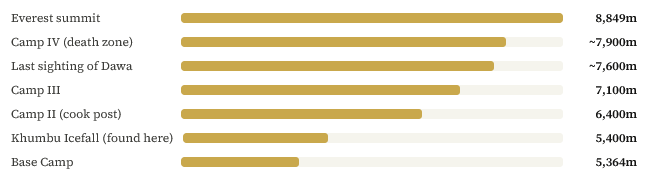
The “death zone” above 8,000 metres is so named because the human body cannot acclimatise to the oxygen levels there — it can only deteriorate. Most climbers who are left there without oxygen do not survive more than a day or two. That Dawa, without supplemental oxygen, food, or water, survived for six days and descended from 25,000 feet to the foot of the Khumbu Icefall at 17,500 feet — a descent of over 7,500 feet — has left the international mountaineering community struggling to find words.

Norwegian record-holder Kristin Harila, who has ascended all 14 peaks above 8,000 metres, told Outside magazine that the story was a reminder never to abandon hope. Billi Bierling, director of The Himalayan Database, called the outcome an “absolute miracle,” adding: “He had no drink, no oxygen, and was probably completely out of steam.”
The questions the industry is now asking
Amid the relief and celebration, the mountaineering community is grappling with a harder question: how did Hillary Dawa Sherpa end up on the upper slopes of Everest in the first place?
Investigative reporting by Outside magazine has revealed that Dawa was not hired as a climbing guide. He was employed as a cook at Camp II — at 21,000 feet — by Himalayan Traverse Adventures, one of the smaller expedition outfitters on the peak. His role was never intended to take him above that elevation.
Bierling put it bluntly: “Sherpas are strong, but this man was not supposed to be a climbing Sherpa; he was the Camp II cook.” It remains unclear exactly how and why Dawa came to be guiding a client above Camp III, deep into the death zone. The circumstances are being investigated.

A reunion beyond words
When Dawa arrived at HAMS Hospital in Kathmandu, his wife and daughter were waiting — the same family members who had already begun funeral rituals in his absence. The reunion was captured in photographs and videos that have since circulated widely, showing a family that had come to terms with loss confronting something rarer: an impossible return.
For Chris Thrall, who had carried the weight of the separation throughout the intervening days, the moment was overwhelming. Speaking to the BBC, he described the experience of grieving alongside Dawa’s family and then seeing their guide — their colleague, their friend — crawling back toward the living.
It was, he said, “absolutely amazing, beyond words.”