
Three parties — a Nashville health firm, a mobile health company, and its founder — have agreed to pay a combined $56.5 million to settle allegations they submitted fake medical diagnoses to inflate Medicare payments over five years.
IDEA Television News Desk

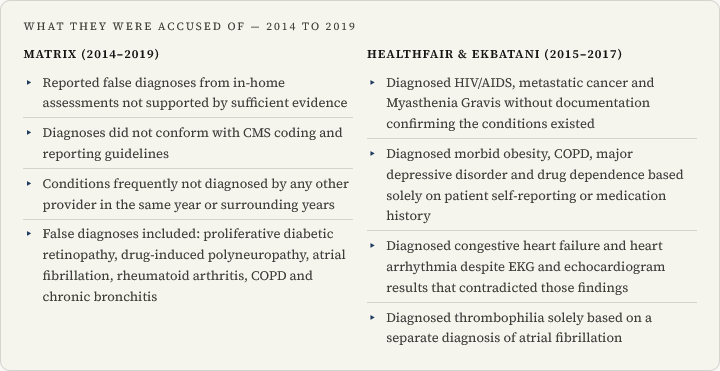
Three parties have agreed to pay a combined $56.5 million to the United States government to resolve allegations that they violated the False Claims Act — one of the most powerful anti-fraud statutes in US federal law — by submitting false and unsupported medical diagnosis codes to the Medicare Advantage programme. The settlement involves Community Care Health Network LLC (trading as Matrix Medical Network), DPN USA LLC (trading as HealthFair), and Shahriah “James” Ekbatani, founder and former manager of HealthFair.
The Medicare Advantage programme — also known as Medicare Part C — allows beneficiaries to enrol in private health plans instead of traditional government Medicare. The US Centres for Medicare and Medicaid Services (CMS) pays those private health plans more for sicker patients, adjusting payments upward based on diagnosis codes submitted by the plans. The government alleged that Matrix and HealthFair exploited this system by submitting inflated or entirely fictitious diagnoses — making patients appear sicker than they were to generate higher Medicare payments that the companies were not entitled to receive.
“Diagnosis codes submitted to CMS must be supported by the beneficiaries’ medical records and be accurate, complete, and truthful.”
— US Department of Justice False Claims Act requirements
Matrix, headquartered in Nashville, Tennessee, is a health services company that contracts with Medicare Advantage Organisations to perform in-home health assessments for plan members. HealthFair operated a fleet of mobile health buses staffed by nurse practitioners and medical technicians and similarly contracted with MAOs across several US states. Matrix acquired HealthFair in 2018 and shut down its operations by 2020. Under the scheme, both companies submitted invalid diagnosis codes to their MAO customers, who in turn passed them to CMS — triggering inflated risk-adjustment payments that flowed back to the plans.
The cases were originally filed as qui tam lawsuits — meaning they were brought by private whistleblowers under the False Claims Act, which allows individuals to sue on behalf of the government and share in any recovered funds. Matrix’s case was filed in the Southern District of New York; HealthFair and Ekbatani’s case was filed in the Eastern District of Texas. The settlement does not constitute an admission of liability by any of the parties.