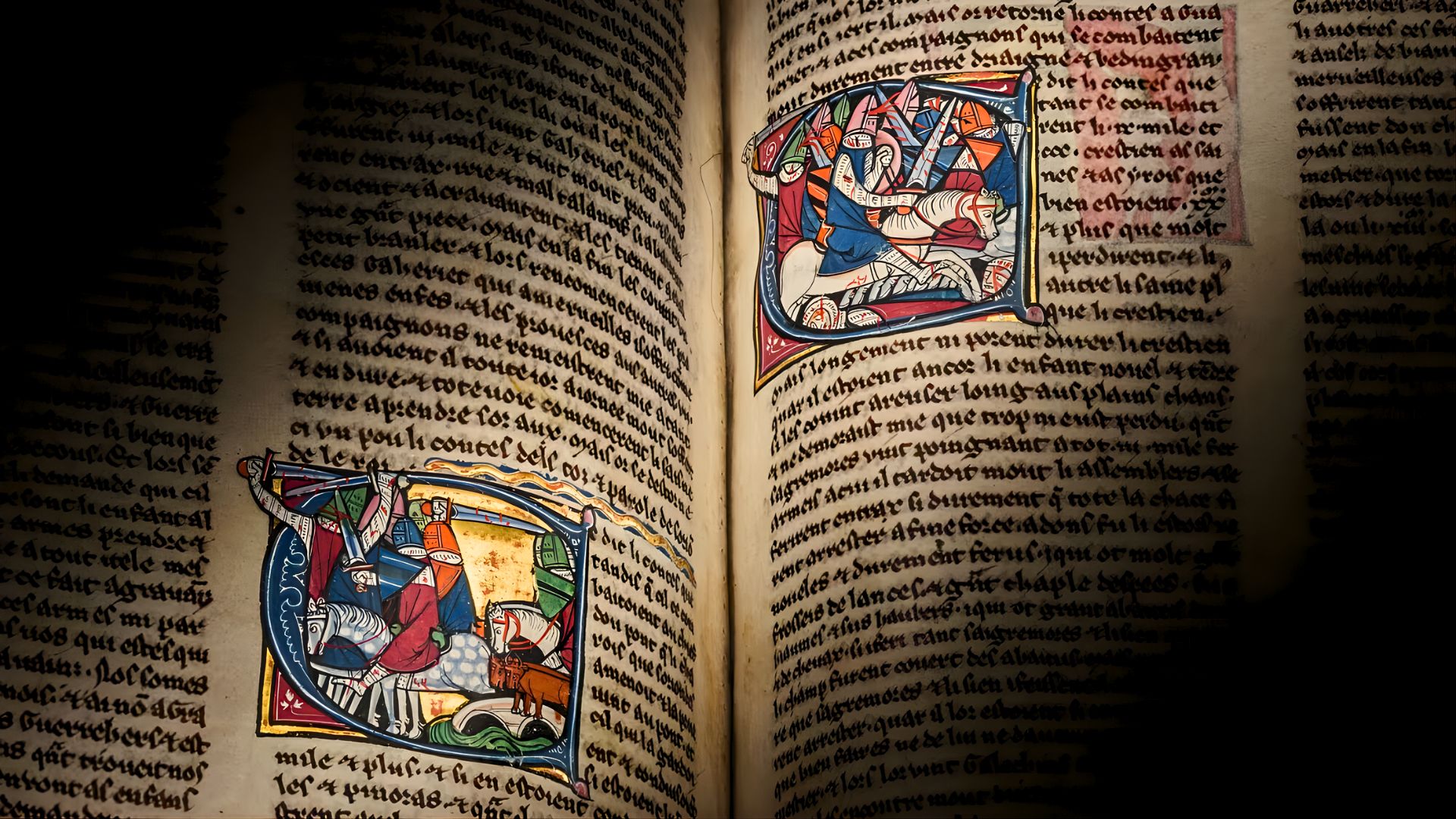
Written in Old French between 1290 and 1310, lavishly gilded, and never publicly exhibited or studied, the Clermont-Tonnerre Grail is expected to fetch up to $2.7 million at Christie’s London in July — and scholars are desperate it doesn’t vanish again into private hands.
IDEA Television News Desk

Somewhere around the year 1300, an anonymous French artist sat down with vellum, ink, and polished gold leaf, and began to illuminate one of the greatest stories ever told. The result — 126 miniature paintings depicting King Arthur, Lancelot, the Knights of the Round Table, and a shape-shifting Merlin transformed into a talking stag — was so magnificent that whoever owned it never let it go. For more than 700 years, the manuscript passed from private hand to private hand, unseen by the public, unstudied by scholars, and unknown to the world.
This summer, that changes. Christie’s auction house in London will offer the manuscript — officially known as the Clermont-Tonnerre Grail — at its Valuable Books and Manuscripts sale on 8 July, with an estimated price of between £1.5 million and £2 million (approximately $2 million to $2.7 million USD). It will be the oldest example of the Vulgate Cycle — the core French medieval romance encompassing Arthur, Lancelot, Merlin and the Holy Grail — ever to appear at auction.

“This is a rediscovered manuscript of one of the greatest of all medieval romances — texts fundamental to Western culture.”
— Eugenio Donadoni, Christie’s Senior Specialist for Medieval and Renaissance Manuscripts
What exactly is the Clermont-Tonnerre Grail?
The manuscript belongs to the Lancelot-Grail Cycle, also known as the Vulgate Cycle — a sweeping series of Old French prose romances composed in France during the 13th century that forms the literary foundation of virtually all subsequent Arthurian legend. The cycle covers the entire span of the Arthurian world: from the origins of the Holy Grail and the enchantments of Merlin, through the chivalric adventures of Lancelot and Gawain, to the fall of Camelot itself.
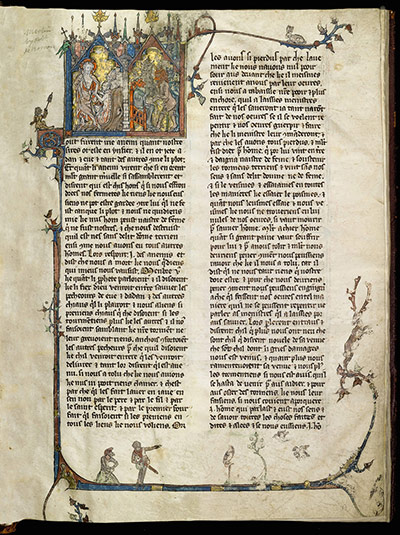
Written on vellum — a fine parchment made from calfskin — and decorated throughout with gold leaf, the tome is a masterwork of medieval illumination. Its 126 miniature illustrations were created by the so-called Master of the Liège Apocalypse, an anonymous French artist identified by his distinctive style: figures with square-jawed faces, sharp black pupils, neatly placed orange dots on cheeks, and dramatically exaggerated “nutcracker” chins in profile. The Clermont-Tonnerre Grail contains some of his finest known work.
Among the illustrations are vivid depictions of Merlin shape-shifting into various forms — including a talking stag — and scenes of Arthur’s knights returning triumphant from battle. Unusually, the manuscript also contains a variation on the standard Merlin narrative in which the focus shifts away from romantic adventure toward Arthur’s battles for royal legitimacy — a textual divergence that has never been fully analysed because the manuscript has, until now, been inaccessible to researchers.


Seven centuries of secret ownership
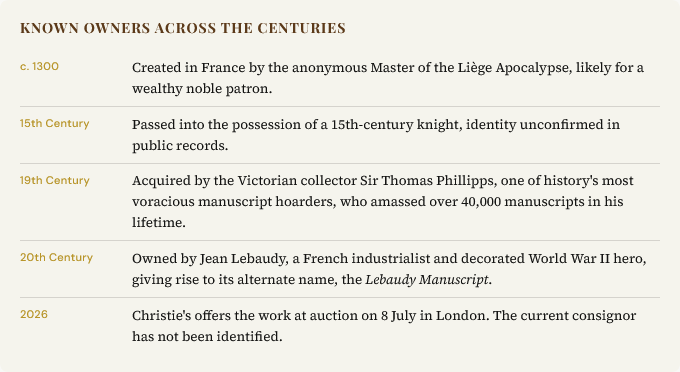
Christie’s has painstakingly traced the manuscript’s provenance across the centuries, revealing a succession of notable — and in some cases remarkable — private custodians.
Scholars urge it enters public hands
The impending sale has prompted an unusual degree of urgency within the academic world. Because the manuscript has spent its entire known existence in private collections, it has never been publicly exhibited and has never been subjected to comprehensive scholarly analysis — a gap that researchers say has measurably hindered the study of one of the most culturally significant bodies of medieval literature.
Dr. Irene Fabry-Tehranchi, a collections specialist at Cambridge University Library, told media it would be remarkable if the manuscript were acquired by a public institution and made available for full study. “There are so many appealing angles to this manuscript: historical, art-historical, textual and cultural,” she noted, pointing specifically to the unusual textual variants found in its version of Merlin’s story.
Donadoni at Christie’s acknowledged the tension between private and public interest. “It should interest institutions because it’s a virtually unknown manuscript of one of the greatest medieval romances,” he said, “but it could interest private buyers for the same reasons that it appealed to the long line of owners who have treasured it.”
“It would be amazing for the manuscript to wind up in a public collection and made available for study.”
— Dr. Irene Fabry-Tehranchi, Cambridge University Library
The fear: another 700 years of silence
That tension is real. With an upper estimate of $2.7 million, the Clermont-Tonnerre Grail is well within reach of wealthy private collectors — and nothing legally prevents it from disappearing once more into a private vault. There are no export restrictions attached to the sale, and no public institution has publicly declared an intention to bid.
For the medievalists and literary historians who have waited lifetimes for this opportunity, the stakes could scarcely be higher. The textual variants alone — including the unexplored shift in Merlin’s arc toward Arthur’s claim to the throne — could reshape aspects of Arthurian scholarship. And the quality of the Master of the Liège Apocalypse’s illustrations in this volume, Donadoni has said, represent some of the finest surviving examples of his art.
The Christie’s Valuable Books and Manuscripts auction takes place in London on 8 July 2026. Whether the Clermont-Tonnerre Grail enters public life for the first time in its 700-year existence — or retreats once more into the shadows — will be decided in a matter of minutes.