
A major new report by the United States Commission on International Religious Freedom paints a harrowing picture of violence, displacement, and impunity — and demands urgent action from Washington and Abuja.
By IDEA Television News Desk
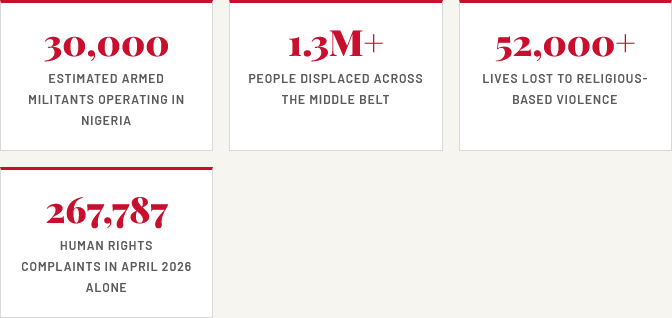
A damning new report by the United States Commission on International Religious Freedom (USCIRF) has declared that fear, mass abductions, and targeted killings have become defining features of everyday life for millions of Nigerians — with an estimated 30,000 armed militants currently operating across the country’s most volatile regions.
The report, released in May 2026 and titled “Nonstate Violators of Religious Freedom in Nigeria: Fulani Militants,” describes the armed groups as among the deadliest non-state actors fuelling attacks, mass displacement, and religious tensions in West Africa’s most populous nation.
A Nation Living in Terror
The USCIRF report catalogues a relentless wave of violence that has left communities shattered from the Northwest to the Middle Belt. Militants, the report says, routinely descend on isolated rural settlements under the cover of darkness, armed with assault rifles and machetes, deliberately eliciting terror to drive populations off their land.
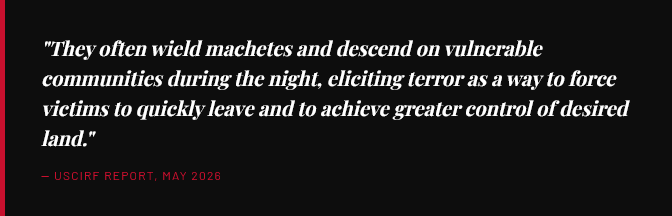
The scale of violence documented in the report is staggering. In February 2026 alone, suspected militants killed at least 32 persons in Niger State and launched a brazen attack on Holy Trinity Parish in the Kafanchan Diocese of Kaduna State, killing three worshippers and abducting eleven others — including parish priest Father Nathaniel Asuwaye. In the same period, armed men kidnapped an imam and seven worshippers from a mosque in Plateau State, demanding a ransom of ₦16 million.
Holy Days Turned Hunting Grounds
One of the most chilling findings of the report is the deliberate targeting of religious celebrations. USCIRF found that militant actors have repeatedly timed their attacks to coincide with major Christian and Muslim observances, including Christmas, Easter, and Palm Sunday — calculated to maximise psychological trauma and break community bonds.
Attacks during Palm Sunday and Easter in April 2026 left dozens dead across Plateau, Kaduna, and Benue states. On Easter Sunday, militants reportedly killed five worshippers at two churches in Kaduna State and abducted 31 others in a single coordinated assault.
The report notes that violence has not been confined to one faith. Muslim worship centres have also been targeted, underscoring that the crisis, while fuelled in part by religious identity, is also driven by land competition, poverty, and the breakdown of state authority.
The Roots of the Crisis
USCIRF acknowledges that the violence is driven by a complex web of factors: intense competition over grazing routes and farmland, deep poverty, the proliferation of small arms, decades of farmer-herder tensions, and what the report calls “corrosive, state-level blasphemy laws” that have fostered an environment of unchecked religious hostility.
The commission also pointed to systemic failures within the Nigerian state itself — including pervasive corruption and what it described as an inadequate government response over many years — as having created conditions in which militant groups operate with near-total impunity.
Human Rights Watch’s own 2026 World Report corroborates this picture. It found that in the Northwest alone, 2,938 people were kidnapped between July 2024 and June 2025 — more than 60 percent of all reported kidnapping incidents nationwide. Zamfara State recorded the highest toll with 1,203 abductions, followed by Kaduna (629), Katsina (566), and Sokoto (358).
Nigeria’s National Rights Commission Sounds Its Own Alarm
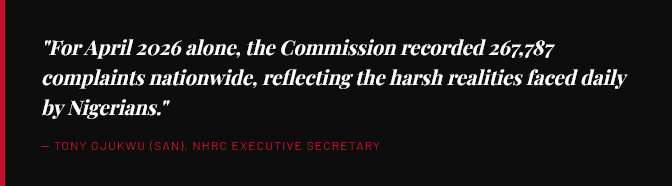
The USCIRF findings arrive alongside a separate disclosure from Nigeria’s own National Human Rights Commission (NHRC). Executive Secretary Tony Ojukwu (SAN) revealed that the NHRC recorded a staggering 267,787 human rights complaints across the country in April 2026 alone — spanning insecurity, abuse of power, gender-based violence, economic hardship, killings, and abductions.
Ojukwu called for stronger regulations in line with national and international human rights standards, and noted that five cases involving the killing of security personnel — including members of the armed forces — were recorded in the same period.
Washington Responds — But Is It Enough?
The United States has not been silent. Former President Donald Trump designated Nigeria as a Country of Particular Concern (CPC) under the International Religious Freedom Act, and issued warnings of possible aid suspension and military intervention if mass killings of Christians by extremists continue.
On its part, the Nigerian government declared armed groups — including Fulani militants — as terrorists in December 2025 and launched military operations in 2026 that resulted in arrests and the rescue of hundreds of kidnapping victims. USCIRF acknowledged these steps but criticised security forces for continuing to respond slowly to attacks on vulnerable communities.
What Must Change
The USCIRF report urges the U.S. government to take tougher action to address religious freedom violations in Nigeria and calls for concrete accountability measures against perpetrators of violence. It also calls on the Nigerian government to accelerate the prosecution of suspected militants, increase security presence in high-risk communities, and address the underlying drivers of violence — including land tenure disputes and poverty.
For ordinary Nigerians — farmers, priests, imams, mothers, schoolchildren — the urgency of these recommendations could not be more acute. As the data shows, the crisis is not abstract; it is lived, daily, and deadly.