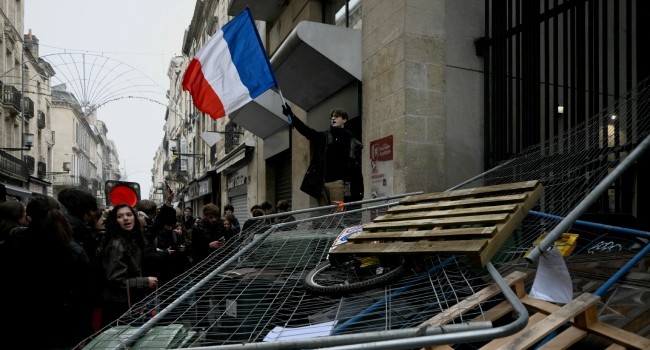
Hundreds of thousands of people are expected to take to the streets across France on Thursday as trade unions stage nationwide strikes alongside student-led demonstrations that have rocked the country in recent weeks.
The protests come as France, the eurozone’s second-largest economy, struggles to address its financial challenges, with the country also preparing for presidential elections in six months to choose a successor to centrist President Emmanuel Macron. The far-right is currently leading in opinion polls.
The demonstrations, initially driven by high school students protesting poor learning conditions, have expanded into a wider expression of public anger over the rising cost of living, economic inequality and working conditions.
The discontent culminated on October 17 in some of the worst rioting France has witnessed in recent years.
“We should be able to make a decent living from our jobs,” CFDT union secretary general Marylise Leon said during an interview with BFM television, directing her appeal at both the government and employers.
The unions are demanding an increase in the national minimum wage, which has not received any discretionary increase since 2012, general salary improvements, tax reforms and better educational conditions for young people.
Authorities estimate that between 500,000 and 700,000 people could participate in demonstrations nationwide on Thursday, with as many as 80,000 expected to march in Paris from 2:00 p.m. (1300 GMT).
However, union leaders are hoping for a turnout comparable to the demonstrations against pension reforms in 2023, when more than one million people took to the streets.
Authorities Prepare for Firm Response
Public and private education unions have called for strike action, alongside organisations representing railway workers, public hospital employees and postal service staff.
Rail services have already experienced some disruption, with commuters reporting delays and cancellations.
At Montparnasse railway station in Paris, a psychologist identified only as Jeanne told AFP that her journey had been delayed by the industrial action.
“It’s tedious to get up early, wait, and then see your train cancelled, but it’s understandable there’s a strike,” she said.
Meanwhile, Interior Minister Laurent Nunez announced on Wednesday that approximately 70,000 police officers and security personnel would be deployed across the country to maintain order.
He promised an “extremely firm response” to any acts of violence or public disorder.
Student demonstrations have also continued in several cities, with dozens of high school students taking part in protests.
In Paris, police deployed tear gas to prevent students from blocking access to the Helene-Boucher high school, according to an AFP reporter at the scene.
Although many of the demonstrations have remained peaceful, some have escalated into confrontations between protesters and security forces, prompting police to use tear gas and water cannon to disperse crowds.
An attempted murder investigation was also launched after petrol bombs were reportedly thrown at security personnel in Paris on Saturday.
Police Response Faces Criticism
The handling of the demonstrations by security forces has attracted criticism, with protesters and rights advocates accusing police of using excessive force.
Internal investigations have reportedly been launched into allegations of police brutality, while several teenage demonstrators have sustained serious injuries and thousands of people have been arrested.
Authorities have also acknowledged security and intelligence failures that contributed to the violence, looting and vandalism of public property during the unrest that erupted on October 17.
In another development, the Paris police prefecture on Wednesday prohibited a major protest route and instead approved an alternative route moving eastward, away from the city centre.
The decision drew criticism from several trade unions, which described restrictions on protest routes as an attempt to undermine the right to peaceful demonstration.
In the southern city of Toulouse, a union source said protesters intended to march through the city centre despite a court upholding a police ban on the proposed route.
Fabrice Fort of the CGT union said public sympathy for the student movement remained strong, while growing restrictions on demonstrations had raised broader concerns about civil liberties.
“We can feel a cumulative effect: public sympathy for the high school and university students’ movement is not waning, and people are questioning restrictions on liberties, especially bans on demonstrations,” he said.
“This has sparked a wake-up call among people who usually don’t speak out much,” he added.
The unrest in France comes amid a wider wave of youth-led demonstrations across Europe, with similar protests reported in Denmark, Germany and Italy in recent weeks.