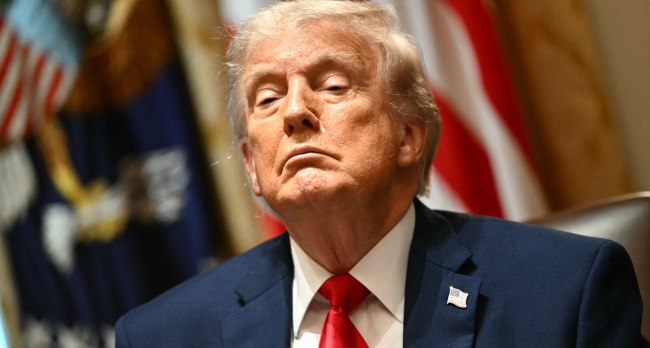
Thousands of demonstrators gathered in Tehran on Wednesday to denounce the United States and mock President Donald Trump following his Republican Party’s heavy defeat in the US midterm elections.
The rally, held outside the former US embassy in the Iranian capital, came hours after American voters stripped Republicans of control of both chambers of Congress, in an election widely regarded as a referendum on Trump’s second-term leadership and his handling of the conflict with Iran.
Demonstrators chanted “Death to America” and “Death to Israel” while waving Iranian flags and displaying banners condemning Washington and its ally, Israel.
One of the banners portrayed Trump as a blood-stained bulldog on a leash held by a devil-like figure resembling Israeli Prime Minister Benjamin Netanyahu.
Other placards demanded revenge for the killing of Iran’s Supreme Leader, Ayatollah Ali Khamenei, in US-Israeli strikes that triggered the regional conflict in late February.
A massive display overlooking the crowd carried the inscription, “The people of Iran set the price.”
Nearby, black oil barrels were arranged across a map of the world, symbolising the surge in global energy prices since the outbreak of the war and Iran’s assertion of control over the Strait of Hormuz, one of the world’s most important oil shipping routes.
Speaking at the demonstration, a 40-year-old participant identified only by her surname, Mahmoudkhani, said the United States had spent decades pressuring Iran without succeeding in weakening the country.
“America has been tormenting us for years, but it has not been able to do anything to Iran,” she said.
The rally coincided with growing political uncertainty in Washington, following Republican losses in an election influenced by public frustration over the rising cost of living, fluctuating tariff policies and Trump’s military confrontation with Iran.
Mahmoudkhani acknowledged that rising oil prices had affected ordinary Iranians but said she found some satisfaction in the fact that other countries were now experiencing the economic consequences of the conflict.
“We are not happy about the surge in oil prices,” she said.
“But there is some satisfaction in knowing we are no longer living this torment alone. We, alone, have been suffering under sanctions for so many years.”
Iran’s claim of control over the Strait of Hormuz has disrupted international shipping through the strategic waterway, while Washington has responded by imposing a naval blockade on Iranian ports.
Majid Heidari, a 62-year-old fabric producer, argued that the resulting increase in oil prices had influenced American voters.
He said Iran’s control over the strategic waterway was a means of exerting pressure on countries supporting Washington’s position.
“When Europe and the US unite against us, we must use our tool (closing Hormuz),” he said.
“There is nothing we can do but put some pressure on governments by making their own people feel the consequences.”
However, Heidari expressed doubt that the Republican defeat would bring any meaningful improvement to the lives of ordinary Iranians.
A 42-year-old civil servant identified as Mohammad shared the sentiment, saying Iran’s relationship with Washington had remained hostile regardless of which political party controlled the US government.
“I believe whether it is the Democrats or the Republicans, there is no difference for us,” he said.
“The US government’s approach towards the Iranian people has unfortunately remained the same over the past 50 years.”
Iran Welcomes US Election Outcome
In Tehran’s first official reaction to the American election results, Iran’s chief negotiator in talks with Washington, Mohammad Bagher Ghalibaf, welcomed the outcome, interpreting it as a rejection of the war.
“Conscience or the cost of living, Americans said NO TO WAR, and we endorse this message,” he wrote on X.
Meanwhile, diplomatic efforts led by Qatar and Pakistan to broker an agreement between Tehran and Washington have made little progress, amid growing concerns that hostilities could resume.
Rally Marks 1979 US Embassy Takeover
The annual demonstration commemorates the storming of the US embassy in Tehran in November 1979, months after the Islamic Revolution that overthrew the US-backed Shah, Mohammad Reza Pahlavi.
The students who seized the embassy demanded the return of the former monarch, who was receiving cancer treatment in the United States at the time.
They subsequently held 52 American citizens hostage for 444 days, an incident that led to the severance of diplomatic relations between Washington and Tehran in 1980.
Iranian authorities have since turned the anniversary into an annual demonstration against what they describe as Western arrogance and interference in the country’s affairs.
At Wednesday’s rally, one banner displayed a blood-stained crown with the inscription, “Crown of arrogance on an empty brain.”
Another participant, a 35-year-old school principal identified only as Bagheri, maintained that Iran’s opposition to the United States would remain unchanged regardless of the outcome of American elections.
“America is the enemy regardless,” he said.