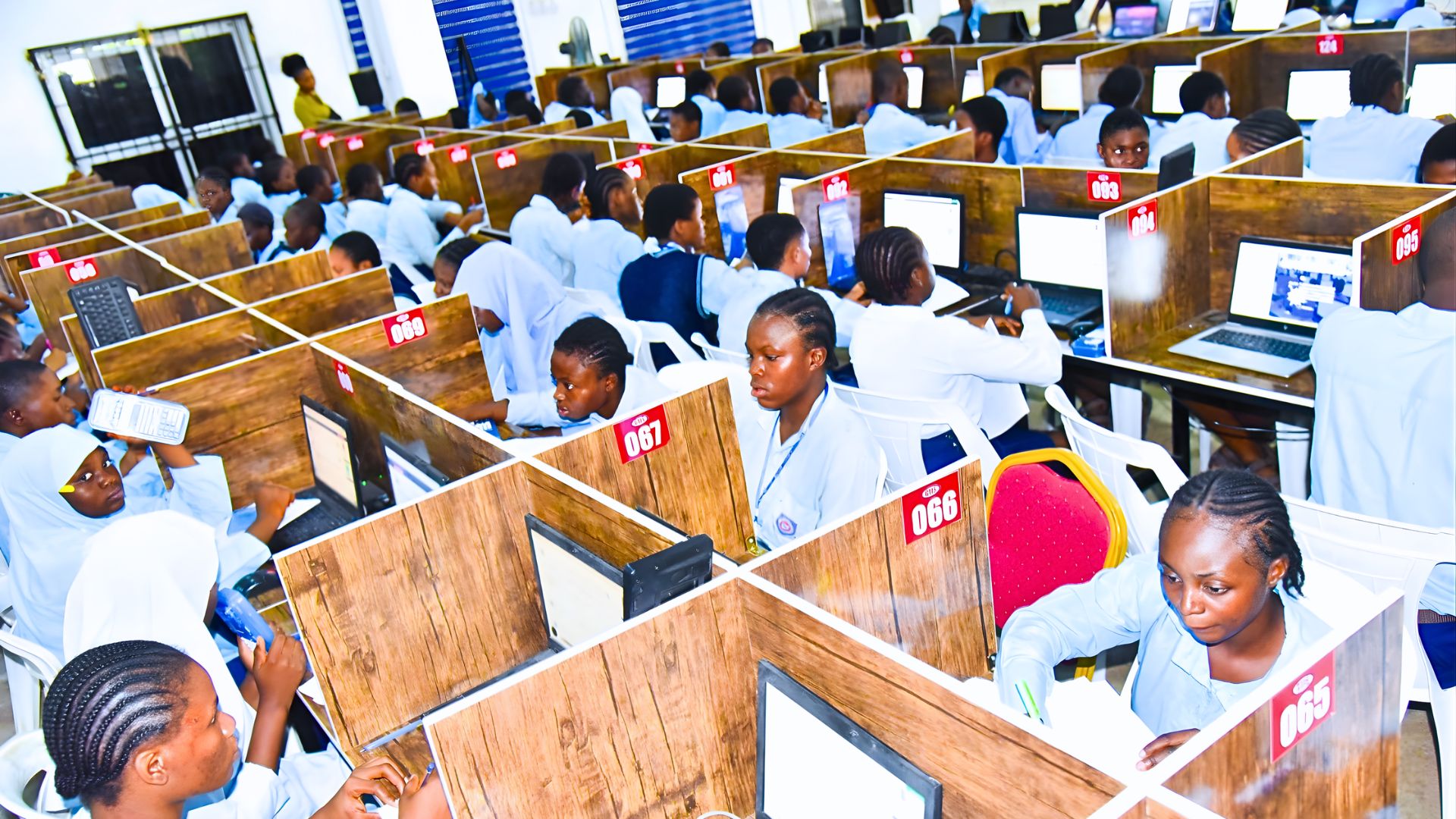
The Federal Government has commended the credible conduct of the 2026 WASSCE, celebrating the debut of Computer-Based Testing at selected centres as a landmark step in Nigeria’s digital examination transition.
IDEA TELEVISION NEWS DESK


ABUJA — The Federal Government has praised the smooth and credible conduct of the ongoing 2026 West African Senior School Certificate Examination (WASSCE), particularly commending the successful launch of the Computer-Based Test (CBT) model at selected centres across the country — a milestone the government describes as a foundational step toward Nigeria’s full digital examination future.
The commendation was delivered by the Honourable Minister of State for Education, Professor Suwaiba Sa’id Ahmad, during a personal, on-the-spot monitoring visit to examination centres in Abuja. The Minister toured Government Secondary School, Garki, and Apo Boys Secondary School, observing both CBT-enabled and traditional paper-and-pencil examination halls in action.
“No candidate or region will be left behind as reforms continue.”
— Federal Government of Nigeria, June 3, 2026
What the Minister saw on the ground
Professor Ahmad expressed clear satisfaction with what she witnessed at both centres. At the CBT-enabled venues, students moved through the digital examination platform with confidence, reporting smooth experiences with no significant technical disruptions. At paper-based centres, the examinations were conducted in orderly, well-supervised environments with visible candidate discipline throughout.
The Minister noted that the conduct of candidates across both formats demonstrated preparedness and composure — qualities that reflect months of preparation not just from students, but from schools and examination authorities.
How the CBT rollout was prepared
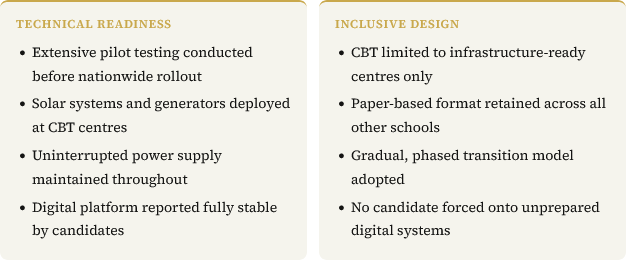
The Minister disclosed that the rollout was preceded by thorough pilot testing to iron out potential issues before examination day. Alternative power solutions — including solar installations and standby generators — were deployed specifically to guard against Nigeria’s well-documented power supply challenges, ensuring that no candidate’s performance was disrupted by an outage.
A gradual, inclusive digital transition
The Federal Government was careful to frame the 2026 CBT rollout not as a wholesale switch to digital examinations, but as the beginning of a phased, infrastructure-led transition. Officials emphasised that the shift to a fully digital national examination system would be managed carefully — with fairness, inclusiveness and reliability as the guiding principles.
The assurance is significant in a country where the quality of school infrastructure varies considerably between urban and rural areas, between the affluent south and the under-resourced north. Officials were explicit: no candidate or region will be disadvantaged by reforms that move ahead of their capacity to receive them.
Why this matters for Nigeria
The WASSCE is not simply a school-leaving certificate in Nigeria — it is a foundational credential that gates access to tertiary education, professional training and formal employment for millions of young Nigerians each year. Any disruption to its integrity, or any perception that its processes are unfair, carries consequences that ripple far beyond the examination hall.
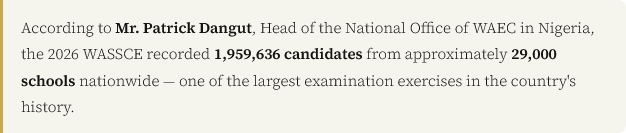
The successful pilot of CBT at selected centres in 2026 therefore carries symbolic weight beyond the logistical achievement. It signals that Nigeria is capable of managing the complex, expensive and politically sensitive migration from analogue to digital public examination infrastructure — and doing so at scale, with close to two million candidates in the system.
That the inaugural CBT cohort completed their examinations with reported ease and no significant disruptions will encourage advocates of digital reform and reassure parents and students anxious about being subjected to unfamiliar technology.
Looking ahead
The Federal Ministry of Education has reaffirmed that the transition to a fully digital examination system remains a firm policy commitment — but one that will proceed on the basis of verified infrastructure readiness across schools, states and regions. The government’s message is clear: the destination is digital, but the journey will be managed, deliberate and inclusive.
As the 2026 WASSCE continues across the country’s 29,000 participating schools, the Federal Government says it will continue to monitor proceedings, support WAEC’s operational needs, and build on the lessons learned from this year’s CBT debut in preparation for an expanded rollout in subsequent years.